

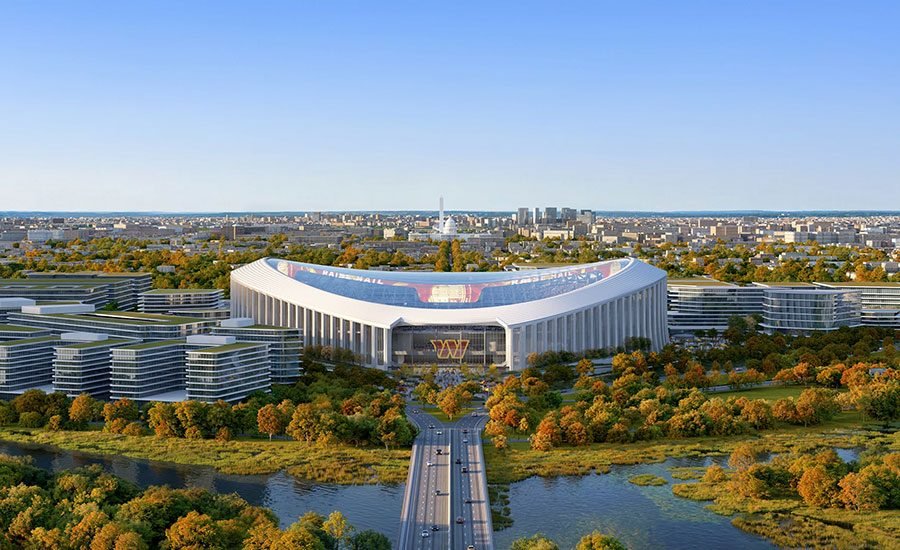
More than $33.6 million in employment opportunities associated with the redevelopment of the RFK Stadium site in Washington, DC will be available this year to certified small businesses, according to the District of Columbia’s Department of Local and Small Business Development.
A total of $30 million will go toward road, utility and stormwater relocation projects at the 180-acre site, part of a nearly $4 billion redevelopment program to create a mixed-use development centered around a new 65,000-seat domed stadium for the National Football League’s Washington Commanders. Other opportunities include landlord representation services, development of a campus energy master plan, battery storage assessment and Sportsplex planning study.
Details on the projects and business eligibility are available in the recently released FY26 edition of the Green Book, the District’s official Small Business Opportunities Guide.
The RFK Stadium redevelopment program is one of the largest public-private investments in district history and aims to have the HKS-designed stadium in place by the 2030 season. No contractor has been announced for the facility.
Comprised of five districts within the site, the program also calls for housing, parks and recreation, hotels, restaurants, retail and neighborhood services on campus. Almost a third of the development will be set aside for parks and open spaces. As part of the agreement between the local government and the owners of the commanders, at least 40% of the expenditure of the program will go to companies in the district.
In February, the National Capital Planning Commission offered feedback on conceptual plans for the 30-acre stadium district as part of the required federal advisory review process that will shape the project’s scope, schedule and engineering cost. According to a statement from the NCPC, the design “is inspired by the architecture of Washington’s monumental core, seeks to balance innovative stadium design with respect for the location by maintaining the view from East Capitol Street to the United States Capitol and referencing the shape of the original stadium.”
The statement reported a very favorable response from the commission, noting that commissioners “liked how the design celebrates Washington as a monumental city, pays homage to the old stadium, and anticipates that it will become a new landmark in the nation’s capital.”

Comprised of five districts within the site, the stadium program also calls for housing, parks and recreation, hotels, restaurants, retail and neighborhood services on campus. Representation courtesy of Washington Commanders
However, commissioners also noted that “additional analysis is needed to confirm whether the proposed stadium visually reinforces the preeminence of the United States Capitol and the Washington Monument by protecting the surrounding visual framework,” according to comprehensive plan guidelines.
The NCPC made several recommendations and requests for the District’s upcoming submission, including additional information on stadium views and lighting approaches “that respect the hierarchy of monuments, memorials, and important civic buildings and spaces in the nation’s capital,” ensuring that the Capitol and Washington Monument remain the most prominent features of the nighttime skyline.
Commissioners also requested designs for the two parking decks and information on landscape and planting plans, kiosk and pavilion designs, perimeter security approach to planned multimodal transportation projects. Another recommendation calls for the District to coordinate with the adjacent DC National Guard Armory and the National Park Service regarding connections and transitions into the larger Anacostia park system.
No timetable has been announced for the District’s responses and other submissions to the NCPC.
