

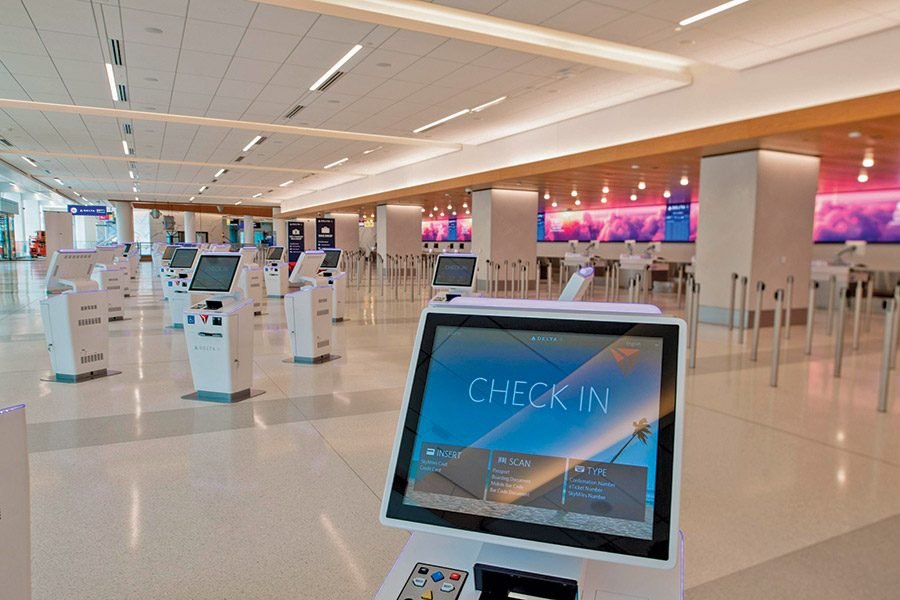
Delta Air Lines Inc. – LGA aerodrome reconfiguration program
East Elmhurst, New York
BEST PROJECT, AIRPORT/TRANSIT
Presented by Turner Construction and STV/Satterfield & Pontikes Construction
Key players
Owner: Delta Air Lines
Design: Gensler and Corgan
Construction managers: Turner Construction and STV/Satterfield & Pontikes Construction
Design, Structure and MEP Engineer: Arup
Design, Civil, Structural and MEP Engineer: Burns and McDonnell
With the completion of Delta Air Lines’ $2.8 billion LGA Airfield reconfiguration program in May 2024, the construction management team of Turner Construction and STV/Satterfield & Pontikes Construction added a major element to the transformational changes at New York City’s LaGuardia Airport. Built as part of a larger $8 billion improvement program, the project replaced the former Terminals C and D, which served as New York City’s regional hub, with a reimagined Terminal C.
Famously described by then-Vice President Joe Biden in 2014 as an airport you’d expect to see in a third-world country, Delta Airlines executives see the Terminal C project as a key component in revitalizing LaGuardia. “Once considered the worst airport in North America, LaGuardia Airport has undergone a remarkable transformation, with Delta’s Terminal C at the heart of this renaissance,” said Ryan Marzullo, Delta Air Lines’ general manager of design and construction.
The project was the airline’s largest airport investment ever and required a stacked construction management team to lead thousands of workers, including record participation from minority and women-owned business enterprises. Despite countless challenges and changes during the eight-year project, including the COVID-19 pandemic, the team delivered the project on budget and ahead of schedule.

A massive digital art installation consisting of 34 lenticular panels is displayed in the centralized security screening area on the third level of the header.
Photo by Vu Quang Tran, courtesy of Turner Construction and STV/Satterfield & Pontikes Construction (JV)
“Everybody left their egos at the door of corporate headquarters and we went in with a very open mind that we were here to work for Delta Airlines,” says Curt Zegler, assistant project executive for field operations at Turner Construction. “The level of collaboration required for the project was definitely driven by our client and that resonated with our entire staff.”
Comprised of 21 sub-projects completed between 2019 and 2024, the project replaced two existing terminals with an upgraded 1.3 million square meter facility. The scope included a new 590,000-square-foot concourse, a 319,000-square-foot E concourse, a 209,000-square-foot F concourse, and a 201,000-square-foot D concourse. Crews also built double taxi lanes, 2,900 square meters of bridge and 200 feet of roadways. covered
Gensler principal Matthew Johnson says the detail phase of the project was critical to the project’s success. He notes that the Delta team worked collaboratively with contractors and designers to determine the most efficient ways to move the project forward while continuing to operate at the existing terminals. “Delta was really a driving force,” he says. “They had a seat at the table and understood how to limit themselves when needed to move the project forward.”
“Everyone left their egos at the door of corporate headquarters and we went in with a very open mind that we were here to work for Delta Airlines.”
—Curt Zegler, Assistant Project Executive, Turner Construction
The team logged nearly 10 million hours of work during the project with a peak workforce of over 1,400. Nearly $1.5 billion in contracts were awarded to M/WBE companies, setting a state record. Approximately $500 million was awarded to Queens-based companies. Throughout the project, education and workforce training programs were instituted to support long-term job creation.
“As a company, we pride ourselves on making sure we’re very diverse in awarding contracts,” says Zegler. “But Delta Airlines is very rooted in the community. They believe in the community and they will give back to the community. That was always the focus.”
Advanced digital program management tools proved critical in coordinating and synchronizing the work of multiple design and construction teams. A proprietary BIM 4D platform integrated schedule and cost data with the construction model, enabling real-time monitoring and visualization. Matterport’s 3D scanning was used to create a “digital twin” to verify building conditions and streamline the enclosure. At the end of the project, the digital twin was transferred to Delta Airlines for future use by its operations staff.
OpenSpace technology further enhanced the documentation by capturing 360° site images linked to the BIM model, enabling remote visits. The technology proved valuable during pandemic restrictions. BIM technology also proved useful in visualizing and coordinating the placement of suspended illuminated sculptures in the three-story atrium. The installation required seismic analysis, mounting at heights of up to 80 feet, and integrated lighting systems, all while the surrounding construction remained active. For a 480-pound mosaic piece, the team partnered with a specialty tile contractor and used precision rigging techniques to safely install each panel.
The COVID-19 pandemic introduced unprecedented disruptions. The construction management team adapted to evolving CDC and government protocols, reconfiguring construction sequencing to maintain safety and progress. With a sharp drop in air travel, the team took advantage of reduced terminal activity by speeding up key phases. This proactive change allowed the Terminal C headquarters to open in the summer of 2022, ahead of peak travel demand. Ultimately, the team’s COVID strategy helped shave nearly a year off the calendar.
Maintaining public access and continuous deliveries required the team to manage the complex phases of traffic, including the construction of two temporary bridge structures. The team also oversaw the installation of pavements, K12 rated bollards, flood prevention systems, ITS infrastructure, utilities and customer guidance. The completed terminal’s flexible layout, advanced security and smart technologies, such as digital ID screening and hands-free bag delivery, meet both functional and aesthetic goals for Delta and its passengers. The new terminal is home to 30% more concession space, a multi-sensory lounge for neurodiverse travelers and the largest Delta
Sky Club on the airline network
Beyond achieving LEED Silver certification, the project incorporates a variety of measures that set new aviation industry benchmarks for energy efficiency, resource conservation and long-term climate resilience. The design allows annual savings of 6.5% in energy costs compared to national airport benchmarks. An ice-making plant was installed to shift cooling loads to off-peak hours. Smart electrochromic glass, LED lighting and high albedo roofing mitigate the urban heat island effect. Over the course of the project, more than 85% of construction waste was diverted and low-emission materials were installed.
The completed terminal features a centralized check-in lobby, intuitive circulation, accelerated projection and light-filled rooms. Enhanced amenities include 30% more concession space, a multi-sensory lounge for neurodiverse travelers and the largest Delta Sky Club in the airline’s network. Smart technologies, such as digital ID check-in and hands-free bag delivery, meet both the functional and aesthetic goals of Delta and its passengers. Port Authority Executive Director Rick Cotton called it “an architectural gem that dwarfs the facilities it replaces in size, style and functionality.”
With the completion of Terminal C, along with other major improvements at LaGuardia last year, the worst-rated airport in the United States was named America’s Best Airport by Forbes Travel Guide for the second year in a row in October.
