

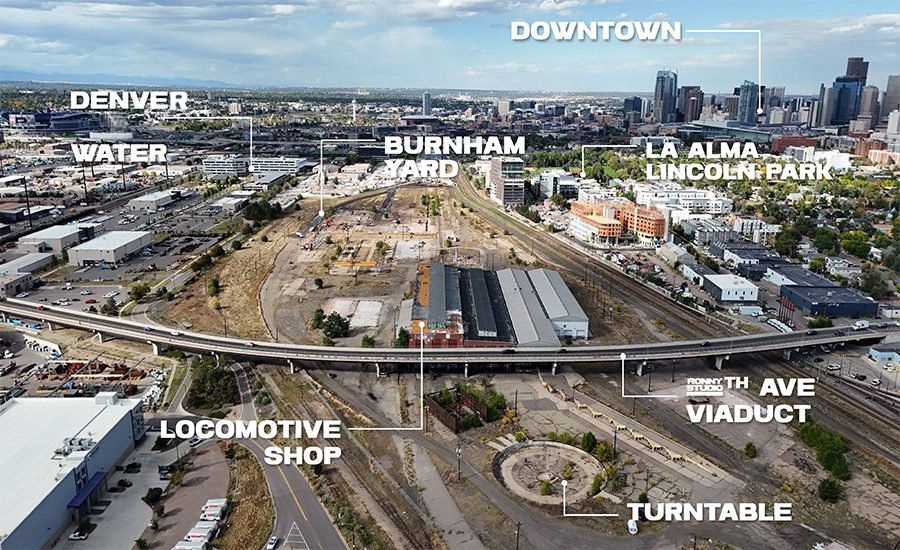
On Feb. 12, the Denver Broncos outlined plans for their proposed Burnham Yard stadium and mixed-use redevelopment, moving through phases and integrating transit with a projected 2031 opening. The organization emphasized that rezoning, architect selection and binding infrastructure agreements are still to come.
In a community update video hosted on the Broncos Wire website, team president Damani Leech reiterated that Burnham Yard remains the organization’s “preferred site,” subject to eligibility approval.
RELATED
Denver Broncos name Burnham Yard as preferred site for new stadium
“This building or the area, Burnham Yard, is not yet zoned for a stadium,” Leech said, noting that permits still need to be secured before the site is official.
The Broncos expect design to begin this year with construction beginning in 2027 and a spring 2031 opening aligned with the expiration of the team’s lease at Empower Field at Mile High.
Scope, schedule and coordination of the public sector
Large Development Review (LDR) materials filed with Denver’s Department of Planning and Community Development describe a redevelopment that spans approximately 150 acres with 5 million to 7 million square feet of mixed-use development, excluding the stadium. The site would anchor the west side of the site, with entertainment uses to the east and residential districts to the north and south.
Planning boards show more than 15 acres of open space, exceeding Denver’s minimum 10 percent requirement. Leech said the club intends to integrate green spaces throughout the district rather than concentrating them in one park.
Looking for quick answers on construction and engineering topics?
Try Ask ENR, our new intelligent AI search tool.
Ask ENR →

A concept site plan shows the proposed Broncos Stadium centered within the Burnham Yard redevelopment, bordered by mixed-use buildings, new open spaces and pedestrian connections to the 10th & Osage light rail station and surrounding neighborhoods.
Map courtesy of Denver Community Planning & Development
The project is developed through coordinated city and state processes. The state of Colorado purchased the 58-acre Burnham Yard property in 2021 and later secured track and freight easements before the Broncos designated it as their preferred location.
The major development review is now proceeding in parallel with a small area plan for the city of Denver and the negotiation of a community benefits agreement, which aligns control of state land with the review of municipal rights.
City planning documents indicate the stadium and mixed-use district are expected to be privately financed by the Walton-Penner Family Ownership Group, with public participation limited to improvements to surrounding infrastructure and no new taxes. The total cost of the project has not been disclosed, although The Denver Post has reported estimates of at least $4 billion.
The site remains primarily zoned for industrial use, with ongoing rezoning discussions. Leech confirmed that no architect has been selected. “Right now there’s no timeline on the reps,” he said. “I haven’t even chosen an architect.”
Project boards indicate design will continue through 2027, with construction expected in 2027 or 2028. Phase 1 would include demolition, enabling infrastructure and the stadium itself, structured to allow for overlapping approvals and construction. Subsequent phases would deliver mixed-use buildings beyond 2031.
Environmental remediation requirements tied to the site’s railroad history have not yet been detailed. Early materials refer to demolition and site preparation, but the extent of remediation and cost allocation remain undefined, variables that could influence the acquisition schedule and strategy. The delivery method and building partners have not been disclosed.
Infrastructure and mobility
The proposal emphasizes the integration of traffic. The site is adjacent to RTD’s 10th & Osage light rail station; Planning materials provide for updates to accommodate demand on the day of the event.
“Light rail is going to be a big thing,” Leech said, noting that the plan maintains the existing station and envisions additional service capacity.
The presentation materials refer to a possible special event stop linked to the future Front Range Passenger Rail, the expansion of the bus stage and integration with the 5280 Trail and the regional bicycle network. About 7,000 controlled parking spaces, similar to the stadium’s current capacity, would be housed primarily in structured and underground garages rather than surface lots.
Public infrastructure commitments intersect with the redevelopment area: According to the project list of the city’s $950 million Vibrant Denver bond program approved by the city’s voters, $89.2 million is allocated for the 8th Avenue Viaduct and multimodal improvements and $50 million for repairs and preliminary design of the 6th Avenue Viaduct for future replacement. These projects aim to improve east-west connectivity along the Burnham Yard corridor independently of the stadium, but will connect directly with the redevelopment.
The relocation of public services will also be considered in the early stages. In a public statement in September 2025, Denver Water said operations and maintenance facilities would need to be relocated and that the Broncos had agreed to cover all relocation costs to avoid impacts on ratepayers.
Together, these transportation and service components underscore that while the stadium is expected to be privately financed, its delivery depends on the city’s capital planning, state ownership of land, and the coordination of public services, each with its own timetable.
The NFL’s stadium construction cycle is ramping up
The Broncos’ 2031 goal places the project within an active NFL equity cycle that ENR has tracked in several markets.
The Buffalo Bills are building a new stadium with a projected 2026 opening, a project ENR has detailed for its winter construction logistics and structural steel sequencing.
RELATED
The project team battles the elements to complete Buffalo’s football stadium for the upcoming season
In Nashville, the Tennessee Titans are replacing Nissan Stadium with a $2.2 billion indoor facility scheduled for 2027, with a large ETFE roof system delivered on an accelerated schedule. Meanwhile, Washington commanders are advancing redevelopment plans at the RFK Stadium site, where land control and public-private financing have shaped the rights schedule.
Recurring themes in these projects include climate-controlled sites, mixed-use districts designed for year-round activation, and delivery schedules anchored to fixed opening seasons.
For Denver, the 2031 deadline tied to the expiration of the lease at Empower Field puts similar pressure on the entitlement schedule, environmental permitting and the acquisition of long-lasting structural systems.
Until rezoning is secured and a design and construction team is selected, Burnham Yard remains a “preferred site” rather than a fully authorized project. But with a defined phase framework and a publicly reiterated opening goal, the Broncos have moved firmly into execution planning.
