

DP World, the global ports and logistics company based in Dubai, signed an agreement with the Taliban-led Afghan government to improve land border facilities at Torkham Pass on the country’s eastern border with Pakistan and Hairatan on the northern border with Uzbekistan.
The deal, announced Dec. 7 by the UAE’s state news agency WAM, could modernize the movement of goods in corridors that have faced chronic congestion and repeated security disruptions, the company said in its announcement. DP World described the deal as a “historic partnership” to develop and operate Afghanistan’s largest land border facility, according to a company statement sent to ENR.
RELATED
ENR Major project delivery companies: increasing risks and rewards
Structured as a public-private partnership, the deal requires DP World to conduct a comprehensive technical and financial feasibility study before finalizing the concession, with planned improvements including expanded infrastructure, advanced cargo handling systems and digitized border processes.
DP World President and CEO Sultan Ahmed bin Sulayem said in a statement reported by Arabian Business that “efficient trade corridors are critical to economic resilience and Afghanistan is uniquely positioned to benefit from stronger ties with its neighbors.” Modernizing the crossings, he added, “will help unlock much greater potential across the region,” creating “pathways to stability and opportunity.” The financial terms and timeline of the project were not disclosed.
The agreement was signed in Kabul by Alhaj Mufti Abdul Mateen Saeed, Deputy Minister of Finance and Customs of Afghanistan, and Nasser Al Neyadi, Executive Vice President of DP World.
At the ceremony, Abdullah Azzam, chief of staff to the Taliban’s deputy minister of economic affairs, said the framework “allows both sides to evaluate investment options,” adding that expanded border management would use “advanced equipment” and conform to “international standards,” as reported by Afghan channel Amu TV.
DP World noted that the project will prioritize local employment and skills development, and the Afghan government will “retain sovereign functions such as customs, immigration, security and regulatory oversight” during and after the upgrade.
The improvements are aimed at congested facilities and changing trade routes

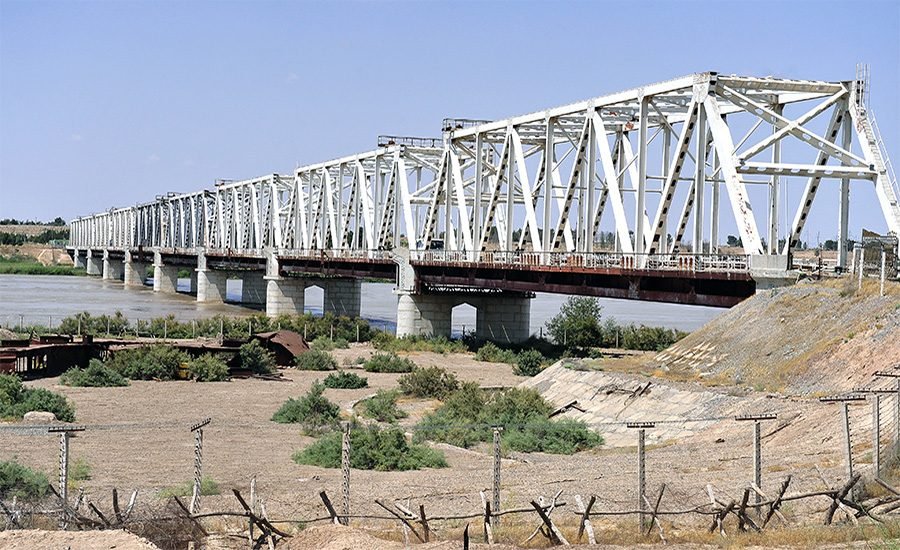
An aerial view of the Hairatan Pass shows the rail and road links connecting Afghanistan to Uzbekistan via the Amu Darya, a key corridor for DP World’s upgrades.
Image courtesy of sunmaya1/Flickr
Existing conditions at both intersections illustrate the extent of potential work. Humanitarian and border control reports describe the Torkham facility as frequently congested, with narrow access roads, limited protected inspection space and mostly manual processing, which can cause delays of several hours during normal operations. Hairatan, which links directly to Uzbekistan’s railways and the wider Central Asian network, operates aging freight yards and limited storage capacity, complicating the management of fuel and food imports.
Trade through both doors remains substantial. Arabian Business reported that trade between Afghanistan and Pakistan exceeded $1.6 billion by 2024, most of which went to Torkham. DP World noted that several billion dollars worth of goods move across Afghanistan’s borders each year, underscoring the importance of Torkham and Hairatan as essential trade arteries.
A Reuters dispatch from November 2025 noted that Afghanistan was increasingly dependent on Iranian routes as Pakistan’s stoppages disrupted traffic, highlighting the vulnerability of the eastern corridor and emphasizing the strategic need for better infrastructure at the two crossings.
With nominal GDP estimated at $17.15 billion in 2023, according to the World Bank, Afghanistan’s economy remains significantly smaller and more fragile than before the 2021 political transition following the withdrawal of US and allied troops.
The US Institute of Peace reports that the country’s GDP contracted by more than 25% between 2021 and 2022, with modest growth in 2024 driven mainly by agriculture. This economic context shapes both the urgency of a more reliable commercial infrastructure and the limitations surrounding large-scale investment.
RELATED
2025 ENR 250 Top International Contractors: Market Volatility Flat Line Earnings
Security and regulatory gaps pose delivery risks
Security and governance conditions represent a central challenge for any long-term development. A 2025 assessment by the United Nations Interregional Crime and Justice Research Institute characterizes Afghanistan’s security landscape as volatile, citing the activity of extremist groups and weak administrative capacity in border areas.
Reuters reported that Pakistani and Afghan forces exchanged fire in Torkham on March 3, forcing a temporary closure. A UN Refugee Agency border report from January to May 2025 noted sustained irregular crossings and pressure on nearby towns during periods of tension.
Regulatory procedures at the crossings operate under Taliban administrative directives rather than codified permitting or environmental frameworks, creating uncertainty for foreign engineering and construction companies about standards, workforce protocols and site safety requirements. DP World has not detailed how the approvals will be coordinated.
DP World has experience in modernizing bridge facilities in complex environments, including the redevelopment of the port of Tartus in Syria. The company is positioning the Afghanistan project within its broader portfolio of inland and border logistics developments in the Middle East, Asia and Africa.
Afghan officials have promoted deeper trade ties with Central Asia to reduce dependence on Pakistan, and local media reports indicate the feasibility phase will first look at upgrades to Hairatan, followed by Torkham. The sequence aligns with Kabul’s broader strategy to diversify trade routes through northern rail connections and regional road corridors.
DP World stated that the feasibility study will assess how upgraded facilities and digital customs systems could reduce processing times and support anticipated traffic growth. The company emphasized that modernized and well-managed border facilities are vital to improving efficiency, security and reliability in Afghanistan’s trade corridors.
