

This audio is automatically generated. Please let us know if you have any comments.
Erik Gronneberg is a reality capture manager for Columbia Construction, based in North Reading, Massachusetts. The opinions are the author’s own.
As a reality capture manager, I regularly use drones and drone software to quickly and accurately calculate the volume and weight of any soil or stored material stored on a job site. This relatively new approach has provided significant benefits to project costs and timelines.
Previously, we relied on our site subcontractor for the amount of material that needed to be excavated, stored or moved.
They would go out to the job site and survey a given reserve with a base station and a rover. They would collect a handful of data points by physically walking through the pile and estimating the volume of material.

Erik Gronneberg
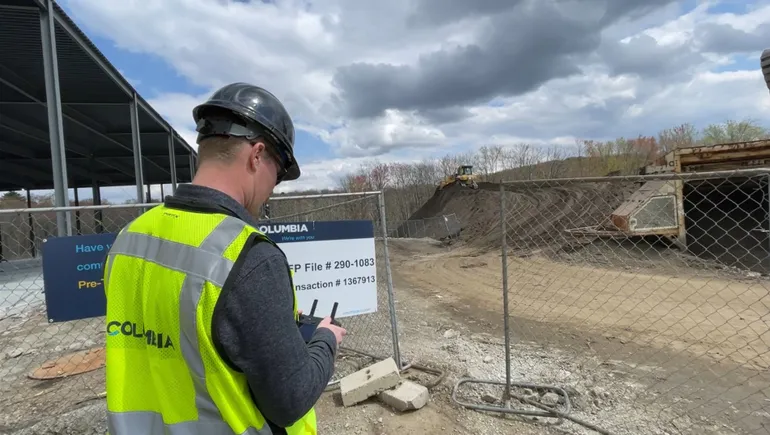
Permission granted by Columbia Construction
In contrast, a properly trained and equipped drone operator can fly over any material storage, generate a point cloud with millions of data points, and have actionable data for the project team in a matter of hours.
Of course, flying a construction drone isn’t as simple as hitting the order button on Amazon. The process to collect this type of data requires three elements:
- The right drone.
- Flight planning and data processing software.
- A properly trained and licensed drone pilot.
The right drone
The drone he flies, a DJI Mavic 3, costs roughly $6,000 and is equipped with a real-time kinematics system that helps with geolocation, which I recommend. There are many other good options on the market, but one thing to keep in mind is that if you do any work for the federal government or federal contracts, you will be required to fly an American-made drone system. For this reason, it is worth noting that DJI, the world’s leading drone manufacturer, is based in China.
The right software
There are many good drone software options to choose from, including some good free options. Most are available through tiered subscription models starting at a few hundred dollars per year. I use DroneDeploy.
It offers flight planning, data processing and analytics in a single package and costs approximately $10,000 per year. It is a well-known software used by many commercial drone pilots that allows flight plans to be programmed so that the drone can capture the desired information on the autopilot.
During a flight over a construction site, the UAV typically takes a few hundred to 1,000 images, depending on the size of the site. When loaded these images generate an easily accessible point cloud from all the images taken during the flight. This point cloud can be used to measure anything in the workplace.
You can also create cut and fill reports by comparing existing conditions captured by the drone to the design surface. This allows you to keep track of how much material needs to be removed or added.
With most drone software options targeting the construction industry, you don’t need to be a CAD wizard and you can view the 3D model directly in the software. Regardless of the software you choose, understanding how to interpret and deliver the data is critical to the success of your drone program.
pilots
When it comes to pilots, you have two options: hire a commercially licensed drone operator to fly at your workplace, or train a member of your own staff.
To hire an experienced commercial drone pilot to do stock assessments, expect to pay between $120 and $250 per hour, depending on the region and scope of work. For a storage flight mission, I would budget between eight and 16 hours total.
This number can vary significantly depending on the scope. This would generally include transportation, flight time, data processing and reporting. Although the pilot may only be on site for a few hours at most, they have many other expenses and time to provide the data.
To train an employee to become a licensed drone pilot, expect to pay $200 to $350 for a Part 107 unmanned aircraft system training course and another $175 to take the Part 107 exam. Also you need to consider the costs of equipment, software and insurance, which can vary significantly.
The other important factor in this scenario is time. This process will take longer than hiring an experienced pilot. Expect it to be several months before anyone is ready to do their first storage mission and generate accurate data. Once you have a pilot on board, you have much more freedom to expand capabilities.
regulations
All commercial drone operators must pass an in-person test by the Federal Aviation Administration to receive a Part 107 certificate. This is the license that allows you to fly legally. The test has nothing to do with how you can fly a drone, but tests your knowledge of airspace rules and regulations.
The right drone software will also be helpful in identifying which airspace restrictions and regulations you must follow. Making sure you comply with all FAA rules and regulations will become even more essential in March when the FAA implements a new set of rules known as “Remote Identification.”
It’s best described as a digital license plate for your drone that allows law enforcement to remotely identify any drone flying in a given area. They will be able to see who owns the drone and the exact location of the remote control.
Newly manufactured drones come with this technology already installed, but older drones will need an external unit that transmits this data. There are stiff fines and significant legal risks associated with the illegal operation of drones.
Our drone is now an essential part of our construction process, and our relatively small investment in equipment and training paid for itself within a year. The kind of data you can get from one of these systems is amazing, and the technology keeps getting better.
