

.webp?t=1772551694)
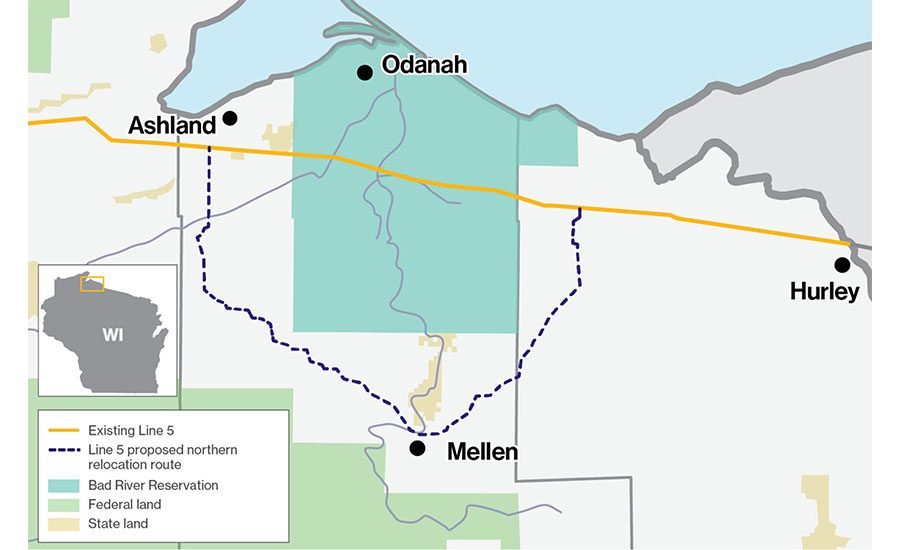
With permits in hand, global pipeline and energy company Enbridge has begun construction on the long-contested $450 million, 41-mile Line 5 pipeline relocation project in northwestern Wisconsin.
On February 24, the US Army Corps of Engineers finalized a permit for the project that would include 12 miles around a reservation owned by the Bad River Band of Lake Superior Chippewa. Crews began working immediately to clear the site and mobilize for construction, Enbridge spokesman Juli Kellner says.
The Corps issued the permit after Wisconsin Administrative Law Judge Angela Chaput Foy issued a decision on Feb. 13, upholding state permits approved by the Wisconsin Department of Natural Resources in November 2024.
Calgary, Alberta-based Enbridge, which owns the pipeline that carries crude oil and natural gas liquids from Superior, Wisc., to Sarnia, Ont., submitted the application to the DNR in 2020.
The project deadline is being advanced. In 2023, a judge gave Enbridge until June 2026 to remove the existing segment of land from the reservation after the tribe sued the company in 2019, seeking to force it to remove it, arguing that land easements for the 73-year-old pipeline had expired and that it was prone to a spill.
RELATED
US Justice Department Seeks Stay of June 16 Enbridge Line 5 Shutdown
Noting the project’s long history, Kellner called it “the most studied pipeline project in Wisconsin history.”
The battle is not over, however; according to opponents, including the Bad River Band, which is represented by the nonprofit public interest group Earthjustice, filed a motion on Feb. 19 to halt construction until the court can hear the legal claims.
“The Wisconsin DNR approved Enbridge’s Line 5 diversion project in violation of Wisconsin environmental laws,” Earthjustice senior associate attorney John Petoskey said in a statement.
“On behalf of the Bad River Band, we are asking the court to review the agency’s illegal approval and ultimately withdraw the permits for this project,” Petosky added. “We are also asking the court to order a stay that will immediately halt any construction activity until our legal claims can be heard.”
Petoskey said the company plans to use horizontal directional drilling, horizontal drilling and direct drilling techniques, which he said have a history of contaminating water and harming wildlife habitat.
“If built, the route will encircle the band on three sides, all directly upstream of the band reserve, and risk severely damaging tens of hectares of previously undisturbed, high-quality wetlands, hundreds of pristine waterways, and countless species and areas of unique importance to the band,” he added.
Other environmental groups also filed a petition in Iron County Circuit Court seeking judicial review and a motion to immediately halt construction activities pending a final decision on the case.
“We are more committed than ever to protecting Wisconsin’s waters from the irreversible harm this project threatens to cause,” Midwest Environmental Advocates Senior Attorney Rob Lee said in a statement.
“We believe the administrative decision incorrectly decided critical factual and legal issues, and we are confident that our efforts to hold DNR and Enbridge accountable under Wisconsin’s environmental laws will be vindicated,” Lee added.
While he did not provide any details on the companies that would work on the pipeline, Kellner said it will be built by a Wisconsin contractor, subcontractors and a union workforce and will create 700 union construction jobs.
The approval of DNR permits for the project “confirmed that project construction impacts will be temporary and isolated, will not have measurable effects on water quality and will not violate water quality standards,” Kellner said.
Line 5 is the focal point of another controversy in Michigan, where Enbridge has proposed fitting another section of pipeline into a tunnel that would extend 4.5 miles under the Straits of Mackinac. Enbridge is seeking permits from both the Corps and the Michigan Department of Environment, Great Lakes and Energy. Neither has given approval yet, but the Corps has accelerated its authorization process in response to a 2025 executive order signed by President Donald Trump that declared an energy emergency.
Meanwhile, Michigan Gov. Gretchen Whitmer and Attorney General Dana Nessel have filed lawsuits to invalidate the easements that allow Line 5 to operate on the Straits.
In December, a federal judge ruled against Whitmer and Nessel in their lawsuits, but the governor has since appealed to the US 6th Circuit Court of Appeals. Meanwhile, the US Supreme Court is deliberating whether Nessel’s lawsuit should be heard in state or federal court.
Line 5 serves ten refineries and propane production facilities, Kellner said.
