

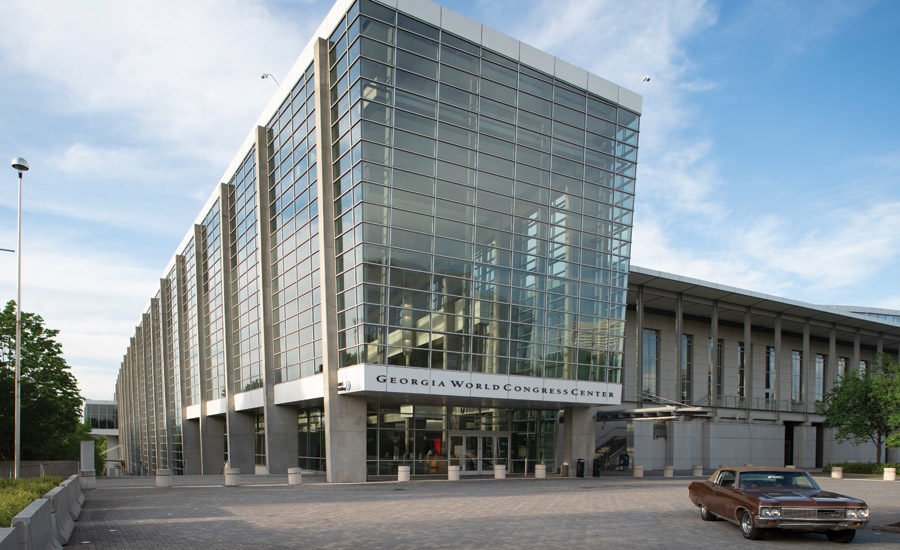
March 2023 marked a high point for the Georgia World Convention Center Authority as it celebrated the topping out of the 453-foot-tall Signia by Hilton Atlanta hotel. The event marked more than reaching the physical summit of the city’s tallest hotel project in decades, it also marked the culmination of years of planning, patience and persistence by the GWCCA.
Over the remainder of 2023, the organization saw the project completed and in January 2024, GWCCA unveiled the hotel as the latest jewel in its crown, joining the rest of the world-class venues in the portfolio of the group, making it the largest combined sports convention. and entertainment campuses in North America. The decade-long journey to build the $326 million hotel provided many twists and turns for the authority, says Kevin Duvall, GWCCA chief operating officer.
“It’s a fabulous project,” says Duvall. “And we’re very proud of that, but I really think you don’t typically see public entities, especially today, being dedicated to their future.”
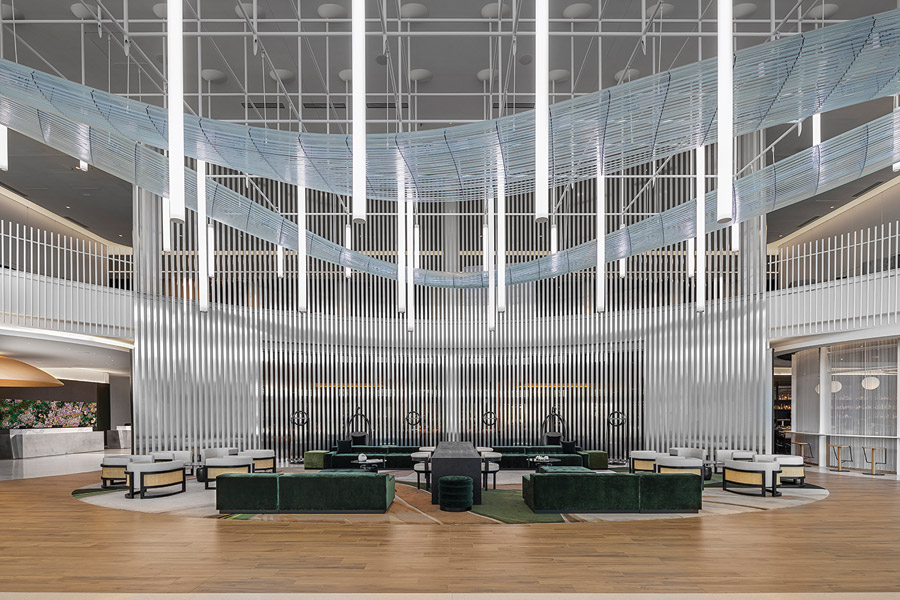
The 976-room Signia by Hilton Hotel offers views of the Home Depot Backyard green space and Mercedes-Benz Stadium.
Photo courtesy of the Georgia World Congress Center
Success case, unfinished
Established by the state of Georgia in 1971 to oversee the development of an international trade and exhibition center in Atlanta, this goal was achieved when the World Congress Center opened five years later. The authority oversees campus operations, as well as the Savannah Convention Center, which is undergoing a $276 million expansion to double its square footage and add a 900-space parking deck.
A 2022 analysis by Georgia State University researchers pegged the center’s total economic impact at $1.37 billion in the 2021-2022 fiscal year, when the effects of the pandemic were still affecting the travel industry and conventions According to its 2023 annual report, which reflects the previous fiscal year, more than $4 million in campus development projects were completed and another $602 million were in various stages of implementation. And it’s not all about spending money either.
GWCCA’s 2023 annual report says the campus contributed $88 million in direct benefits to the state in fiscal year ’23, including a direct operating benefit from the World Congress Center of nearly $6.7 million.
Figures highlighting the centre’s success this year include 3.2 million visitors, which equates to more than 8,800 each day, up 8%, despite hosting around 30 fewer events than the previous year.
Atlanta’s last landmark
The Signia by Hilton Atlanta hotel project took its first steps in 2013, setting its sights on redevelopment rights obtained through a deal with the Atlanta Falcons. Three firms were hired to provide a market study for a potential hotel on the GWCCA campus. Two years later, the Drew Co. she was hired to lead the project.
The next leg of the trip took GWCCA leadership to Los Angeles, Houston, Chicago and New Orleans, where the group studied various developments. In 2020, GWCCA selected Hilton as the hotel operator and began preparations to begin work. Then the COVID-19 pandemic hit, forcing GWCCA to pause the project.
Meanwhile, the authority took time to refine drawings, pricing and other details. Discussions ensued, Duvall says, about whether he should continue with the hotel project. There was uncertainty about how long the pandemic might last and what impacts it would have on the event center and hospitality market.
“We are very proud [the hotel]but I really think that you don’t usually see public entities, especially today … approaching their future.”
—Kevin Duvall, COO, Georgia World Convention Center Authority
“Ultimately, we are responsible for facilities that have been started before us,” he says, adding that it is a responsibility he takes seriously. “When I joined the organization more than 20 years ago, I was entering an organization that was already fully developed. It had a great reputation and great facilities, and I know I had to be a steward of that and a caretaker of that.”
By the end of 2020, as the impacts of the pandemic were better understood, the bank called to tell GWCCA that an opportunity to return to the market was approaching. The authority prepared its position, selling bonds in March 2021 and embarking on the hotel project that would be a benchmark to see how the global market would react to such a large project.
The 976-room Signia by Hilton is Atlanta’s largest hotel development project in 40 years. It is connected to GWCCA’s C Building and overlooks the Home Depot courtyard, 11 acres of green space and Mercedes-Benz Stadium.
Crews from Skanska, which served as the hotel’s general contractor, found their own reasons to be patient and persistent because the new hotel would be built in part on the remaining foundations of the Georgia Dome that was demolished in 2017. First, crews had to examine existing conditions. The columns and foundations of the new structure were then reinforced with a combination of slabs and roof beams to stretch and accommodate the weight.
Finally, just under 300 auger cast piles and 60 caissons ranging from 54 inches to 86 inches in diameter were installed. This paved the way for the rest of the work to continue.
Now with the project complete, Duvall says the council is looking toward the next update to its comprehensive plan, for which it has partnered with HKS.
“We’ve made this big move from the hotel,” says Duvall. “Now, what’s going on?
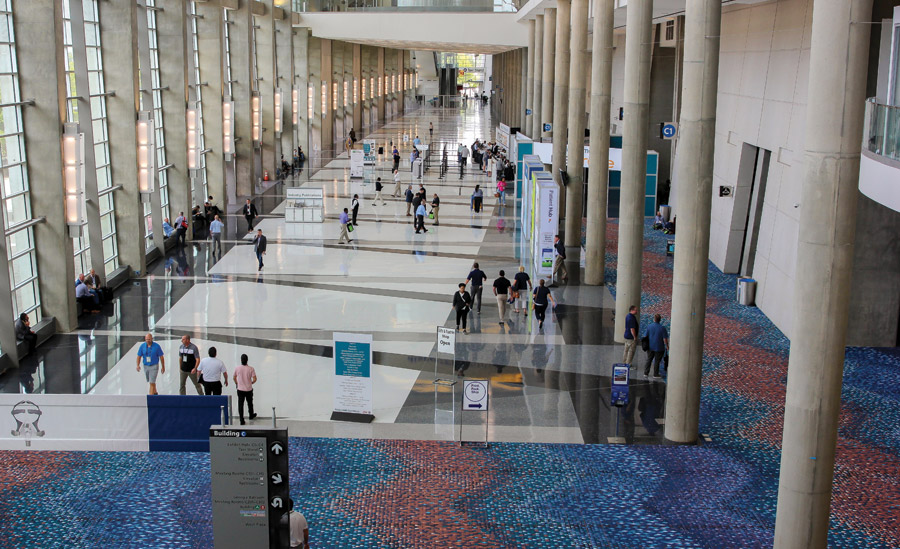
The Georgia World Congress Center welcomed more than 3.2 million visitors in fiscal year 2022-23.
Photo courtesy of the Georgia World Congress Center
Stay ahead of the curve
The authority did not neglect other initiatives amid the uncertainty of the pandemic era, ultimately moving forward with more than $615 million in planned capital projects. These include the hotel and a new pedestrian mall and transportation terminal project at the World Congress Center, as well as a new parking deck, the addition of more than 500 parking spaces, and a multi-phase project to replace over 2.2 million square feet of deck space.
Ken Stockdell, director of project and program management, sits in a somewhat unique seat at the authority, he explains. With 35 years of experience in convention center architecture under his belt, he now manages the center’s ever-evolving master plan.
“Now that we’ve finished the hotel… what happens? And what will we be like in 10, 20 years?” Stockdell asks.
Since 2010, the center has invested more than $2 billion in public and private investment on its 200-acre campus in the heart of downtown Atlanta, the largest in North America. The complex has more than 1 million square feet of contiguous exhibition space. Alongside the new hotel, the Georgia World Congress Center also oversees Mercedes-Benz Stadium, home of the NFL’s Atlanta Falcons, and Centennial Olympic Park, which commemorates the attention-grabbing 1996 Atlanta Olympics from the world to the city.
Thirty years later, the center is preparing to once again be the center of attention in the world. The venue will host eight matches of the 2026 FIFA World Cup. This follows its turn to host the NCAA College Soccer Championship in 2025. All this with Stockdell lining up work on the facility’s roof and taking stock of the projects that have yet to be determined will be necessary for the World Cup.
“They’re collaborative, they’re innovative … They’re willing to pitch in and help however they can, and that really comes down to the people.”
—Brad Hutto, Vice President of Headline Construction
“Since I’ve been here, I’ve preached the mantra that there’s nothing we work on in this building that’s not customer-oriented,” he says. “Whether it’s a roof or an air handling unit or the pedestrian mall.”
The best outcome for Stockdell is a facility operations team that is invisible to crowds of football or soccer fans, convention attendees or hotel visitors.
Success also means hitting the occasional curveball, like during Christmas 2022, when abnormally low temperatures caused three air handlers to freeze. Crews returned from vacation to find 3 feet of water in the air handling room.
Brad Hutto, vice president of Holder Construction, can testify to the authority’s ability to adapt and keep working while the center remains open.
Hutto worked consistently with GWCCA from 2014 to 2022 on a variety of projects, including work on Mercedes-Benz Stadium, the Home Depot patio area, parking decks and more, including the B+C project Connector, which added 110,000 square feet between two of the center’s showrooms.
Flexible and focused
In 19 years at Holder, Hutto has worked at several convention centers across the country, and he says
GWCCA is among the best of those he has worked with.
“They’re collaborative, they’re innovative,” says Hutto, who also served as project manager
GWCCA’s demolition of the Georgia Dome. “They’re willing to pitch in and help however they can, and it really comes down to the people.”
Along with naming Stockdell and Duvall, Hutto also pointed to Jeff Oden, senior director of campus operations, and Frank Poe, executive director, as people at the helm who set the tone for the culture and success of organization
One project that stands out is the B+C Connector, a $55 million project that won first place for construction excellence at the 2020 AGC Build Georgia Awards. The project had to face the challenges of working on a busy site and required GWCCA to successfully overcome these obstacles for both its clients and contractors.
The scale of the center gives it a hand when projects are put out to tender, leading to plenty of competition for high-profile jobs like the Signia.
“They are very professional and calm under pressure,” says Hutto. “There will be bumps in the road along the way, but it’s how people react in those moments in the heat of the moment.”
But the center’s operational success may threaten to hamper its capital projects once construction begins because the campus is still open to thousands of visitors for a wide variety of events.
“Everybody wants the project done, they just don’t want it done during their event,” Duvall says.
An ongoing project, a three-year effort that began in February to replace 35 escalators, is a timely example, Stockdell says, with multiple teams in the organization now coordinating to minimize impacts on customers.
“Construction can be noisy, vibrating, impactful,” says Hutto of Connector B+C. “They were more supportive of how we operate and how we work and were trying to help us adapt.”
Work was scheduled to accommodate events and moved further if needed into the afternoon, morning or weekend to minimize impacts on guests. And it’s the organization’s exceptional communication, he says, that keeps things running smoothly amid these changes.
