

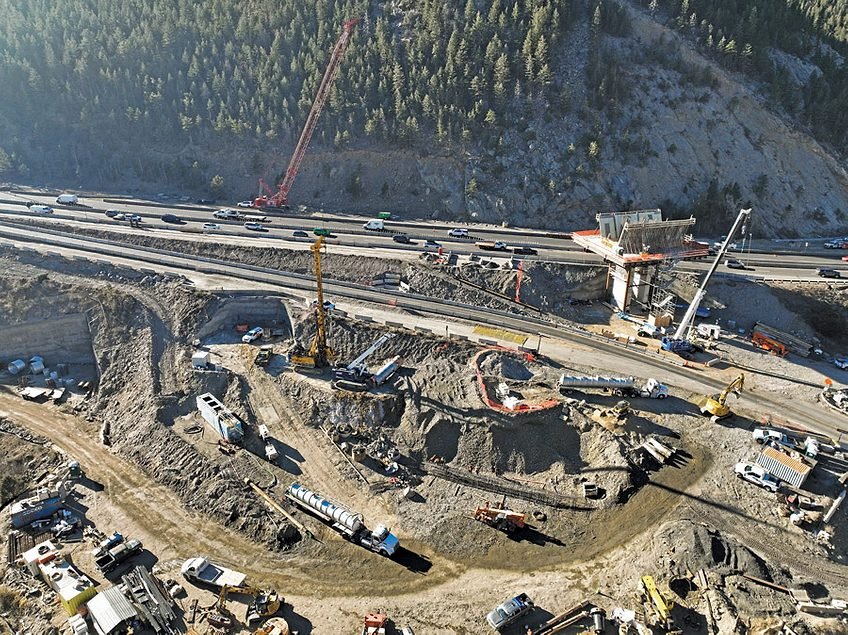
It’s been a blast for crews widening a vital eight-mile section of Interstate 70 from west of Evergreen to east of Idaho Springs—a lot of blasts, in fact.
In order to widen I-70 while eliminating sharp curves through Granite Mountain, Kraemer North America crews have been conducting up to six rock blast operations a day at any of the five locations since fall 2024, requiring drivers to wait up to 20 minutes on the freeway.
In addition to general message boards, the Colorado Department of Transportation has a hotline, website and text alert system that has about 20,000 subscribers, says Emily Wilfong, CDOT spokeswoman.

A new 1,000-foot-long viaduct is part of the realignment of I-70 through the Floyd Hill area.
Photo courtesy of the Colorado Department of Transportation
Kraemer and designer AtkinsRéalis lead a construction manager general contractor team that is literally moving mountains to widen, improve and realign the freeway stretch, including clearing a bottleneck on westbound I-70 at the top of Floyd Hill, where three lanes of traffic coming from Denver are narrowed to two lanes by adding an express toll lane in that section.
The $905 million project also includes rebuilding or constructing 10 bridges, adding a two-mile section of frontage road between the US 6 and Hidden Valley/Central City Parkway interchanges, relocating the left-merge US 6 entrance ramp to westbound I-70, building a widened ramp from eastbound US 6, a wildlife underpass and the building I-70 roundabouts at the intersections of US 40 and Homestead Road and US 40 and County Road 65 and paving the Clear Creek Greenway Trail.
“We have up to 150 full-time employees on the Kraemer team and another 100 subcontractors,” says Matt Aguirre, senior division manager at AtkinsRéalis. They “battle the elements of wind, snow and cold” while keeping an eye out for moose, deer, bear, sheep and mountain lions, as well as drivers, people fishing, rafters, cyclists and an active landslide.

The new alignment reduces curves and grades and adds capacity to the eight-mile section.
Photo courtesy of the Colorado Department of Transportation
Past and present
“The [I-70] The Floyd Hill project has been in the works for a long time,” says Kurt Kionka, CDOT project manager. It is a critical component of the I-70 Mountain Corridor Programmatic Environmental Impact Statement, a long-term multimodal plan established in 2011 to manage congestion and safety on the 144-mile corridor between Denver and Glenwood Springs.
Built in the 1960s, the Floyd Hill section is “ready for upgrades,” Kionka says. Design assessments a decade ago determined that a tunnel would be too risky and expensive. Named after the founder of a wagon wheel company formed during the 1800s-era gold rush, the Floyd Hill stretch posed underground hazards like old mine shafts, he notes.
But realigning and widening the existing freeway “has its own unique challenges,” he says. “How do we fit a path [the mountain]?” says Kionka. Hemmed in by a canyon wall on one side and a creek on the other, the new alignment had to be elevated and shifted south in the central section, requiring a 1,000-foot-long, 115-foot-high segmented cast-in-place concrete viaduct that will carry westbound traffic.
“The project has been in the works for a long time.”
—Kurt Kionka, Project Manager, CDOT
These design aspects were informed by public input. “We would present the concepts to the stakeholders and work with them to determine whether they meet the objectives or not,” says Aguirre. Maintenance of traffic plans and an aesthetic corridor guideline including colors and patterns for noise walls were established.
Communication with interested parties is ongoing. For example, “Idaho Springs is on the western boundaries of the project, and what can happen is sometimes it gets blocked” because of drivers coming in to wait out weekend traffic or rock blasts, Wilfong notes. “We meet quarterly with first responders to discuss concerns and traffic management. There is a plan in place if we see the queue building and we can close the exit to the city.”
Average daily peak traffic along the stretch reaches 50,000, and Saturday mornings see drivers heading to ski resorts in the winter, Kionka says. “We are designing this project for the traffic volumes of 2045, where the average daily traffic will be up to 63,000.”
The aim is to avoid delays of 90 minutes on the section in peak travel times, he adds. “Right now we’re seeing a maximum of 3,700 vehicles an hour before it breaks down [into the major delays].”
Easing sharp curves should reduce crashes by 20 percent, and the new two-mile section of frontage road between the US 6 and Hidden Valley/Central City Parkway interchanges will improve resilience and emergency response. The trail improvements will meet ADA standards, and the wildlife underpass and four miles of fencing will dramatically reduce wildlife collisions.

The Floyd Hill section of I-70 carries thousands of commuters and tourists between the mountains and foothills of Denver.
Photo courtesy of the Colorado Department of Transportation
Dangerous curves
The CMGC team began preconstruction in 2022, says Matt Hogan, Kraemer’s area manager. There are four build packs. Package 1, the first two miles of the project, recently reached substantial completion this month, he says. “That was on the eastern end and was the easiest to design,” he says. This included the four miles of deer fencing and the widening of I-70 from five general-purpose lines to seven lanes, including the express lane and new shoulders.
The section included four areas of rock excavation to move the highway south, totaling about 50,000 cubic meters and with 70,000 soil nails.
“They fight against the elements of wind, snow and cold.”
—Matt Aguirre, Senior Division Director, AtkinsRéalis
Package 2 spanned two miles of the west section, Hogan says, with 350,000 cubic meters of rock cut alongside I-70. “We made a 220-foot-high cut through the drill and blast while keeping the freeway open.” Crews are down to one or two blasts per week, he adds.
“We’re working to streamline blasting operations between 9 and 3” during the day, he says. “That corridor was 45 mph [capacity] curves We are updating it to 55 mph. We are moving the mountain to flatten the curve. At the bottom of Floyd Hill is a sharp curve, [with capacity for] 35 mph and a 7% gradient. The section of the project will reduce the grade to 3-4% and is scheduled for completion in 2028.
“US 6 merges to the left with westbound I-70, and that’s tricky when navigating the curve,” adds Hogan. “That goes away too.” A frontage road is also being widened approximately one mile.
“The center section is the meat of the project,” says Hogan. It includes eight structures, including the viaduct over Clear Creek. “Just to build it, another contract was made to build the access and speed up the schedule while the bridge was being designed,” he says. “Otherwise, it would take nine months to start building the bridge.”
Across the section, bridge foundations range from 30 feet to 80 feet in depth, with drilled shafts ranging from 36 feet to 90 feet in diameter and a pier location that requires a cofferdam. The upgraded westbound I-70 is scheduled to open in 2027, with the eastbound lanes in 2028. “Then we’ll have another year for restoration and landscaping and facade work,” Hogan says. The project includes approximately 150,000 square feet of soil nail walls, 30,000 square feet of mechanically stabilized wire basket wall, and one million cubic yards of excavation.

Crews must conduct periodic cantilever and climb operations to allow for the changed alignment.
Photo courtesy of the Colorado Department of Transportation
“We try to process most of the excavation into backfill and aggregate on site,” says Hogan. “If it’s good quality, it goes into the crushing operations. Not all of it can be used, so we’re working with landowners to develop some fill sites.” Around 30% of the material is recyclable.
Subcontractor Arizona Drilling and Blasting, a division of Fisher Industries, will drill about 150,000 cubic meters through the spring in the west section and about 30,000 cubic meters for the central section, Hogan says.
Aguirre notes that Kraemer was able to prevent the realignment of Clear Creek, which is a popular spot for rafters and anglers. At the 20% design stage, the plan was for three rock cuts in the west section and realignment of the creek. “The contractor said that this rock on the north face is much more solid than on the other side of the creek,” he notes. A larger cut avoided disturbing the creek.
“The CMGC delivery method was the only way to deliver this project at this location,” says Kionka. “It allowed the owner to take a risk where we saw it.”
