

The U.S. Federal Trade Commission is trying to block the proposed $725 million acquisition of construction adhesives business Liquid Nails by German consumer chemicals and brands maker Henkel AG & Co., arguing the deal would eliminate significant direct competition in a widely used construction material.
In a complaint filed Dec. 11 in U.S. District Court in New York City, the agency said combining Henkel’s Loctite brand with Liquid Nails — now owned by private equity firm American Industrial Partners — could lead to higher prices, reduced innovation and fewer options for contractors and distributors.
“Construction adhesives are essential products that are used daily on jobsites,” the commission said in announcing the lawsuit, adding that the proposed transaction would consolidate what it described as the two largest competitors in the US market for professional-grade construction adhesives.
The agency is seeking a court order to prevent the transaction from closing while its administrative challenge continues.
“Antitrust laws protect Americans from anticompetitive mergers that threaten to raise the costs of the products we use to build and maintain our homes,” said Daniel Guarnera, director of the commission’s Bureau of Competition, in describing the action to block the proposed Loctite-Liquid Nails combination.
RELATED
US building materials prices rise 3.5% as contractor backlog shrinks
Broader Market Volatility Signals Caution
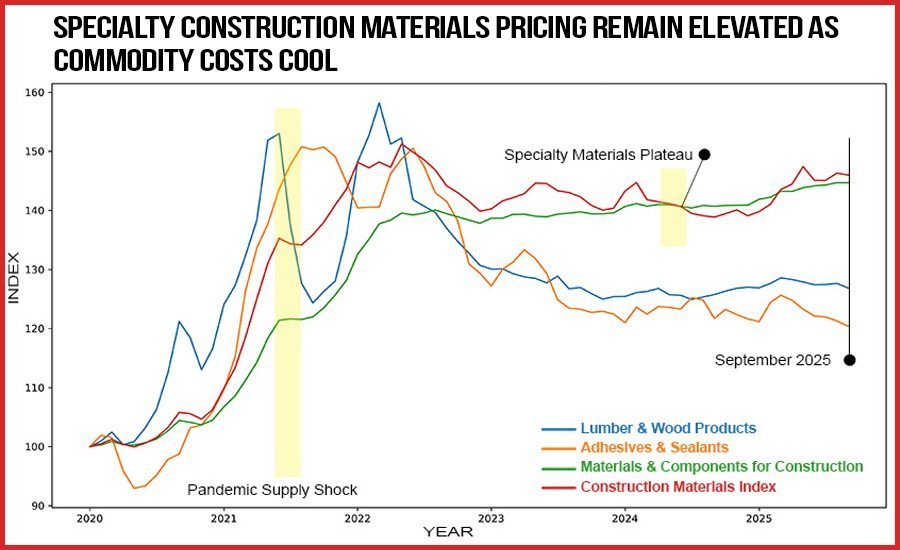
The action comes as construction material prices have remained high through 2025, complicating bid assumptions and escalation planning for contractors preparing for 2026 work.
Data from the US Bureau of Labor Statistics show that the producer price index for construction materials and components rose about 2.8% in September from a year earlier, indicating that wholesale construction inputs are continuing to rise even as pandemic-era supply disruptions have moderated.
September is the most recent month for which fully released index data is available, as the extended federal government shutdown halted data collection for more than 40 days.
Düsseldorf-based Henkel markets Loctite as a premium adhesive brand sold through building materials distributors and large retailers. Liquid Nails is widely used in framing, finish carpentry and general construction applications.
The commission alleges that the two brands compete more directly for professional users, limiting the ability of smaller manufacturers or private label alternatives to restrict prices. The agency did not disclose specific market share figures, but said its analysis was based on competitive effects, customer substitution and price behavior.
American Industrial Partners acquired Liquid Nails in 2023 as part of its purchase of PPG’s former architectural coatings business in the United States and Canada, which now operates as Pittsburgh Paints. In the business press following the commission’s legal filing, the vendor disputed the agency’s market definition, arguing that the construction adhesives industry remains competitive and includes a range of alternative products. Henkel declined to comment on the lawsuit when contacted by several outlets, including ENR.
Why does this matter?

ENR’s Q3 2025 Cost Report found construction input prices remain elevated, reinforcing contractor concerns about material costs, escalation risk and bidding assumptions for 2026.
While the trade commission’s legal challenge focuses on construction adhesives, it comes amid uneven pricing behavior across construction input categories. Basic materials such as wood and steel have seen price fluctuations and declines in 2025.
In contrast, many specialty building products, including adhesives, sealants and chemical-based coatings, have not experienced similar long-term price declines and remain higher than last year.
Economists and federal regulators have said the pattern is more common in markets characterized by strong brand differentiation, fewer effective substitutes and higher switching costs for professional users.
In competition reports and merger challenges published since 2021, the commission and the US Department of Justice have said that higher concentration in differentiated manufacturing markets can weaken price discipline and reduce incentives for innovation.
A relevant comparison is FTC v. Staples, Inc., a landmark antitrust case in which the commission successfully argued that eliminating direct competition between close rivals could lead to measurable price increases even in markets with other sellers.
In that case, economic analysis showed that prices were lower in markets where business supply companies Staples and Office Depot competed head-to-head, and the court accepted evidence that a merger would likely increase prices by 5% to 10%.
Henkel’s lawsuit reflects similar reasoning, arguing that Loctite and Liquid Nails limit each other’s prices for professional users in a way that smaller brands or private label alternatives cannot.
Industry data also points to a long-term change in market structure. The US Census Bureau’s most recent economic census, released in 2024 and covering production patterns through 2022, shows a decrease in the number of mid-sized manufacturers in several building products subsectors compared to previous census cycles, indicating continued consolidation.
For contractors and estimators, these dynamics translate into incremental and persistent supply risk. Adhesives and similar specialty materials are typically a small single-digit portion of total material costs on most large-scale projects, but are used in nearly every trade.
Even modest aggregated year-over-year increases in large volumes can affect margin assumptions, particularly in labor-intensive fields of work.
Consolidation can also reduce distributors’ negotiating leverage over discounts, promotions and inventory flexibility that contractors rely on when locking in material costs. Large contractors are not isolated from this dynamic.
Pricing behavior and allocation decisions in construction materials markets are often fixed in the middle market, where volumes are high but buyer leverage is limited and contracts are renewed more frequently.
When consolidation reduces competition to this level, the resulting price and supply signals tend to propagate upward, shaping the distributor’s economics and national accounts frameworks that ultimately affect large, long-running projects.
While the commission’s legal challenge does not predetermine future pricing outcomes, its timing, amid high wholesale input prices, delayed federal data releases and ongoing consolidation, underscores a growing regulatory focus on how materials market structure can influence long-term costs, availability and risk allocation for construction firms.
