

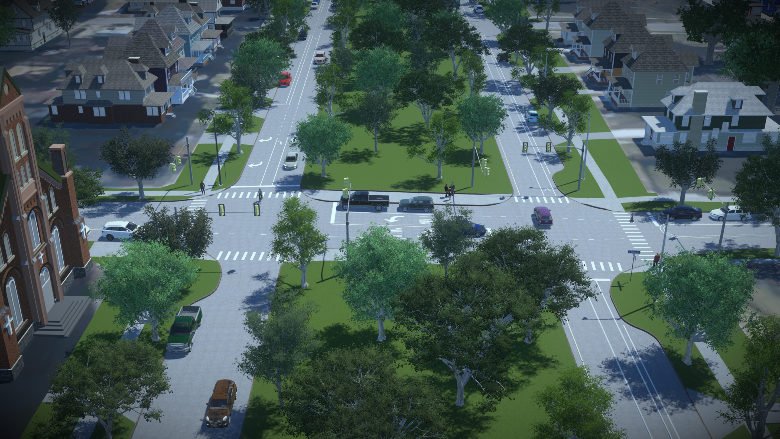
The Federal Highway Administration (FHWA) approved the $1 billion Kensington Expressway project in Buffalo, New York after finding it would have no significant environmental impact, according to a Feb. 22 notice in Federal Register. The plan is to cover a section of the highway to reconnect communities and add green spaces.
With federal approval, the New York State Department of Transportation aims to begin construction in the fall, Gov. Kathy Hochul said at an event to announce the project’s progress.
The project involves covering a six-lane, 4,150-foot-long section of the Kensington Expressway, also known as State Route 33, from Dodge Street to Sidney Street in East Buffalo. The cap would be used as public green space with at least 3 feet of soil on top to allow for mature trees up to 50 feet tall.
The planned scope also includes rehabilitating 9 miles of local streets, adding “complete street” features for pedestrians and cyclists and replacing the Best Street Bridge to build a roundabout at the Best Street Interchange. According to Paul Brown, president of the Buffalo Niagara Building Trades Council, the work is expected to support hundreds of union construction jobs.
Kensington Parkway was originally built in the 1950s and 1960s. It replaced the historic tree-lined Humboldt Parkway, which had been designed by Frederick Law Olmsted, best known for his work designing New York City’s Central Park. In its place, a below-grade road divided the neighborhoods of East Buffalo. More than 600 homes were demolished to make way for the freeway, and most of the displaced residents were black.
“Hundreds and hundreds of lives were uprooted and businesses were destroyed all in the name of this faster route to the suburbs,” Hochul said.
Buffalo Mayor Byron Brown called the plan “a true people’s project.” Jomo Akono, business representative for Carpenters Local 276 and vice president of the Buffalo Juneteenth Festival, said in a statement that residents have been fighting for this project for decades.
“This project will set out to repair our community, honoring the many who have died but left us instructions to help heal the small differences our community faces and leaving room for healing and growth,” Akono said. .
 The six-lane Kensington Expressway bisects parts of East Buffalo. Photo by Mike Groll/New York Governor’s Office
 Hochul compared the plan to other projects aimed at reuniting neighborhoods split in two by freeways in the middle of the last century, such as in Syracuse, where the state is working to replace a viaduct that carries I-81 with a “community grid” and Rochester, where a plan is being drawn up to replace a partially below-grade road with streets, parks and local land for new development.
“And now we’re laser-focused on sewing back together the wonderful tapestry known as East Buffalo,” he said.
The U.S. Department of Transportation awarded the project a $55.6 million grant last year through its Reconnecting Communities pilot program funded by the Jobs and Infrastructure Investment Act. It was the largest grant of the funding round.
