

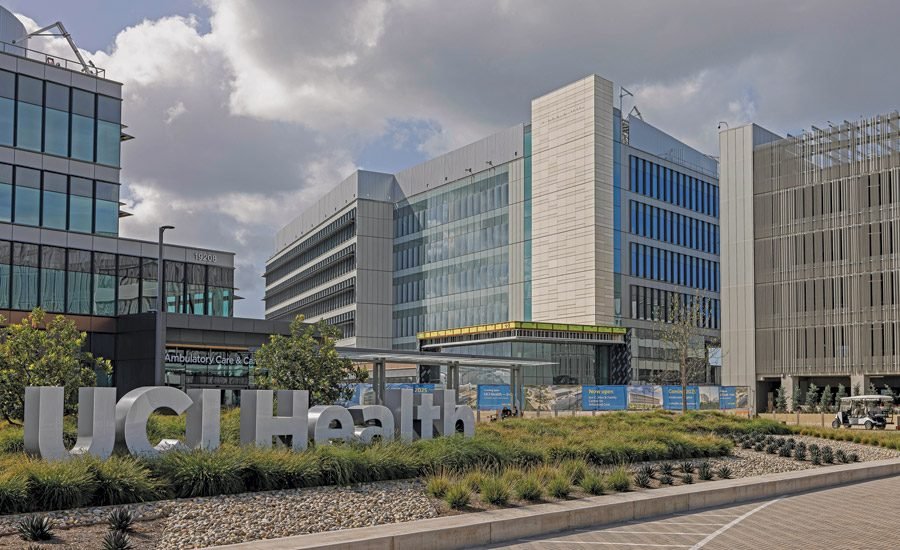
When the $1.3 billion UCI Health – Irvine Hospital & Ambulatory Care Center makes its debut this December, the project will be one of a kind. The facility, on the campus of the University of California, Irvine (UCI), will be the first all-electric, zero-emissions hospital in the country.
Brian Pratt, UC Irvine campus architect, says the project team looked at the UC system’s goal of decarbonizing its 10 campuses and six academic health centers by 2045, and “we felt an obligation to be sensitive and environmentally friendly, recognizing that hospitals are big benchmarks for energy users of the future.” hospitals.’”
This ambitious goal also created major construction challenges for the design and construction team of CO Architects + Hensel Phelps, who worked closely with UCI Health. In September, the team reached substantial completion of the project and officially handed over the ceremonial master key to UCI Health management.
The new facility will offer a 350,000 square meter specialty hospital, a 220,000 square meter ambulatory care center (ACC) and a parking structure, but the star of the show is the large 31,848 square meter central utility plant that supplies power to the entire facility.
Working with the air-source heat pumps on the central floor was a challenge because they took up about 6,000 square feet of space, says Gina Chang, principal and healthcare team leader at CO Architects. To fit things in, the team had to expand the roof area on the central floor and add a 60-foot extrusion to accommodate all the air stacks.

The energy demand of the hospital’s all-electric systems exceeds a standard installation by 10%.
Photo courtesy of CO Architects
A higher power
By their very nature, hospitals are energy intensive buildings. Apart from the fact that they are always open, they must meet higher standards in areas such as airflow, which require energy-consuming systems. According to the US Energy Information Administration, healthcare buildings accounted for 4% of total commercial space, but these buildings accounted for approximately 9% of energy use in commercial buildings.
“Our campus leadership basically said, ‘Let’s set the standard for the future of hospitals. . . .’
— Brian Pratt, Campus Architect, UCI
Pratt says the UCI project required 12 kV service from Southern California Edison (SCE). “A 22,500 kVA all-electric hospital has an electrical load roughly equivalent to 13,000 to 15,000 single-family homes, depending on the home’s energy use and local climate,” says Pratt. “The electrical load is approximately 10% greater than that of a traditional gas boiler and central cooling plant that supports a hospital.”
One of the main issues in going electric was ensuring that SCE, the electricity provider, could handle capacity, resilience, reliability and green energy. “So the first hurdle was utility,” says Pratt. “We worked for almost two years with them to build trust between both parties that this was possible. And Edison was a team player and was excited about the prospect,” says Pratt.
This year’s model
Brian Maximuk, chief operating officer of Hensel Phelps, says he saw great value in the way UCI introduced the progressive design-build model for the project and in the collaboration of this delivery method.
“I think we were able to go through 208 cost trends that were developed in collaboration with the UCI and the users to refine the budget and develop the scope and know what the end users really wanted in this project,” he says. “So we were able to validate and refine the project schedule early with accurate cost information that allowed them to make the decisions to allow things to move forward. And it was really all tied into this progressive design-build model that was very collaborative.”
Pratt says they ran a progressive design-build competition and the teams competing for the contract took the ICU concept and in about 14 weeks effectively designed the hospital that is now being built.
He says one of the defining and contract-winning features the CO Architects team came up with is a long, shared surgery platform that runs under both buildings. The platform, located on the garden floor, connects the outpatient operating theaters of the ACC building with the hospital’s inpatient operating theaters. “The platform flows like an operating theater suite, and there are great economies of scale and sterilization and humidification,” says Pratt.
The other advantage is that you’re actually saving a lot of steel weight because the columns and beams aren’t as heavy as the moment frame system, and there can also be fewer frames, says Fabian Kremkus, director of CO Architects. “So I think that was a 15% weight saving, which also reduces the biggest contributor of embodied carbon, which is steel and concrete.”

Central utility plant chillers allow the hospital to meet the high airflow standards required by the facility.
Photo courtesy of CO Architects
Game the system
Chang says the interconnected mega-floor platform that runs between the buildings is a big department and a big sterilization process.
“We’d never done that before, so we built it on the computer in a game engine called Unity,” he says. “We have a digital technology group here that does AI-generated computer simulations, and our digital designer, Nazli Tatar, designed it like a video game.” Chang says that the characters in video games are called agents, and the agents designed by his team know how to look for doors to pass through and how to find bathrooms and perform other mundane tasks.
“So we built it and ran several simulations over a year to find breakpoints. Nazli [Tatar] modeled how fast the surgeries had to be for the surgery platform to fail, which happened at 30 minutes per surgery. And 30-minute surgeries are never going to happen, and the patterned failure wasn’t even a major catastrophe.”
Because of the importance of hospital seismic safety, the team opted for buckled support frames (BRBs) instead of moment frames, which would normally be used in a facility like this, Pratt says.
“We did this because of resiliency after a major event. Access to moment frames and the type of failures in moment frames are much more difficult to deal with than braced frames,” says Pratt. “So after a major regional earthquake, we believe by using braced frames [the hospital] it will be up and running faster than we would if we had used moment frames because of the kind of research you have to do to ensure seismic safety.”
Kremkus says that after a seismic event, BRBs, which are like shock absorbers, “can be easily taken apart and new ones installed. Then a building will return to performance. For a while, you’d have to cut out sections of the beams. It’s a much more invasive thing, and you’d probably be out of service for a year instead of a few months. So”

The hospital has energy efficiency features such as automatic shading strategies and solar panels on top of the parking lot.
Photo courtesy of CO Architects
Energy efficiency
In addition to its fully electric status, the project has a number of sustainable aspects. Targeting LEED Platinum and LEED Gold ACC building status, the project integrates energy-efficient features such as automatic shading strategies, solar panels on top of the parking lot, and high-efficiency glazing and window rubs that will reduce solar heat gain by 85% and also protect against bird strike.
To incorporate the project’s location next to the San Joaquin Marsh Ecological Reserve, the team studied bird strike mitigation and provided glass that is compatible with bird strikes and also built an 18-inch high turtle fence to protect a threatened turtle species from leaving the marsh and entering the hospital grounds.
Pratt says they also worked extensively with UCI marsh managers to capture stormwater runoff.
“For the runoff, we thought they would be absolutely against anything running into the swamp, but it was quite the opposite,” he says. “The marsh is thirsty for water, so they wanted our runoff, but they needed it treated properly. And so we did. It runs into the marsh after it’s treated, and it feeds and fills the marsh.”
All in all, the integration of all the different elements required by the installation posed enormous challenges but also enormous opportunities.
“This historic achievement, delivered through ICU’s first progressive design-build project, shows how innovation, collaboration and dedicated teamwork can redefine what’s possible in healthcare construction,” says Maximuk.
