

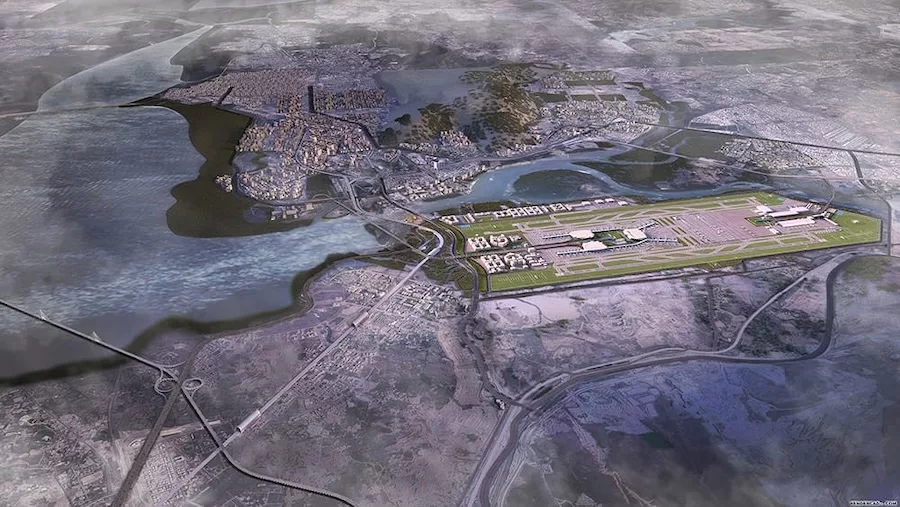
For two decades, builders at Navi Mumbai International Airport have sailed on a complex journey through environmental authorizations, land acquisition obstacles, engineering challenges and extensive community negotiations. The development of phase 1 of Greenfield Airport of $ 2.5 billion, 1,160 hectares in Ulwe is planned for the opening of the Indian Prime Minister, Narendra Modi, on September 30. Full -scale operations are expected to be expected at the end of the year, along with the launch of the construction of Phase 2.
Navi Mumbai International Airport Pvt ltd (nmial) It has a majority participation in a public-private collaboration with City and Industrial Development Corp. by Maharashtra LTD (CIDCO), the State Planning Authority of Maharashtra responsible for the acquisition of land and early infrastructure under a model of transfer of fin-bulld-finance operations (DBFOT).
The Adani group, which operates eight airports throughout India, took over the Navi Mumbai site in 2021. Phase 2 prediction activities include landwork, place services, geotechnical surveys and regulatory authorizations.
A subsidiary of the ADANI group, NMIAL, is the leading planning, the preparation of the site, the regulatory approvals and the coordination of the agencies for the new airport, according to a spokesman for Adani Airports Holdings LTD (AAHL). Currently, Phase 1 of NMIAL is 94% and includes terminal 1 with an annual capacity of 20 million passengers, a track, a air traffic control tower, load installations, support systems and integrated road connectivity.
The design of phase 1 of the NMIA was directed by Zaha Hadid Architects, based in London, with lots inspired by lotus and petal -shaped canopies that define the terminal. The L&T secured the contract for the construction of the origin of engineering (EPC), which covers the terminals, the track and the infrastructure, while its subsidiary delivered detailed engineering of phase 1. Asoka Buildcon managed the first work of the Earth and the final master plan of Jacobs Engineering included models of terminal dimensioning. Aecom was the independent engineer, supervising the planning, the methodology of construction and security. The completed south track covers 3,700 meters x 60 meters; The north track will follow in later phases.

Terminal 1 of the new Navi Mumbai International Airport is planned to start operating this year.
Photo courtesy l & t
Phase 2 of NMIAL will introduce terminal 2, increasing capacity to 25 million passengers, along with a second court, modular updates of usefulness and advanced digital and safety infrastructure. L&T is expected to play its role as an EPC and infrastructure contractor, with the design of the selected terminal through a design competition. The end is oriented by 2030.
The planned opening is a key milestone for the Aviation Infrastructure Building of the Indian Government Blitz.
Phase 2 of NMIAL has triggered more than 200 high -value tenders that cover air expansion, terminal adjustments and advanced security infrastructure, with Larsen and Tubro anchor core packages. The phase prioritizes technology improvements: personal recognition, RFID luggage monitoring, body scanners, AI -based resource planning and predictive maintenance. Sustainability measures include solar panels and rainwater collection systems.
The NMIAL site posed extraordinary engineering challenges due to its natural topography. According to an Adani spokesman, the Earth had a diverse land, including Ulwe Hill, which was once 96 m where the track is now. The engineers executed large -scale hydrological modifications and hydrological modifications, lowering the hill to 10 m through a controlled explosion, with excavated material repopulated for Earth level. At the same time, the ULWE River was diverted by 90 degrees to a 3.2 km channel for floods, supported by embankments and drainage systems. The interventions created a stable airport foundation, but triggered environmental concerns around the loss of mangles and increased flood risks in the adjacent areas. Cidco has rehabilitated nine peoples affected as part of the mitigation strategy.
The challenges of connectivity persist. South Mumbai is linked to NMIAL by Mumbai Trans (MTHL) port connection. However, northern Mumbai accesses hinges in the next projects, especially $ 1.8 billion line, an Express airport runner covers 35 km (25.8 km high, 9.25 km underground), which will connect Adani-Chattrapati Shivaji Maharaji International Airport (CSMIA) to NMIAL. Developed jointly by the Development Authority of the Metropolitan Region of Mumbai (MMRDA) and CIDCO, the project is provisionally oriented to its completion for completion for the end of 2029.
Recently renamed DB Patil Navi Mumbai International Airport to pay tribute to the activist who defended the rights of displaced farmers, the installation It leads an adjoining development, including a planned aerocity and a 375 -hectare corporate park with residential, hospital and business nuclei. Cidco also leads the notified city initiative of the notified city of Navi Mumbai of $ 2.4 billion to align the regional urbanization with the airport -oriented growth. As part of this expansion, $ 400 million has been issued for $ 400 million for main planning, public-private collaboration, mobility updates, tunnel waterproofing, useful city networks and smart city systems. Additional offers cover plots for hotels, convention centers and mixed use spaces.
