

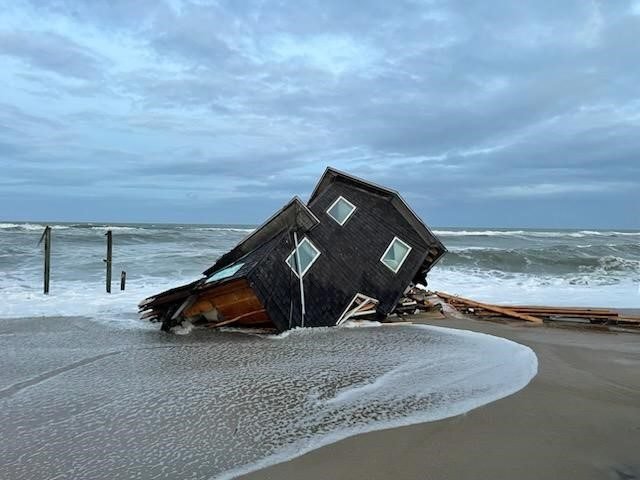

As the Atlantic Ocean continues to eat away at expensive beachfront properties in Rodanthe, North Carolina, and flooding intensifies across the United States (in coastal, riparian, and even urban areas), an emerging ecosystem of businesses is stepping in to fill the impact knowledge gaps that the federal government has been unable to fill.
Raleigh, North Carolina-based Natrx is now working with the North Carolina Coastal Federation to develop an analysis of the state’s 4,000 miles of coastline. Using artificial intelligence and remote sensing technologies, the effort will study ecological changes in both wetlands and coastlines.
Meanwhile, global water and climate risk intelligence firm Fathom is providing flood risk data to the Virginia Department of Conservation and Recreation as part of the state’s efforts to develop a flood protection master plan, which is expected to be completed by the end of 2025. Fathom is a unit of reinsurer and insurer Swiss Re, which acquired the British company3 in Zurich.
The companies say they are providing information that the Federal Emergency Management Agency has not traditionally offered under existing statutory frameworks. FEMA does not typically assess the risks associated with flash flooding, and its mapping associated with fluvial flooding of rivers and inland water bodies is more limited, especially in rural areas, according to multiple sources.
But FEMA maps go through a rigorous public review process, notes Meg Galloway, senior policy adviser for the Association of State Floodplain Managers. Data provided by different vendors can be useful when used properly, but each has its own strengths and limitations, he says, adding that because agency maps undergo a public process, “they are legally defensible.”
FEMA conducts base-level engineering to determine where to focus its efforts, and it’s usually in the locations that are at the highest risk, Galloway told ENR.
How to map a coastline
Jacob Boyd, saltwater program director for the NC Coastal Federation, notes that North Carolina has never had maps with the kind of data Natrx is collecting. The goal, he says, is “to have the vision necessary to direct resources where they will have the greatest impact.”
Natrx Chief Operating Officer Tad Schwendler adds that with limited resources, having accurate data will help decision makers focus on funding the projects most critical to protecting human safety and health. “These kinds of problems are acute, and North Carolina is a good example of that. But this is happening all over the country, all over the world, and we think there needs to be more work like this, this work of resilience and restoration,” he told ENR.
The North Carolina team will use a combination of multispectral and remote sensing data, including Sentinel L2A satellite data, aerial imagery and LiDAR from the National Oceanic and Atmospheric Administratio Digital Coast Program. “These sources allow us to quantify erosion, analyze wetland change, and model carbon distribution with a high degree of precision over large-scale areas like all of eastern North Carolina,” Schwendler said.
The North Carolina analysis is part of a larger effort funded by the US Environmental Protection Agency and led by the Atlantic Conservation Coalition, which also includes state governments in Maryland, South Carolina and Virginia, as well as the Nature Conservancy, Coastal Federation and 18 other organizations.
Planning for the future
In June, Fathom was awarded a contract to provide current and future statewide stormwater, river and coastal flood data to the Virginia Department of Conservation and Recreation to inform a flood protection master plan in partnership with Arcadis. According to the latest from Virginia hazard mitigation plan, anticipates about $13 million in annual damages from flood-related events.
Arcadis project director John Millspaugh said in a statement, “Consistent data across localities is essential to developing a meaningful statewide plan that addresses data gaps and allows comparison across regions.”
Gavin Lewis, Fathom’s head of engineering, said in an interview with ENR that the company, which boasts that it has already mapped much of the nation’s watersheds and coastlines, aims to complement what FEMA is already doing. “There’s a lot of good data from FEMA, but there’s a significant proportion that’s … 15 to 20 years old,” Lewis said. “We’re able to provide this contemporary view of flood risk for people to analyze and have a much clearer understanding at the scale they need for flood impact,” whether it’s communities or property.
