


Clint R. Williams
Company manager
Turner Construction Co.
The construction effort in California’s Central Valley is often overlooked because of the large amount of activity in the state’s coastal urban centers. San Francisco, for example, is expected to see more than $16 billion in starts this year, compared to $2.1 billion in the Fresno area, according to Dodge Data & Analytics.
The difference is that the recent volatility seen elsewhere has been mostly absent in the Central Valley. Fresno is quietly enjoying a boom that is expected to continue. Dodge expects new starts to top $2.5 billion by 2026, up 44% from the previous two years.
A key factor, Williams explains, is a strong waiting list for projects such as a large-scale Fresno County justice project slated for 2027.
“The Fresno AEC community is concerned about securing design and construction funding for priority projects that have been debated and delayed for years,” he notes.

Graph by ENR
Nonresidential buildings are expected to fuel the lion’s share of planned starts with volume nearly doubling between last year and 2026. Also notable are health care projects such as medical outpatient buildings, emergency department expansions and $100 million-plus seismic upgrades that are planned or recently completed, Williams notes.
By 2022, Dodge had just $6 million in health care startups for the region. That number should exceed $91 million this year.
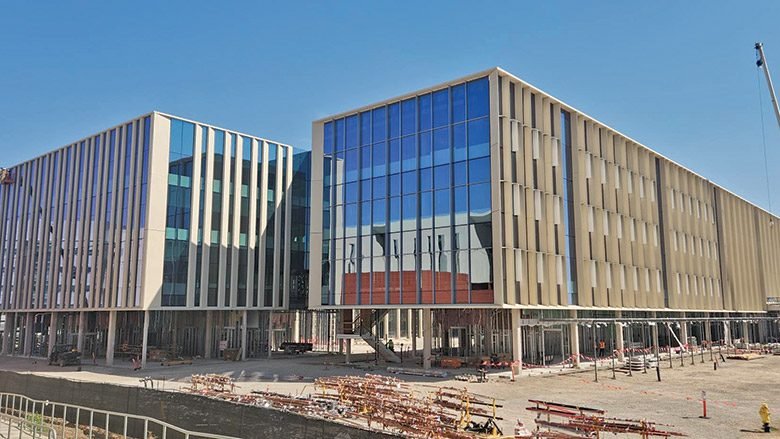
A good example is the $300 million UC Merced Medical Education Building that Turner is halfway through building through a construction manager’s at-risk delivery. Designed by architecture firm ZGF, the facility, which is expected to be completed next fall, will feature 203,500 square meters of instructional offices, academic offices, research and community-oriented spaces and common areas. The building will be part of UC Merced’s medical education program developed in partnership with UCSF and UCSF Fresno.
The education market remains strong with student housing projects at Fresno State and UC Merced currently under construction and more education projects planned from local bond measures passed in 2024. Private developments of department stores and distribution centers also continue to drive the private sector construction market throughout the region.
There are also multiple new tribal casino projects, ranging from $200 million to $600 million, planned or under construction.
“[The Fresno region] differs from the rest of California, which is often technology-led and has a more robust private sector and developer-led market,” says Williams.
The region has remained stable with selective activity in key public sectors such as large-scale heavy civil infrastructure, roads and highways, healthcare, education and the private casino market. As long as the economic outlook is positive, these sectors are expected to remain robust.
Across the state, the popularity of design-build delivery has been growing, and the boom in major projects in the Central Valley is also driving the trend in the region, Williams says.
“Public sector owners are planning or considering delivery of their larger and more complex projects using a design-build delivery method,” he says. “This trend is based on past project performance and delays that owners want to mitigate through a single design-build contract entity.”
Another commonality with the wider construction industry is ongoing supply chain challenges and long procurement lead times, along with volatility in material costs and rates.
“This impact has hurt the private sector more than the public sector, with developers pausing or even considering canceling projects until economic and market conditions improve,” he says.
Another major question mark is the state’s beleaguered high-speed rail project, which centers on the Central Valley, where the initial 171-mile segment between Merced and Bakersfield is being built.
Earlier this year, the Trump administration withdrew $4 billion in funding for the effort and is in the process of directing some of those funds to other projects. The $35 billion project is now $7 billion underfunded. The state has launched a legal effort to recover that funding, but is also moving to shore up some spending with state funds.
Still, construction continues on nearly 70 miles of guideway and about 60 structures.
