

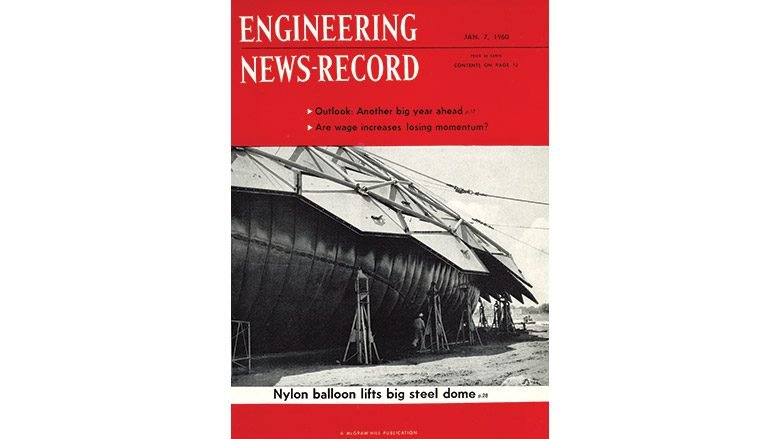

This 1960 cover depicts a huge nylon bag raising a 384-foot-diameter steel geodesic dome, the largest pneumatic erection operation up to that time.
The dome, which consisted of 893 hexagonal welded steel panels, structurally supported on the outside by a lattice of 6-inch-diameter pipe struts, weighed more than 500 tons.
The nylon diaphragm, which was 1⁄33 inch thick, was attached to the bottom of the cap in a circle 175 feet in diameter, and air was forced into the diaphragm through an underground tunnel.
During erection, the pressure was maintained at 1.45 ounces per square inch, only slightly above atmospheric pressure.
At this pressure, 90% of the dome’s weight was supported by air, with the remaining 10% resting on hydraulic jacks, which helped stabilize the dome and prevent it from “floating”. In addition to the jacks, 10 wire ropes prevented lateral movement during strong winds.
A net of 326 ropes hung from the bottom of the dome by the bag at 3-foot intervals, cradle. During lifting operations, the dome rose at a rate of 1 inch every 30 seconds.
Designed by architect and inventor Buckminster Fuller, the dome was fabricated and erected by Graver Tank & Mfg. co. for its parent company, Union Tank Car Co. It served as a railroad tank car repair and maintenance shop in Wood River, Illinois until 2019.
Looking for quick answers on construction and engineering topics?
Try Ask ENR, our new intelligent AI search tool.
Ask ENR →
