

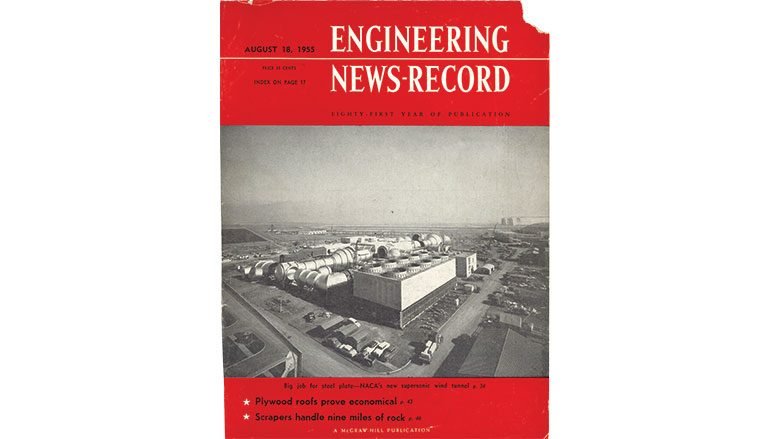

This 1955 cover shows a supersonic wind tunnel under construction at the Ames Aeronautical Laboratory in Mountain View, California.
Now known as the Ames Research Center, it has been a major NASA research center since the agency’s founding in 1958.
The Ames Unitary Plan wind tunnel was designed for aerodynamic research, with air speeds in the transonic and supersonic ranges, up to 3.5 times the speed of sound. Wind tunnel circuits are huge steel ducts that follow rectangular planes.
Diameters vary from 20 feet to 70 feet and steel thickness ranges from 0.5 inches to 4.5 inches. It was made of 15,000 tons of heavy plates of low carbon steel that had good welding characteristics.
Cylindrical sections of steel plate were joined by automatic welding while slowly rotating, but much of the welding was done by hand. The welds were inspected by X-ray and magna flux, and the finished shells were vacuum tested.
The foundation was a challenge, as the underlying strata near San Francisco Bay consisted of alluvial fill and bay mud. About 1,700 piles were sunk to an average depth of 48 feet. Chicago Bridge & Iron Co. was a general contractor.
It remains NASA’s most widely used wind tunnel. All major commercial aircraft, most military aircraft, the Mercury, Gemini and Apollo spacecraft, as well as the space shuttle, were tested there.
Looking for quick answers on construction and engineering topics?
Try Ask ENR, our new intelligent AI search tool.
Ask ENR →
