

Science is always evolving, but many scientific jobs are stuck in the past.
According to a recent CBRE report titled “The next generation of the scientific workplace”, laboratories and research facilities have not changed much in the last 50 years. (This was when the first floppy disk was released, for context.)
Paul Janssenswillen, head of Scientific Projects at CBRE and co-author of the report, says updating old laboratory designs involves thinking about the future. “You want a future-proof space that you can change as organizations change, technologies and processes change, something that can easily adapt.”
Janssenswillen takes us back to the original design of scientific workplaces. “There are two elements to the R&D (research and development) facility,” he says.
“There’s the lab, which we all know is the place that houses the equipment… to generate data to back up theories and explorations. The other part is where all the time is actually spent, which is just office space.”
That was then and (in many cases) now.
But the CBRE report predicts big changes to science jobs in the coming decades.
Greater adoption of cloud-based computing, AI cobots (collaborative robots), and digital twin technology (a virtual model of a real system) will allow experiments to be controlled from anywhere on the network.
“At some point, the lab doesn’t need to produce data in the same place as the scientists,” says Janssenswillen. In the future, laboratories and offices will not have to be located on the same campus.
In the short term, however, “modular and agile workplace solutions are cornerstones in the movement to adapt to evolving team needs in a matter of days,” the report says.
This more adaptable and flexible “next normal” will lead to more innovation across disciplines as scientists come together in workplaces that foster creativity and collaboration.
Traditional science labs versus solutions adaptable to the workplace
Traditional laboratories were built for focused research and functional needs. The solo scientists each worked on desktop experiments. And some scientific workplaces still reflect this repetitive approach to design.
“Some companies are still very conservative (with) individual prep spaces for individual biologists or individual fume hoods for individual chemists,” explains Janssenswillen.
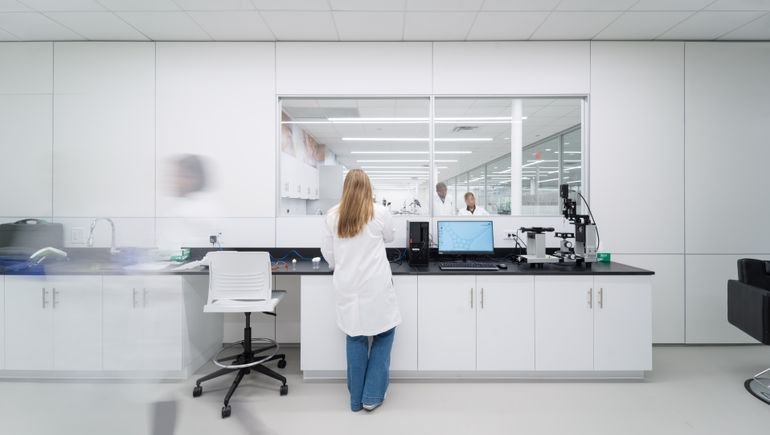
According to the CBRE report, however, the modular labs are “designed to be adaptable and reconfigurable to suit a variety of research needs.” This is something Saquib Butt knows all about. As Senior Vice President of Infrastructure and Assets at SmartLabs, he sees the benefits of prefabricated and modular lab spaces every day.
SmartLabs’ mission is to accelerate the pace of science through a variety of services for a custom lab space, and they consolidate interior construction and off-site manufactured components such as walls, doors and furniture. “If you take all of this and pre-fabricate it in a factory and basically bring it to the site and deploy it in a day or less, it’s a big win,” he says.
Even without advances in AI and cloud computing, today’s lab model benefits from a modular construction approach. Imagine a company doing cell gene therapy research in a bio lab and not flinch. With venture capital funding increasing by the minute, they need to focus on chemical research.
“They want to change their workflows and their science within this space now, without going through a full design and build. We’ll take the existing modular system and reconfigure it the way they want, which is a huge benefit for these companies because they don’t have to shut down their existing research and look for a new space to design and build.”
The same thing happens in the academic world. Whether it’s a chemistry lab or an educational lab (what Butt would call a dry lab), using adaptable interiors makes a lot of sense for educational institutions so they can meet changing needs quickly and simple
“Basically we can show them how to design a life science infrastructure in a flexible way that meets their demands. And the advantages of reconfiguration with this modular system is definitely a plus for them.“

SmartLabs cutting-edge innovation space at Boston Landing
SmartLabs
Make a connection
Collaboration is also an increasingly important element of modern scientific workplaces.
“The year of the generalist is gone,” says Janssenswillen. “Scientists (have) deeper knowledge in a narrower field, so their need to integrate with other technologists, engineers and other scientists is even greater. The need for collaboration and multidisciplinary teams becomes more important”.
As a result, the report found that “transitional spaces have expanded, ranging from break rooms and lounges to other places where researchers can relax and collaborate outside the lab.”
Here, people make organic connections. As Janssenswillen says, “no technology will replace face-to-face communication.”
In fact, the report found that US patent citations dropped as remote work increased and fewer face-to-face meetings took place. Even casual meetings with colleagues in person can foster innovation.
The report also found that the positive emotions of well-designed emotional environments “not only elevate individual performance, but also drive organizations to achieve peak performance.”
Carbon reduction and delivery time
As technology advances, modular labs make equipment easily reconfigurable and adaptable to various experiments as well as other evolving needs, obviating the need for so much renovation, the report said.
This includes sustainability goals. According to Butt, a modular approach to laboratory construction offers a 20% carbon reduction over a conventional process. “There’s a big green component to this modular system that I think people don’t know about or take for granted,” says Butt. “Everything is recyclable.”
Ultimately, as the very nature of laboratory spaces changes, the need for flexibility remains.
According to the report, if the space is flexible by design, it will “allow teams to build new infrastructure and upgrade old systems quickly and efficiently,” whatever the future may demand.
