

The Gateway Development Commission said March 23 that this year’s federal funding freeze cost the Hudson Tunnel Project millions to keep sites idle, disrupted production and delayed the awarding of major contracts, and could force construction to shut down again within months if payments fall behind.
Gateway’s head of program delivery, Jim Shays, said the project is operating on a short financial track despite the release of more than $254 million in overdue federal reimbursements.
“If the federal government doesn’t continue to disburse the funds for the project, we’re going to have to stop construction again in two to three months,” Shays told commissioners.
The effects of the roughly two-week shutdown are still unfolding.
Shays said Gateway “spent millions to secure and maintain construction sites” during the roughly two-week shutdown and is still quantifying those costs with contractors.
Court filings from New York and New Jersey indicate that those costs can rise, with site security, equipment maintenance and field operations running into the millions per week during a shutdown, and total demobilization running into the tens of millions depending on the length and accounting for final costs.
He added that hundreds of workers lost pay and production slowed even before the shutdown as uncertainty grew.
Looking for quick answers on construction and engineering topics?
Try Ask ENR, our new intelligent AI search tool.
Ask ENR →
The outage delayed major construction phases. Two major construction packages, the Hudson River Tunnel and the New Jersey Surface Alignment, were expected to move forward in 2026 but have not yet been awarded because of uncertainty over continued federal payments, Shays said.
This uncertainty is now affecting procurement timing, compressing the window to move forward on major tunnel packages without introducing downstream inefficiencies. Taken together, these impacts show that funding disruption is no longer just a legal dispute, but is beginning to affect construction sequencing, the contract schedule and overall project delivery.
Public officials warned that projects of this magnitude “cannot be stopped and resumed at the flick of a switch,” and that each interruption introduced a new cost and schedule risk.
RELATED
Gateway Hudson Tunnel work resumes even as funding uncertainty increases
Labor advances, but sequencing risks remain
Despite the disruption, Gateway officials reported continued progress on critical work fronts.

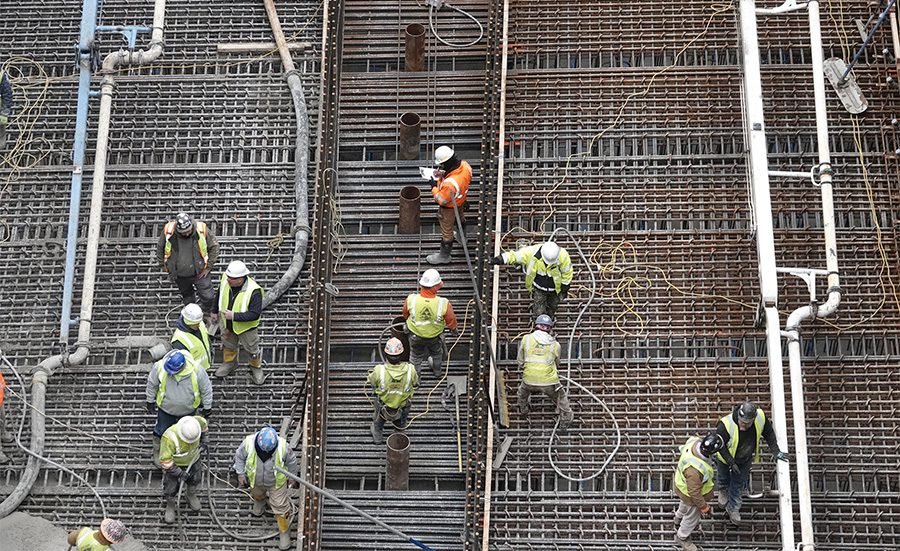
Crews install reinforcing steel for a structural member near a TBM launch area as ground work on the Gateway Hudson Tunnel project progresses in March 2026.
Source: Gateway Development Commission
At the Tonnelle Avenue site in North Bergen, crews have begun assembling the first TBM, with components for a second one arriving. A second machine from German manufacturer Herrenknecht AG is also arriving as crews prepare to fully drill the tunnel.
On the Weehawken side, the slurry wall of the Hudson County Access Shaft has been completed, allowing excavation to begin. In the Hudson River, soil stabilization using cofferdams, deep soil mixing and grout injection is approximately 70% complete.
On the Manhattan side, crews have placed more than 11,000 cubic meters of concrete in the Hudson Yards shell, with ongoing wall construction and recent pours adding another 2,000 cubic meters for the tunnel floor slab.
These activities align with previously awarded packages that are progressing toward tunnel boring, including the excavation of the Manhattan side and the Palisades rock tunnel—approximately 5,100 feet of twin tunnels with a 25-foot, 2-in. diameter: led by Frontier-Kemper Constructors Inc./Tutor Perini Corp. JV and Schiavone Dragados Lane JV.
The disruption also affected construction crews, who must now manage workforce continuity, staging and sequencing of equipment amid uncertain reimbursement cycles. Other active packages include river bed stabilization led by Weeks Marine Inc. and the first works related to the Tonnelle Avenue Bridge and the relocation of utilities, delivered by a Naik Consulting Group/Conti Civil LLC team to support the launch of the TBM.
Labor and industry representatives said the outage exposed vulnerabilities for workers and contractors on a project that depends on steady monthly repayments. Robert Campos, vice president of Laborers Local 472, said nearly 100 union members were fired during the stoppage, with broader impacts on the workforce if the disruptions continue.
“What doesn’t shut down ongoing projects, and shouldn’t shut down projects like Gateway, are political issues,” Campos told the board.
RELATED
Federal funding freeze threatens to halt $16 million Hudson Tunnel project
The legal battle moves to long-term certainty
The reboot follows legal action by Gateway and New York and New Jersey after the Trump administration halted funding tied to a review of hiring practices.

Federal refunds totaling more than $254 million were released in February and early March 2026 following legal action by New York and New Jersey, which restored cash flow to the Gateway Hudson Tunnel Project.
Source: Gateway Development Commission
Gateway’s head of federal affairs, Rob Hickman, said a federal court found the government breached its contracts by withholding roughly $205 million in payments, though those claims were dismissed after the funds were released through separate state litigation. Two remaining claims linked to the construction pause remain pending.
New Jersey Gov. Mikie Sherrill (D) told commissioners that New York and New Jersey will return to court on April 16 to seek an injunction to keep the payments and a final ruling barring the federal government from withholding funds again.
The project is expected to provide approximately 95,000 jobs and generate nearly $20 billion in economic activity, according to the testimony.
The new tunnel will complement and enable the rehabilitation of the 115-year-old North River Tunnel, a critical choke point in the Northeast Corridor.
Although Gateway is back to full construction, Shays and other officials made it clear that the project is now operating on a compressed schedule tied directly to federal reimbursement cycles.
“Funding for the nation’s largest and most urgent infrastructure project cannot be threatened every time Donald Trump decides to break the law,” New Jersey Gov. Mikie Sherrill said as states prepared to return to court on April 16 to seek a final decision to ensure uninterrupted payments.
