

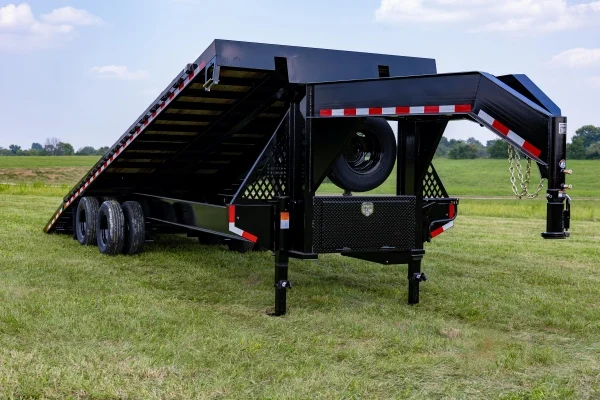
Gooseneck trailer with tilting deck for transporting heavy equipment and vehicles
If you’re moving heavy equipment, hauling vehicles, or running a haulage business, a tilt-top gooseneck trailer is one of the most practical solutions you can invest in. The main reason is simple: it makes loading faster, safer and much more efficient compared to traditional ramp trailers. Instead of dealing with loose ramps, alignment issues, or safety hazards, the deck tilts and creates a smooth loading angle. This means less setup time, fewer errors and a much better experience for operators who need reliability every day. For B2B buyers, especially in construction, logistics and automotive transportation, this is not just a feature. It directly affects productivity and operating costs.

What is a tilt deck gooseneck trailer
Definition and logic of real work
A tilt deck gooseneck trailer combines two proven designs into one system that solves real hauling problems. The tilting platform allows the trailer bed to tilt down for loading, while the gooseneck hitch connects directly over the rear axle of the tow truck. This combination is widely used in heavy transport because it improves both loading efficiency and driving stability. In actual use, this type of trailer is preferred when loads are heavy, valuable or require frequent loading and unloading.
Why the gooseneck design changes everything
The gooseneck connection is not just a different style of attachment. It fundamentally changes how the weight is distributed. Instead of pulling from the rear bumper, the load sits on the truck’s axle, which reduces sway and improves control. If you’ve ever towed a heavy load on a bumper trailer, you know how unstable it can feel at highway speeds. With a gooseneck configuration, the trailer follows the truck more naturally, especially during turns and braking. This is why professional haulage companies almost always choose gooseneck trailers for heavy duty applications.
How the tilting roof system improves loading efficiency
No hassles, no guesswork
The most immediate benefit you will notice is the elimination of cramps. Ramps are often the weakest point of traditional trailers. They may shift, bend, or require manual adjustment. A tilting platform eliminates all of that. The platform itself becomes the loading ramp. This is especially useful when loading vehicles with low ground clearance or heavy machinery that requires a stable angle. Simply tilt the cover, load the gear and return it to a flat position. This process reduces loading time and significantly reduces the risk of accidents.
Hydraulic vs gravity tilt in real use
There are two main tilt systems, and choosing the right one depends on how often you use the trailer. A hydraulic tilt system gives you full control. You can adjust the angle precisely, which is important when dealing with expensive equipment or uneven loads. Gravity tilt systems are simpler and require less maintenance, but rely on weight distribution to function. For commercial users who load equipment daily, hydraulic systems are often the best choice because they provide consistency and reduce operator effort.
Key components that define performance
Axles and load capacity
Axle configuration is one of the most important factors when choosing a tilt deck gooseneck trailer. Most models use tandem or triple axles because they can handle higher loads and distribute the weight more evenly. A tandem axle configuration is suitable for medium to heavy duty applications, while triple axles are designed for extreme loads such as construction machinery or industrial equipment. The more evenly the weight is distributed, the more stable the trailer becomes during transport.
Braking and safety system
Braking is another critical factor that should never be overlooked. Depending on your region and load requirements, trailers typically use electric or hydraulic braking systems. Electric brakes are common and easy to control, while hydraulic systems provide stronger stopping power for heavier loads. Choosing the right braking system ensures compliance with regulations and improves overall safety during transport.
Where Tilt Deck Gooseneck Trailers Are Used Most
Construction and transport of heavy equipment
In construction, time is money. The team must move quickly between jobs without delay. Tilt deck gooseneck trailers are widely used to transport excavators, skid steers and wheel loaders because they allow quick loading without additional tools. The stable structure also reduces the risk of equipment shifting during transport, which is critical when dealing with high-value machinery.
Car transport and commercial transport
For vehicle transport companies, especially those dealing with low-profile cars, the tilting deck design prevents damage during loading. Sports cars, racing vehicles and luxury cars usually have low ground clearance, which makes ramps risky. A tilt platform provides a gentler angle, reducing the chance of scraping. This is one of the reasons why many professional transporters prefer this type of trailer.
Steel vs Aluminum: Which Should You Choose?
The choice of material directly affects durability, cost and long-term performance. Steel trailers are stronger and better suited for heavy duty work. They can withstand higher stress and are more resistant to impact damage. Aluminum trailers are lighter and more resistant to corrosion, which can be beneficial in coastal or wet environments. However, they usually have a higher cost. For most commercial applications, steel remains the preferred choice due to its strength and reliability.
Conclusion
A tilt deck gooseneck trailer isn’t just another piece of equipment. It is a tool that directly improves the way you work. From faster charging to better road stability, every design element is built around efficiency and safety. If your business depends on reliable transportation, choosing the right trailer will have a direct impact on your productivity and cost control.
Frequently asked questions
What is the main advantage of a tilt deck gooseneck trailer
The biggest advantage is that charging is easier and safer. You don’t need ramps, and that alone eliminates one of the most common pain points in everyday transportation. The tilt platform creates a smooth loading angle, which is especially important when dealing with heavy equipment or vehicles with low ground clearance. Combined with the gooseneck design, you also get better balance and stability while towing. For businesses that load and unload frequently, this directly saves time and reduces operational risk.
It’s a better tipper than a ramp trailer for heavy equipment
In most real-world scenarios, yes. A tilting deck trailer is more efficient because it simplifies the loading process and reduces manual work. With ramp trailers, you often need to adjust the ramps, align the equipment carefully, and deal with unstable angles. A tilting platform eliminates these problems. For heavy equipment like skid steers or excavators, the smoother transition also reduces stress on both the machine and trailer structure.
How do I choose the right load capacity for my trailer?
Start by identifying the heaviest equipment or vehicle you want to transport, then add a margin of safety. It is not enough to match the exact weight. You should always choose a trailer with a capacity greater than your maximum load. This improves safety, extends the life of the trailer and prevents overloading problems. For commercial users, it is common to select tandem or triple axle configurations to handle higher weight requirements more reliably.
What is the difference between hydraulic tilting and gravity tilting
Hydraulic tilting systems give you full control over deck movement. You can adjust the tilt angle precisely, which is useful when handling expensive or uneven loads. Gravity tilt systems are simpler and rely on weight distribution to function, which means less maintenance but also less control. If you own a business and use your trailer frequently, hydraulic tilting is often the best investment because it improves efficiency and reduces operator effort.
A tilt deck gooseneck trailer can handle long distance hauling
Yes, and this is actually one of its strengths. The gooseneck design distributes the weight over the axle of the towing vehicle, which improves stability at higher speeds and during long trips. This makes it a preferred choice for logistics companies and professional carriers. When properly loaded and maintained, a tilting deck gooseneck trailer performs very well on highways and long distance trails.
What maintenance is required to keep the trailer in good condition
Regular maintenance includes checking tire pressure, inspecting the brake system, lubricating moving parts, and making sure the hydraulic system is working properly if equipped. It is also important to clean the trailer after use, especially if it has been exposed to mud, salt or harsh environments. Simple routine checks can prevent major problems and significantly extend the life of your trailer.
Personalization is necessary for B2B buyers
In most cases, yes. Standard trailers may not fully match your actual working conditions. Customization allows you to adjust dimensions, axle configuration, cover type and additional features such as winches or tool boxes. For businesses, this isn’t just about preferences. It directly affects efficiency, safety and how the trailer fits into your daily operations. Choosing a custom solution often offers better value in the long run.
