

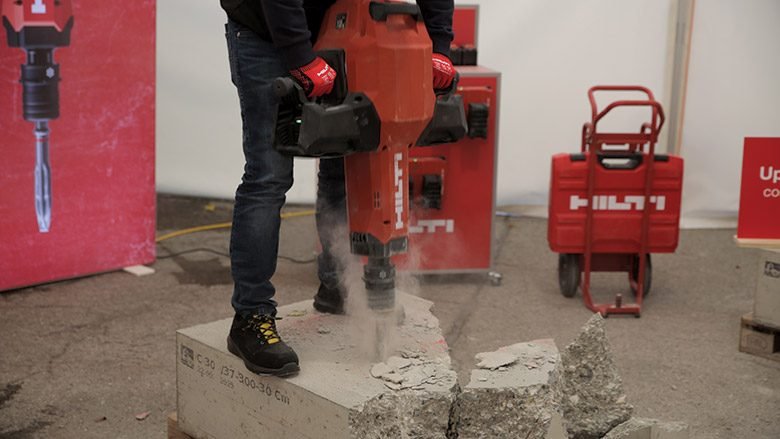
When Hilti announced its Nuron battery platform in 2021, there were open questions about whether its commitment to a single 22-volt battery format would hold as it moved into more demanding applications typically dominated by corded and gas tools. The tool maker has responded with 60 new heavy-duty tools in cutting, breaking and drilling applications that can all run off their existing Nuron batteries.
Addressing more demanding tool categories, without introducing rugged batteries, was always Nuron’s goal, says Ewald Kaluscha, Hilti’s global head of marketing and senior vice president of power tools and accessories. “When we first launched Nuron in 2021 and 2022, we thought a lot about how this electrical and mechanical interface that connects tools and batteries should be designed to be future-ready,” he explains.

Nuron’s new battery-powered band saw delivers constant power throughout the charge.
Photo by Jeff Rubenstone/ENR
In the new line are several tools that would normally have trouble getting through a shift on a battery. Metal drill, concrete and cut-off saws tend to lose their bite after a few holes or cuts, but Hilti has worked hard to maintain productivity until the Nuron’s battery runs dry.
ENR tested several of them along with breakers and angle grinders at a Hilti event recently and found that the tools held their power through the battery cycle. Associated dust control systems, whether vacuum hoods for portable drills or water-based systems for cutting drills also work on the Nuron platform, eliminating the need to juggle multiple batteries around the site. And the Nuron-powered TE 3000 Cordless Hammer Drill has about the same breaking power an operator can handle, all with the same batteries as the smaller tools. Hilti also showed off the TE 1000 portable concrete breaker that works on Nuron, which could be used in conjunction with its EXO-S exoskeleton, which transfers the weight of the tool to the operator’s hips. The platform allows the operator to drill at waist and shoulder height without putting the full weight of the tool on their arms, reducing overall fatigue.

Silica dust is captured using vacuum or water-based systems that also run on batteries.
Photo by Jeff Rubenstone/ENR
Battery Tech opens new horizons
While this current Nuron expansion is going after some of the most demanding gas and corded tool categories, Kalushcha says there’s even more on the way. “There’s still room to take it even further,” he says, citing recent developments in battery cell technology to improve power density and reduce waste heat.
“With the chemistry we use inside the battery, we’re seeing such rapid improvements, especially in the last two years, that along with a [tool] A ready interface to take that energy and put it into the tool, the chemistry is getting so much better that with the same package size you can double, or maybe in the future triple, what’s inside,” he notes. And greater battery power means the hassle of setting up on-site power for corded tools or having fuel for gas equipment just isn’t worth it after a certain point.
And preparing its tool offerings is a natural fit for Hilti, Kaluscha adds, since the previous battery standard lasted 25 years. “There’s so much on the horizon that a tool-battery interface from the 1990s wasn’t enough now. We’ve put so much effort into Nuron that we want to see them out there for another two decades.”
