

Marsia Geldert-Murphey’s first construction job was working on a bridge over the Mississippi River. She was excited to get out in the field, but the job didn’t have a seat belt small enough for her.
“I had to hold the seat belt with one hand because it wouldn’t fit around my waist,” he said. “I took an even greater risk trying to use the safety equipment available at the time.”
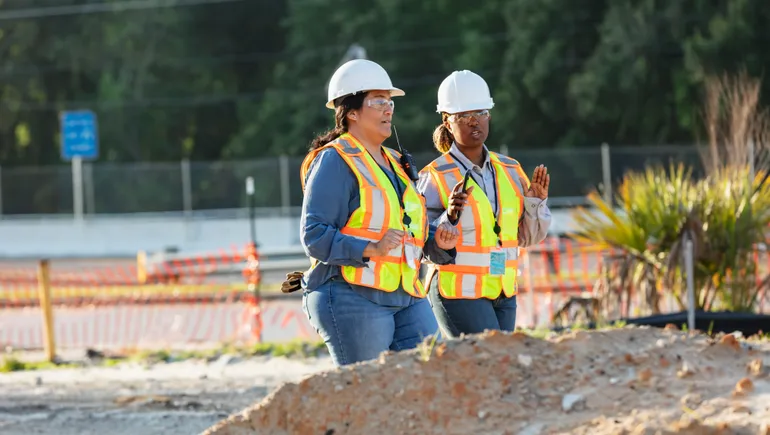
Geldert-Murpheynow president of the American Society of Civil Engineers, said such a situation would be unthinkable now, with about 1.2 million women working in construction, according to the Bureau of Labor Statistics. That’s about a tenth of the industry’s workforce.

Marcia Geldert-Murphey
Courtesy of ASCE
As the labor shortage continues to drag on, the exclusion of women, whether intentional or not, continues to hamper efforts to fill open positions, which the industry is working to address.
But change is happening.
For example, Geldert-Murphey noted that, for the first time in its 117-year history, ASCE’s board of directors has more women than men.
When it comes to the workforce, “as the demand has increased and the supply has reflected a better percentage of what our actual population looks like, things will change organically, but we still have pockets where we just have to really stand up for ourselves. everyone,” he said.
Visibility and legacy
In 2021, leaders at Jacksonville, Fla.-based Superior Construction began talking about what more the company could do for the women who worked there, in part because company owner Nick Largura asked why people assumed he would bring his son into the business, but he never did. asked by the daughters.
After a series of round tables, she created the group of Senior Women in Construction. The initial pilot group, which launched in 2022, included a dozen women who developed a mission statement, a vision for the group, and a list of the types of issues they wanted to address.

Scott Witt
Authorization granted by Superior Construction
“They want to be a talent pipeline for women in construction,” said senior financial officer Scott Witt, who helped start the group. They now have more than 20 members.
This work includes outreach to the local community with efforts to bring more women into the industry.
“If you’re a young woman in high school who’s thinking about a career in construction, we want our initiative to be so strong that they say ‘I’m going to call Superior and see what they can do to help me,'” she said. she said, whether that young woman goes straight into the workforce or college.
The initial pilot group developed a mentoring program, where all women were paired with a senior executive. It has been so successful, Witt said, that it serves as a model for expanding to other types of employees.
“They want to have an impact on the whole organization, not just the women,” she said. “They want to be an integral part of our global leadership and development plan.”
Towards a good idea
DPR Construction, based in Redwood, California, has created initiatives by listening to what its female employees see as pressing needs. To start, the company has made changes to its hiring process to diversify who is involved in recruitment efforts in the community and part of the hiring process, so potential candidates can see themselves working there.

Gretchen Kinsella
Permission granted by DPR
“We’re intentional about where we’re hiring and who represents us on our hiring team,” said Gretchen Kinsella, leadership team member and business unit leader for DPR in Arizona. “We want people from diverse backgrounds in the community to tell our stories.”
DPR also has an annual women’s golf tournament, which was created after internal discussions revealed that women did not feel comfortable in some golf environments, which were considered a male-dominated world of networking. Eight years ago, DPR began to address this by offering golf lessons.
Now, women and design clients also attend, an idea that started “all to create a safe place and environment that can be an intimidating place,” she said. “They can create connections and give that level of networking for someone like me who felt like I was missing out.”
The golf outing now has close to 90 attendees and male employees get involved by playing caddies.
Making women feel like they belong in construction can be part of a larger effort to help people from other underrepresented communities feel welcome, Kinsella said.
“Gender may be seen and felt more quickly by many, but inclusion in general is really important to create a safe and thriving environment” for everyone, she said.
Welcoming the next generation
Despite the huge gender gap in construction, things are changing fast thanks to younger workers.
“Each semester it recruits more women into the program,” said Angela Smith, a professor in the construction science program and faculty advisor for the Women in Construction student organization at the University of Tennessee Knoxville. “It’s encouraging that women are finding the program and realizing that construction management is a good place for them.”
The UT Knoxville Women in Construction group launched this semester with about 30 members.
“They are still members and actively support the building science club which represents everyone, but there was a need and an advantage to have something tailored for women,” she said.
The group’s goals include networking with other women in construction, in jobs other than their main one. This includes engineers, architects, lawyers, entrepreneurs and managers of local branches of construction companies.
“They want to create a much larger network of support and communications tailored to the students in the program,” Smith said.
Smith thinks women will continue to enter the field in increasing numbers as they see people who look like them working there, but also because attitudes about what women can do are changing.
“I think what’s really happening is a radical change in our culture, where parents and grandparents treat their daughters and granddaughters the same way they would treat their own sons and grandsons. They’re showing them how you fix this, how you move it, or they go out and work together,” he said.
Those parents and grandparents who own construction companies are just as eager to bring the girls along as the boys.
“I have a lot of very proud parents who come with their daughters-to-be students and I’m so proud that their daughter is going into construction,” he said.
