

This audio is automatically generated. Please let us know if you have any comments.
Imagine inserting a 20-foot-tall, two-foot-wide slice of bread into a gigantic toaster, while it’s hanging from a crane and winds are blowing 10-15 mph, causing it to sway.
This was the problem with PCL Construction.
“This big piece of formwork, this 25-foot square, essentially becomes a sail as the wind picks up on it; it starts to spin,” said Jared Rasula, project manager for the $250 million PCL. McCarrons water treatment plant improvements in St. Paul, Minnesota. “It gains momentum, and at 10,000 pounds, that momentum is hard to stop, especially if your only means is to grab a rope hanging 30 feet below and try to stop it.”
The project began in 2022 as part of a progressive design and construction effort between PCL, which has its US headquarters in Denver, and Magney Construction, which is based in Chanhassen, Minnesota. It consists of building foundations, erecting external walls and placing roofs.
“This artifact is George Jetson stuff”
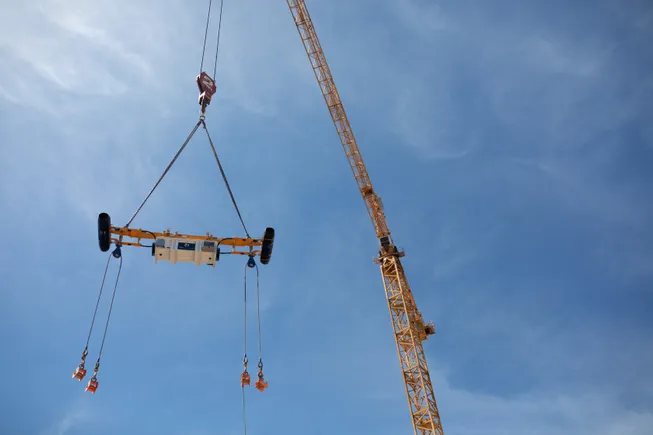
The problem with shapes swaying in the wind at work led PCL to Vita Industrial’s Load Navigator, a semi-autonomous propulsion-driven device that hangs under the crane’s hook.

Vita’s Load Navigator stabilized panels like this during construction amid windy conditions.
Permission granted by PCL Construction
Broomfield, Colo.-based Vita says the team uses sensors to measure 1,000 data points per second to detect real-time load changes, such as those caused by wind. It then uses high-powered fans to eliminate twists, wobbles and rotations. Clayton Schneider, another PCL project manager, described it as a “spreader bar with jet engines.”
Using the device, which has an adjustable spreader bar that expands in two-and-a-half-foot increments, the team was able to position and control the loads as they descended.
“On windy days, it allows us to hold position and doesn’t start spinning in the air,” Schneider said. “That allows us to pre-program it and drop it exactly where it’s supposed to go, without worrying about this thing going out of control and hitting someone or hitting other equipment or equipment.”
The remote control interface includes different buttons: turn left, turn right, clockwise, counter clockwise, hold position and the ability to set presets for certain repetitive lifts. The device also allows for automatic retention, which keeps loads positioned even in difficult conditions; dynamic speed control, which affects the speed of rotation of the load; and a standby mode.
“This artifact is George Jetson stuff,” said Mike Weber, PCL’s project superintendent.
Get started
After seeing the device at a trade show, PCL began leveraging Vita Load Navigator in the summer of 2023. Vita trained PCL workers on how to use the technology over the course of a day.
PCL bought the technology for about $150,000 and said factors such as delivery and a trial period play a role in the cost, the company confirmed. Schneider estimated the technology could save thousands to tens of thousands of dollars.
Rasula said that after using the equipment, the PCL team saw a 30 percent increase in efficiency, which he tracked through crew productivity.
Eliminating wasted time was also a crucial factor. Schneider said that during the initial testing period, the company faced three days in which high winds would have stopped the device from working, if not for the device.
For his part, Superintendent Weber believes that it is a tool that will have rapid adoption in the sector.
“It’s pretty cool technology,” Weber said. “Everybody will have to have it eventually. We have it, and the next one doesn’t. We do it for cheaper. Pretty soon everyone has it, right? You want to keep up.”
