

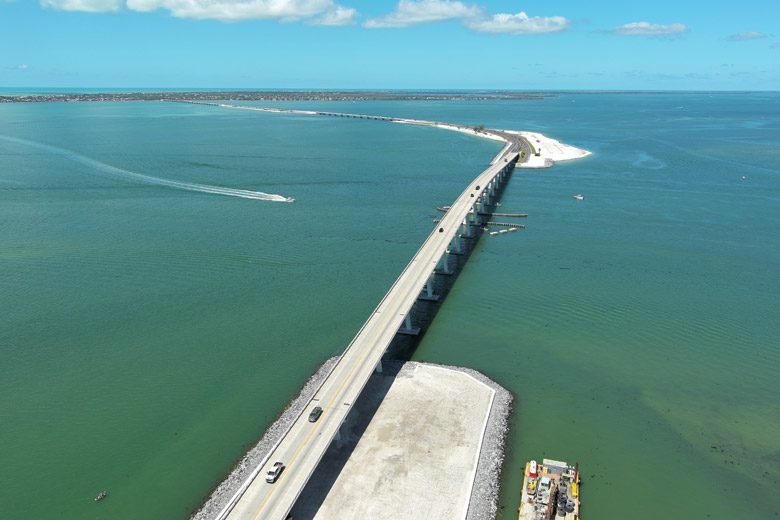
Hurricane Ian Sanibel Access Project
Sanibel, Fla.
Project of the Year Finalist and Road/Bridge
Sent by: Superior-de Moya joint venture
Region: Texas and Southeast
Owner: Florida Department of Transportation
Principal Design Firm/Civil Engineer: Kisinger Campo and Association
General contractor: Superior-de-Moya
Structural Engineer: H&H (Hardesty and Hanover)
High winds, storm surge and the collapse of the coastal corridor made rebuilding the Sanibel Causeway one of Florida’s most demanding infrastructure efforts in decades. With the only road connecting Sanibel and Captiva cut off by Hurricane Ian, the team mobilized quickly and executed with precision, applying specific design adjustments and a delivery model designed for speed to rebuild a 75-year-old corridor that has stood firm through multiple storms.
The roadway is the only access route for residents, workers, emergency services and millions of visitors each year. When Ian made landfall on September 28, 2022, the Category 4 storm washed away approaches and embankments, isolating more than 6,400 residents. The Florida Department of Transportation issued an emergency contract assigning Superior Construction, in partnership with Ajax Paving, to stabilize the corridor and restore temporary access. Despite washed-out roads, restricted staging areas and widespread power outages, crews worked around the clock and reopened the route in 15 days, two weeks ahead of schedule.

Crews work to rebuild the Sanibel Causeway after the destruction of Hurricane Ian in 2022.
Photo courtesy of Superior Construction
The emergency work, however, revealed deeper vulnerabilities. The original 1963-era design was based on mechanically stabilized earth (MSE) walls and embankments that could not withstand hydrostatic pressure and wave action. A full reconstruction was necessary, prompting FDOT to switch the corridor to phased design construction, its first use of the method for a catastrophic event. The permanent rebuild was awarded to the Superior-de Moya joint venture, which combines Superior’s heavy civil and marine capabilities with the coastal and structural expertise of the Moya Group. Work began in September 2023, backed by $51.6 million in state funding approved earlier this year.
Senior Construction Area Manager Toby Mazzoni says two first decisions proved critical. The first was to treat emergency repairs as permanent infrastructure from day one, eliminating the need to remove temporary structures later. The second was the change from traditional MSE walls to a steel pile system with king pile technology. “The sheet steel pile system was not just replaced by MSE walls,” he says, adding that it was deployed to stiffen the roadway and protect substructures and bridge approaches, an area informed by the use of advanced CIRCulation and wave simulation coastal modeling.

Photo courtesy of Superior Construction
The permanent reconstruction was substantially completed in 105 days, meaning that the full structural reconstruction was completed and the corridor was ready for traffic. Crews installed 750,000 square feet of steel sheet piling, raised levees to 8 feet from 5 feet, rebuilt embankments, added drains and shore lines reinforced with 127,996 tons of stone. The elevation of the road was increased to improve storm performance and advanced drainage systems were installed to reduce long-term maintenance needs.
The work required careful coordination with weather, tides and sea traffic. Crews operated from barges and temporary platforms in changing wind conditions, sequencing operations to maintain access while progressing pile installation, shore shielding and road reconstruction. The phased design approach allowed FDOT and the contractor to issue advanced work packages and refine design elements as construction progressed.
The 2024 hurricane season became the project’s first major testing ground. The completed sections withstood the direct impacts of Hurricanes Debby, Helene, and Milton with minimal damage, affirming the modeling-driven decision to switch from traditional MSE walls. Although the unfinished areas saw washout, the hardened features performed as intended. “During these three hurricanes, the steel pile wall systems, elevated roadway profile and marine mattress protection performed as intended, a real confirmation of the design team’s decisions,” says Mazzoni.
Looking for quick answers on construction and engineering topics?
Try Ask ENR, our new intelligent AI search tool.
Ask ENR →

Photo courtesy of Superior Construction
The project also brought ecological and community benefits. In 2025, the Sanibel-Captiva Conservation Foundation recorded the most successful nesting season for lesser tern seabirds on the causeway islands since the 1990s, marking the third year of a steady upswing. Black skimmer seabirds also returned, as did economic activity, with carriageway traffic reaching 82% of previous levels and overall business recovery reaching 74% by the end of 2025.
“This corridor is built to handle what’s coming,” Mazzoni says. “The systems we put in place are doing exactly what they were designed to do, and will continue to protect this link for years to come.”
