

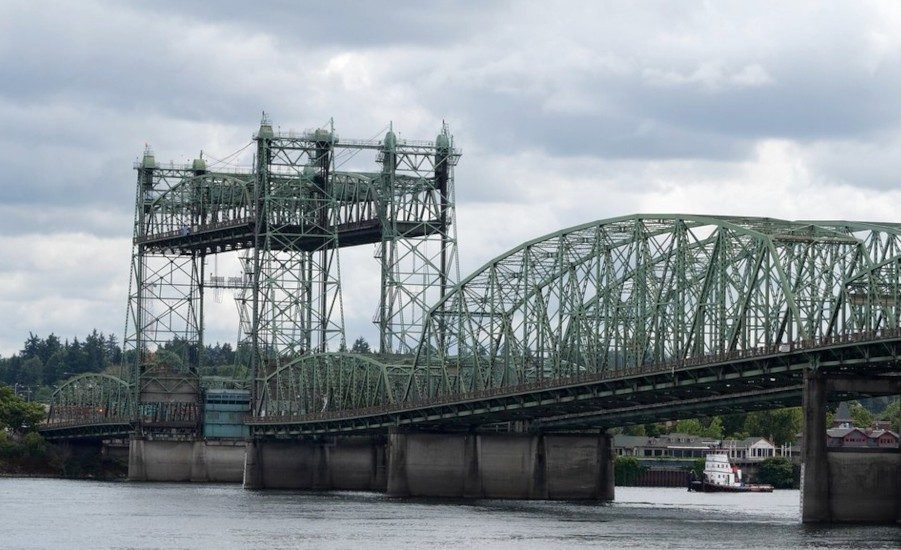

The Oregon Transportation Commission reprimanded Interstate Bridge Replacement (IBR) program officials Jan. 22 for keeping the project’s rapidly escalating preliminary cost estimates from public view. Commissioners questioned the feasibility of the project amid growing concerns that the $6 billion price tag could more than double before construction begins.
Still, the effort to replace the Interstate 5 bridge that connects Washington and Oregon across the Columbia River continues. A Jan. 19 decision by the US Coast Guard approved a fixed bridge design, and the IBR plans to issue a request for proposals to contractors in late 2026.
Funding remains the central challenge. The most recently published cost analysis for the five-mile IBR program dates to 2022 and ranged from $5 billion to $7.5 billion, with $6 billion often cited. An August 15, 2025 consultant report prepared for the IBR estimates that costs have doubled to at least $12.2 billion and could reach $17.7 billion. The report’s fixed bridge estimate is closer to $13 billion.
Carley Frances, interim administrator of the IBR program, said the estimates haven’t been fully revised and she doesn’t expect updated numbers until March 2026. She acknowledged to the commission that “costs will definitely go up,” reflecting construction inflation across the country.
The four-member commission openly questioned whether the project could go ahead because of the project’s high costs.
RELATED
The Interstate 5 Columbia River Bridge project secures a $1.5 million federal grant
“I just don’t see a $12 million to $16 million project being viable,” said Commissioner Lee Beyer. “I worry about the numbers jumping so far so fast. If those numbers are right, there’s no way we can do this project. There’s just no money.”
Transparency concerns
Beyond the funding issues, commissioners slammed IBR leadership for not disclosing the new estimates. While the 2025 consultant’s report was circulated internally, it was not publicly discussed or shared with the commission during meetings late last year when the commission asked pointed questions about the budget.
Joseph Cortright, a Portland economist and critic of the project, obtained the report through a public records request. The Oregon Journalism Project later reported on the findings, alerting commissioners to the project’s spiraling costs.
“Let’s be really honest here,” commission chairwoman Julie Brown said to Frances and Ray Mabey, assistant administrator of the IBR program. “It’s a shock to us to find out how we did it. You’ve put us all in a bad situation. Staff shouldn’t be trying to hide anything.”
Frances, who had been in office for nine days at the time of the Jan. 22 meeting, said the document was part of an internal workshop process and stressed that more analysis is needed, especially since the fixed bridge design was not approved until this month. She declined to discuss specific cost figures.
Baker said the information presented for the second half of 2025 was outdated, adding that the IBR continued to refer to economic valuations based on an estimate of $6 billion without acknowledging that internal projections showed costs doubling or more.
RELATED
California Accepts Funds for Vincent Thomas Bridge Upgrades and Other Stories
IBR officials said the Coast Guard’s approval of a fixed bridge with a 116-foot navigation span allows the program to proceed with a final environmental impact statement as it moves toward a record of decision tied to a Sept. 30 federal grant modification deadline.
IBR plans to announce updated cost estimates in March and has moved to a design-build phased delivery model. Frances said the approach will allow for early contractor involvement rather than building risk premiums into bids. Mabey said the IBR can issue a request for qualifications before the formal RFP, and he already knows of at least two teams forming, with a possible third, more interest than expected under the previous delivery model.
Baker said without additional funding from the two state legislatures, the IBR must operate within existing financial commitments. More than $4 billion has already been committed through federal grants and credits from Oregon and Washington, not including toll revenue that is expected to exceed $1 billion.
The project has received a $1.5 million Federal Highway Administration Bridge Investment Program grant, a $600 million US Department of Transportation Mega Grant and a $30 million Reconnecting Communities grant awarded in 2025 to the City of Vancouver and the Washington State Department of Transportation for improvements linked to the IBR program.
Federal grant funding would be lost if construction does not begin by 2026.
