

The pace and volume of new construction activity in the Orlando metro area should increase markedly in 2026, with Dodge Data & Analytics forecasting $15.6 billion in new contracts moving forward this year.
In particular, Dodge expects across-the-board increases in its three major construction categories, with the volume of non-residential starts forecast to increase by about $500 million to a total of $4.6 billion. Meanwhile, the residential sector is expected to see a boost of nearly $1 billion by 2026, for an estimated total of $8.75 billion.
In its nonbuilding category, Dodge sees nearly $2.3 billion in new starts by 2026, with “other public works” the only declining category.
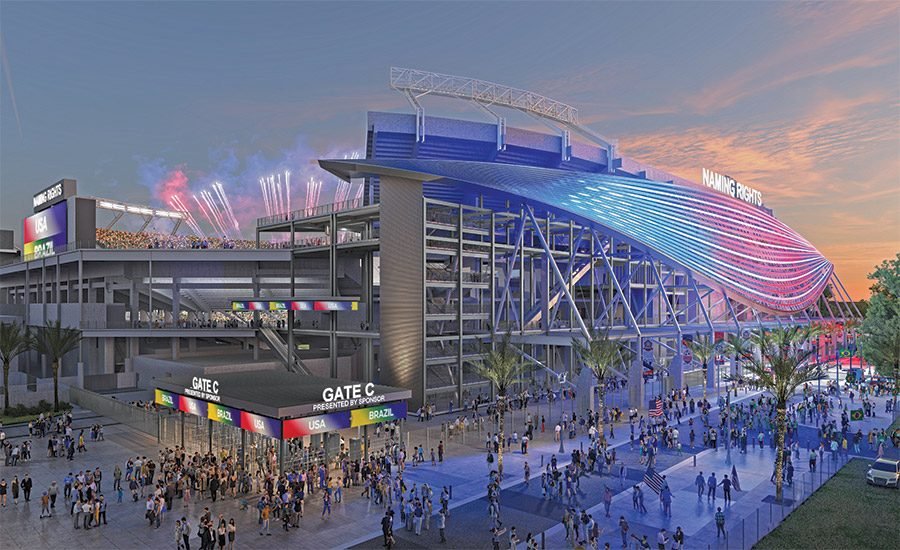
One of the largest and most high-profile projects currently moving forward is the latest redevelopment of Camping World Stadium in Orlando, with construction led by a team of Barton Malow Builders and AECOM Hunt, with DLR Group as the architect. Key stakeholders include the City of Orlando, Orlando City Locals, Orange County and Florida Citrus Sports.
With this $400 million contract, the largest investment in the stadium’s history, the redevelopment aims to modernize the venue into a facility capable of hosting college football playoff games and major concerts.
The project is expected to generate approximately 1,500 construction-related jobs over its duration, with up to 400 workers on site during peak periods.

“This $400 million renovation represents a large-scale modernization of a nearly 90-year-old stadium that has been in continuous use,” says Len Moser, vice president of Barton Malow.
During this contract, contractors will rebuild the east and west upper terrace levels and add improved concession and restroom facilities, a new north end zone tower with premium amenities, flexible south end zone seating for concerts and major events, and better entrances and vertical circulation.
Another notable addition to the stadium will be its new metal exoskeleton, which the project team describes as also serving as “hurricane reinforcement, providing protection against Florida’s severe weather conditions.
The project’s website describes the exoskeleton feature as a “transformational [that] it enhances the structural integrity of the stadium while presenting a contemporary and robust appearance.”
For the Barton Malow-AECOM Hunt team, “the primary challenge is executing this scale of transformation within an existing structure,” says Moser.
“Coordinating demolition, reconstruction, and new systems within an active site requires careful phasing, sequencing, and collaboration, which the team is addressing through early coordination, detailed phase plans, and close integration among all partners,” adds Moser.
The objectives of the project are to “maximize [the] seating mix” to include a minimum of 65,000 seats, improve stadium functionality, upgrade superior seating, elevate the fan experience and modernize and improve stadium systems.
Delivering this project in an already busy construction market is a challenge. Moser says the project team is taking steps to address this critical issue.
“There are still significant opportunities, especially for complex projects that require experienced teams.”
—Len Moser, vice president of Barton Malow Builders
“The Orlando market continues to be very active, so there is competition for skilled labor,” he says. “However, the size and duration of this project provides stability that is attractive to commercial partners, and early workforce planning has been key to sustaining progress.”
Looking beyond this big project, Mosers says the greater Orlando area continues to offer additional opportunities for contractors.
“Central Florida continues to be a strong and active construction market,” he says, “especially in sports and entertainment, hospitality, education and public infrastructure.
“There are still significant opportunities, especially for complex projects that require experienced teams and disciplined execution.”
Overall, Moser says, “construction activity in Central Florida is expected to remain steady” due to continued population growth, tourism investment and ongoing infrastructure upgrades.
“The market will continue to reward projects that are well-defined, properly financed and carefully executed, with an increasing focus on upgrading existing facilities rather than new ground-up developments,” says Moser.
