

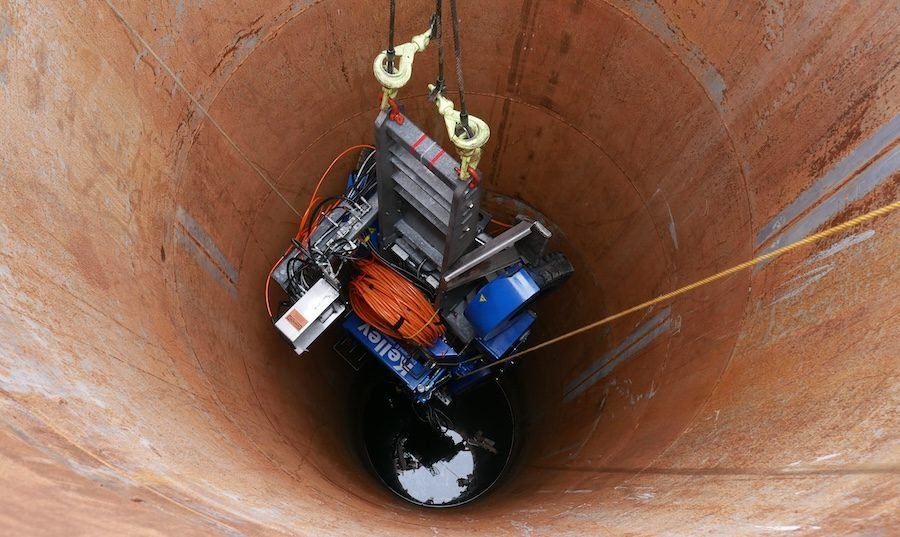
A project nearing completion in the Detroit area used a custom-built, diver-operated vehicle that can operate underwater and replaced concrete linings with two raw water tunnels, eliminating the need for dewatering and diversion or extended outages.
The The diver-powered liner plate installation vehicle is a 25-foot-long modular electric-on-hydraulic conveyor called the BURT, for Ballard Submarine Ring Transporter. Ballard Marine Constructionpart of the Traylor Constructor Group, led a team that developed and tested BURT on land and in the OH Hinsdale Wave Research Laboratory at Oregon State University before deploying it in 2022 to a 12-foot-diameter cast-in-situ concrete tunnel constructed in the 1930s and a 10-foot-diameter tunnel from the 1950s. The tunnels have precast primary segments and an unreinforced secondary lining, and are owned by the Great Lakes Water Authority..
BURT completed liner installations last fall, following three years of October-April construction windows. The approximately $90 million progressive design and construction project is scheduled for completion this spring with final grouting operations.
“Originally we were going to design-bid-build,” says Todd King, GLWA’s director of resilience. “We would have dewatered the tunnels, we would have taken the treatment plant out of service and we would have done it little by little.” But after learning about the possibility of avoiding it, the agency switched to PDB.
The tunnels are about 95 feet below grade in soft clays and silts. Inspections had found cracks severe enough that a loss of pressure inside the tunnel posed a structural risk, said Shawn Drobney, Ballard’s principal engineer.
Ballard worked with Kelley Engineered Equipment to develop BURT. “They said, we have this interesting problem: We want to try to reline this tunnel without draining the water out of it,” recalls Matt Short, Kelley project engineer. The team brought the Norwegian firm Innova, which specializes in solutions for high voltage underwater hydraulic machines.
“It’s basically a forklift, but it works underwater with humans around it,” says Short. “How do you make a safe toaster underwater? We went back and forth with them on how to protect BURT with a line isolation monitor. On the hydraulic side, how do we keep it at a higher pressure so water doesn’t get into the machine?”

Photo courtesy of Ballard Marine Construction
At the site, BURT was lowered via an 8-foot-diameter access shaft and reassembled in the 95-foot-deep reverse. “The water in the winter is around 33°F,” Drobny notes. “Divers were 1,800 feet from repair sites with limited time frames.” Crews built tents over the manholes and heated them, he says.
A deep dive
A technical brief written by Ballard and co-authored by Drobny describes the process. BURT’s main body houses a deepwater hydraulic power unit with a custom bladder accumulator, a programmable logic-controlled electrical system sealed in a nitrogen-filled vessel, and an onboard roller with more than 1,100 feet of 3/4-in. umbilical cord to feed and communicate from the surface, says Drobny.
Four independently driven hydraulic wheels provide positive traction; the system can hydraulically “lock” the units so that the 20,000-pound vehicle is safely secured during peak flows. Two onboard cameras and eight LED lights feed two underwater monitors at the operator’s station. “Underwater cameras and monitors for divers were critical to our success,” says Drobny.
A pre-installed bright orange cable centerline in the inverted tunnel allows navigation down to half an inch to avoid contact between the liners and existing concrete walls of the tunnel.
At the front workstation, divers were able to raise and lower two rings, raise the assemblies horizontally, and make complex axial and rotational adjustments to align with the circumferential screw patterns of the custom-designed liners. The HPU delivers 3,000 psi at just over 9 gpm and allows divers to operate two hydraulic tools simultaneously. The vehicle’s payload capacity exceeds 9,000 pounds, allowing the transport and placement of two full rings (approximately 7,500 pounds of liner plate) per trip. These two liners allow a total of 9 feet of tunnel liner installed per tunnel trip.
Ballard’s engineering team developed a stainless steel liner designed for a hydrostatic head of 95 feet and a service life of 50 years, grouted in place. Each ring consists of three 120° curved plates, which are 54 inches wide and have flanged and bolted longitudinal and circumferential joints for repeatable and inspectable assembly underwater. Integrated screws and dedicated grout ports allowed for balanced and sequenced grouting. Bulkhead rings at 50-foot intervals subdivide the stages of grouting and protect water quality throughout the operation.
BURT’s electrical circuits are protected by a line insulation monitor that trips the power in milliseconds if the insulation is compromised. The lighting system includes three hours of battery backup; The two air bottles mounted on the vehicle provide each diver with up to three additional hours of breathing air in the event of an emergency.

Photo courtesy of Ballard Marine Construction
After practicing in a model tunnel on land, the team tested BURT in a 324-foot-long, 12-foot-wide, 15-foot-deep wave channel at the university. “We went from a pencil drawing to OSU in 10 months,” says Drobny.
Full-scale mock-ups and testing informed details such as a symmetrical plate geometry that allowed for multiple positions, joint refinement, and a patented screw sequencing plan that standardizes the diver’s tasks.
Ultimately, “there were days … where we placed four rings in an 8-hour shift,” says Drobny. Between the two tunnels, about 13,000 feet were repaired.
“We want to do more projects like this,” says Short. “There are many water pipelines in the US where it is a potential solution versus building a new tunnel.”
