

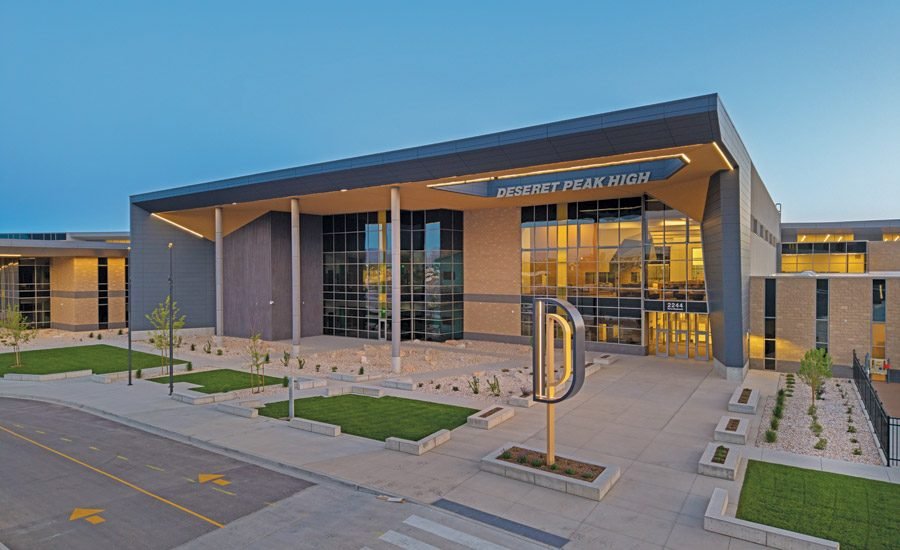
Deseret Peak High School
Tooele, Utah
BEST PROJECT, K-12 EDUCATION
Presented by Hughes General Contractors
owner Tooele County School District
Leading design company VCBO
General Contractor Hughes General Contractors
Structural Engineer Reaveley Engineers
MEP engineer A&B Mechanics
A combined tilt-up and CMU structural system proved to be a strategic solution to several challenges of this two-story high school in Tooele, Utah, combining modern educational design and advanced construction techniques to achieve an iconic aesthetic.
“Deseret Peak High School represents a new learning model for the Tooele County School District, with a focus on collaboration, flexibility and adaptability,” said Michael Garcia, the district’s director of construction. “Every part of the building was planned to support how students and teachers interact today and evolve as education changes over time. The design encourages teamwork and shared learning through flexible classrooms and group spaces.”
One of the team’s priorities was the prudent use of the public bond funds that made this project possible, which meant focusing on durable, low-maintenance materials like precast concrete panels, tiles and polished concrete floors, Garcia adds.
“Thanks to strong collaboration between the district, design team and contractors, the result is a facility that is efficient to operate and maintain, built to last and ready to serve Tooele County students for generations to come,” he says.

Deseret Peak’s football stadium has a wing-shaped canopy, similar to the one at the front of the high school, that provides shade and shelter for sports fans.
Photo by Alan Blakely
Location of the site
This unique high school spans 340,000 square feet on a 45-acre site that slopes roughly 60 feet from the southeast to the northwest corner, says Mark Spence, project executive for Hughes General Contractors.
“Through careful consideration and planning with the design team, we were able to help orient the building to follow the natural contours of the site,” he says. “By creating a retaining wall and separating the building into a three-story section and a two-story section, we were able to maximize the use of the existing grades and reduce our cut and fill on site.”
During initial design, the team realized that a FEMA floodplain encroached on about 7 acres in the northeast corner of the site, affecting the original plans. Working in close collaboration, the design and construction team reconfigured the site to its current 45 acres, leaving everything undeveloped from the FEMA floodplain to the east.
“We were still able to provide football, soccer, baseball and softball fields and six tennis courts. We were also able to balance the site to reduce the amount of transportation by placing and grading excess soil in the undeveloped area,” adds Spence.
The building itself is mainly composed of three types of structure: load-bearing masonry block, structural steel and tilting concrete. Large portions of the hallways and common areas have exposed polished concrete floors and much of the joint space extended over 150 feet.
But sourcing materials proved difficult as lead times and costs increased in the run-up to the project breaking ground in April 2022. Spence recalls that lead times for joists and decks were just 14 months.
“We worked with the design team to shift gears and use more structural steel beams instead of joists and decks, greatly reducing the procurement time. However, we still needed joists in some places and issued an early procurement bid package to accommodate these deadlines,” says Spence. “Also, we worked closely with the school district to find storage facilities for other long-lead products. We had warehouses full of materials not only to control delivery, but also to reduce price increases that were changing dramatically.”

Located above the school’s common/lunch area is a flexible work and collaboration space that provides students with natural light and expansive views.
Photo by Alan Blakely
A masterpiece tilted upwards
One of the main reasons the school has a combined tilt and CMU structural system, in addition to schedule and cost savings, was to address the regional shortage of available labor. This allowed work to continue, even with the limited workforce available.
“The concrete tilt-up construction in particular is also unique, where the walls exceed 80 vertical feet and weigh over 155,000 pounds. These tilt-up walls are identified as some of the tallest tilt-up panels in the state of Utah, and there are 275 individual tilt-up panels in the project,” says Spence. To support these structures, “Hughes also developed a proprietary floor system called MagicSlab, a spread-joint concrete floor system,” he adds.
The combination of lean and masonry also provided the institute with acoustic advantages, durability and design flexibility.
Rather than bother with cladding, paint, or other means of hiding these structural elements, the design team decided to prominently expose the upward sloping structural concrete in key interior spaces.
“Every part of the building was planned to support the way students and faculty interact today and to evolve as education changes over time.”
—Michael Garcia, Director of Construction, School District of Tooele County
However, with unpainted and patchless tilt-up panels serving as both structure and finish in the 1,200-seat auditorium, student common area and athletic facilities, ensuring meticulous finishes on the first pour was critical. As a result, each panel had to meet rigorous aesthetic and structural standards on first placement, without relying on patches or cosmetic adjustments.
“The unique design of our custom three-dimensional tilt shapes and integral panel color provide a look that has not been achieved in the industry,” says Spence.
This custom cladding system eliminated almost all visible joints, even at panel corners, creating the visual effect of massive, monolithic walls. In the end, the walls gave the impression of being single-cast concrete elements, despite being tilting walls.
Ensuring the proper installation of these massive elements required extensive planning, highly detailed shop drawings and carefully choreographed lifting sequences, which helped ensure safety and precision throughout the erection process.
“We were able to complete this project on time [and] cleanly, with little or no impact to students and teachers. Additionally, we were able to stay under budget,” says Spence, noting that key strategies included early bid packages, material warehousing, strong schedule management, material procurement management and material selection processes.
Construction was completed in May 2025, and the facility is already providing a positive and healthy learning environment for students and faculty, Spence says. “Previously, some of the students had stayed in laptops, but now that this new institute has been built, they have better classrooms and resources,” he says. “The new Deseret Peak High School will allow for future growth.”
