

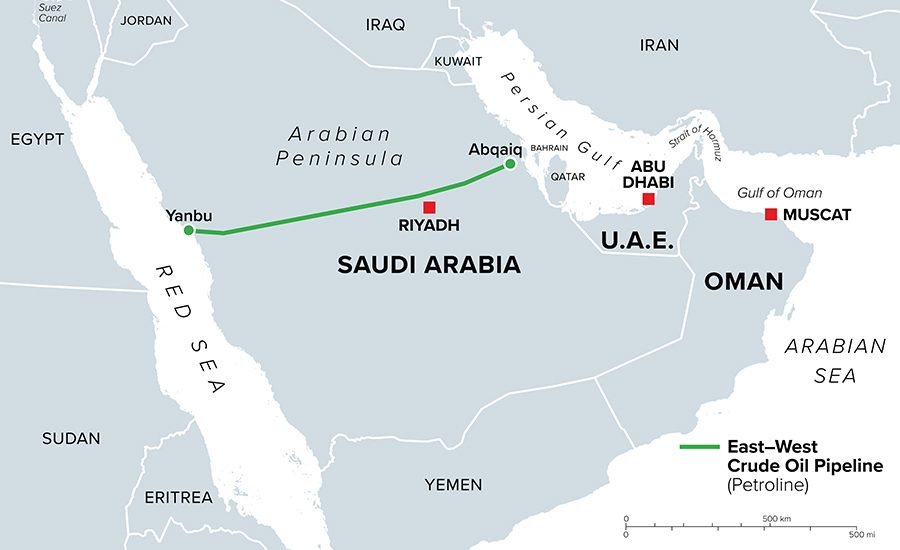

Saudi Arabia’s state-run news agency confirmed on April 9 that the country’s East-West pipeline, also known as Petroline, had been attacked and that a pumping station along the 1,200-kilometer pipeline was damaged on April 8 afternoon, just hours after a two-week ceasefire reportedly agreed to by the US and Iran.
The Saudi Press Agency cited Saudi Energy Ministry sources as saying that damage to a pipeline pumping station resulted in a loss of approximately 700,000 barrels per day of production.
The SPA also noted that attacks on production facilities upstream of the Manifa and Khurais oil fields have also affected output, reducing the kingdom’s output by 600,000 barrels per day.
The East-West pipeline was built during the 1980-1988 Iran-Iraq war, when the two countries were engaged in the “tanker war,” which involved attacking each other’s oil tankers as they moved out of the Persian Gulf. Petroline runs from Abquaiq processing facilities and oilfields in eastern Saudi Arabia to facilities in Riyadh and the west.
Wary of being a target during that war, Saudi Arabia chose to build a pipeline running from its prolific oil fields in the east to the western port of Yanbu in the west, which is on the Red Sea. Since then, the Yanbu and al-Jubail area has become an important heavy industrial region.
Iran’s forced closure of the Strait of Hormuz at the mouth of the Persian Gulf has restricted 20% of the world’s supply of crude oil and other petroleum products. To address this situation, Saudi Arabia increased throughput through Petroline, and in doing so, has eased some of the strain on achieving global supply balance.
Petroline has an enhanced capacity to transport about 7 million bpd through various pipelines to the Yanbu processing and export facilities.
Looking for quick answers on construction and engineering topics?
Try Ask ENR, our new intelligent AI search tool.
Ask ENR →
Any serious disruption to the flow through Petroline could wreak further havoc on oil prices. Only a few tankers have traveled through the strait in recent days, and Iran has demanded a toll of about $2 million for tankers from friendly nations before allowing them through.
A ceasefire mediation session between the US and Iran is now underway in Islamabad, Pakistan.
Over the course of the war, which began on February 28, Saudi Arabia and all other Gulf Cooperation Council (GCC) members Kuwait, Bahrain, Qatar, the United Arab Emirates and Oman have suffered Iranian missile and drone attacks targeting energy facilities and public services.
Saudi Arabia’s Ras Tanura refinery on the Gulf Coast was targeted by drones on March 2, and debris from the intercepted drones caused fires at the refinery that temporarily halted operations.
The Jubail petrochemical complex on the Red Sea was hit by Iranian missiles on March 7, causing minor damage.
The huge Shaybah oil field in eastern Saudi Arabia, near the border with the United Arab Emirates, has been repeatedly attacked by swarms of Iranian drones since March 7, according to media reports.
The Samref refinery in Yanbu was hit by a drone on March 19 causing minor damage to the plant, which is owned 50/50 by ExxonMobil.
Cargo was halted at Yanbu port for a short time in mid-March after Iran targeted Red Sea shipping routes.
