

Klamath River Renewal Project
Hornbrook, California
Project of the Year Finalist and Water/Environment
Sent by: Kiewit Infrastructure West Co.
Region: ENR West
Owner: Klamath River Renewal Corp.
Main design company: Knight Piesold
General contractor: Kiewit Infrastructure West Co.
The Klamath River Dam Removal Project was not only a massive undertaking—four hydroelectric dams were deconstructed and removed over 40 miles of difficult terrain in California and Oregon—but also a multifaceted ordeal. Could the project incorporate various stakeholder interests, such as tribal communities, two states, conservation groups and regulatory agencies? Would it restore water quality and encourage the return of endangered salmon? Could it serve as a model for similar companies in the US and globally?

Copco Dam 1 used a lake tap technique for water extraction.
Photo courtesy of Kiewit
The Klamath Dam removal was the largest of its kind in the US, according to the project team. After owner PacifiCorp’s license to operate the dams expired in 2006, it would take a decade to reach a settlement agreement in which the company surrenders its license, setting the stage for eventual withdrawal operations. Approximately five years of preconstruction would follow, aligning agencies and departments into management plans. It then took less than two years for all four dams, Iron Gate, JC Boyle, Copco 1, Copco 2, to come down, three simultaneously, as the project team maneuvered under deadlines dictated by fish migration and spawning stations and electrical operation.

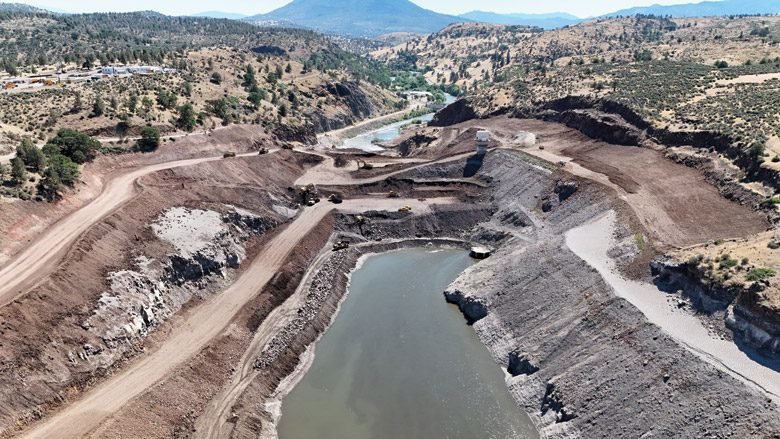
First the Copco 2 dam was removed.
Photo courtesy of Kiewit
“Dam removal is a growing industry,” says Dan Petersen, project manager for contractor Kiewit Infrastructure West Co. “A lot of that infrastructure is in its useful life and out of date, really. I think the whole industry was looking at the Klamath removal to see if it could be done. … That’s probably the biggest thing they have to get over in asking their own questions. [of whether] does it actually make a difference – will the salmon come back?
Salmon returned, starting within days of dam removal, and their numbers have grown steadily since then, with water quality also benefiting from sediment removal and reduced algal blooms. The goal was also to restore the river’s natural flow patterns, putting the banks back in place, essentially making it look as if humans had never been there. “This is an uncommon process in the construction world,” says Petersen. Much of the materials used in this effort came from their source or were returned to their source. Of the 1 million cubic meters of soil removed from the Iron Gate Dam, 800,000 cubic meters were returned to the original borrow pit. Riprap was created on site from local stone.

With dam removal complete, attention turns to restoration and revegetation of 8,000 acres of former reservoir.
Photo courtesy of Kiewit
Unique organizational and communication structures were critical to the success of the project. For starters, there was the Klamath River Renewal Corp., created specifically to oversee the dam’s removal after federal legislative action faded, becoming the new owner of the license. His establishment was “unprecedented,” says general manager Mark Bransom. The organization’s special purpose made it “easy to coordinate,” says Petersen. Working from a central office, under a progressive design-build contract, the corporation focused on permitting and agency coordination, and Kiewit managed the construction, but making sure “the schedules came together in sync with each other, and not really by surprise,” and roles under the decision-making structure were clearly delineated, Petersen adds.

The teams lived in a camp to facilitate access to remote project sites
Photo courtesy of Kiewit
Another important attendee at the meeting was the contractor overseeing the cultural resource monitoring teams, ensuring that the work was integrated with the construction activity. With the watershed of many indigenous groups, “our construction sites were just loaded with fishing villages and traditional dwelling sites, farmhouses, burial sites, artifact sites. We were constantly implementing plans for looting and vandalism, plans for inadvertent discovery, control of cultural resources to protect these known and unknown sensitive cultural resources,” says Bransom.
That communicative consistency extended to the safety program, which resulted in zero recordable incidents despite the nature of the work, with “every shot a different set of scenarios,” Petersen says. There was abseiling and the use of winch systems to move people and heavy equipment up the canyon walls to access the tunnel. At Copco 1, crews tapped the lake, tunneling 160 feet below the water level, leaving 10 feet of a 100-foot-thick steel-reinforced concrete dam to explode, similar to pulling a plug, when it was time to release the water. Two 260-foot temporary bridges were built at the Iron Gate Dam to move heavy equipment across the river.
Looking for quick answers on construction and engineering topics?
Try Ask ENR, our new intelligent AI search tool.
Ask ENR →

Photo courtesy of Kiewit
A safety officer traveled to the 40 workplaces to ensure compliance with safety protocols. The team also made sure local communities were informed about the work being done and created a crisis management plan that covers everyone. Due to the location of the project, this included training on fire prevention and evacuation route planning.
While Bransom says he’s not advocating removal in general, the Klamath project serves as a solid template for those being planned. “We pioneered a number of new areas in project execution, risk management and creating this dam removal entity that others are learning from and have already adopted,” says Bransom. In Europe, Petersen adds, there is considerable interest in removing the Klamath Dam “and some of the dams they want to remove there, so it’s bigger and bigger than just this country … It’s affecting us globally in a positive way.”
