

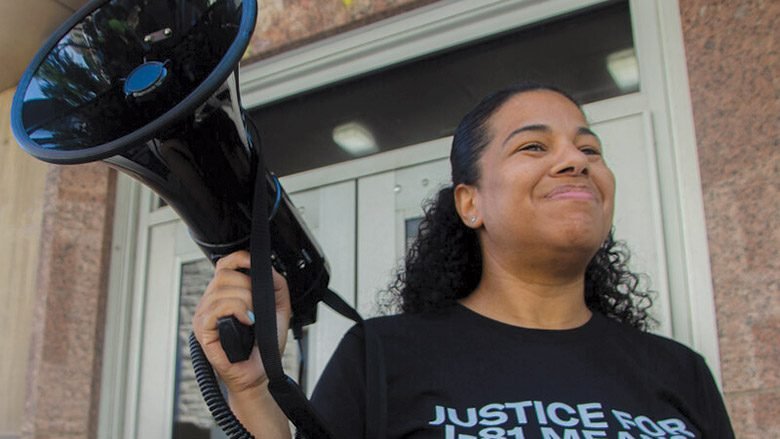

In launching an environmental justice case in Syracuse, New York in 2018, Lanessa Owens-Chaplin looked beyond her lawsuit against the $2.3 billion plan to replace the aging Interstate 81 viaduct that bisects a historically black neighborhood. The director of the New York Civil Liberties Union’s Center for Racial Justice deployed modern jurisprudence to build a legal and advocacy model for other communities grappling with the divisive legacy of freeway construction in the mid-20th century.
Owens-Chaplin replicated the strategy in 2025 by halting in April a $1.5 billion project to narrow a portion of the Kensington Expressway in Buffalo, New York. The New York State Department of Transportation did not appeal a state court order for a full environmental impact statement (EIS), agreeing to examine air quality and construction impacts before moving forward. “There was a sense that New York had to do it right,” says Owens-Chaplin. “We have to do it in a way that other states can look to us and say, ‘This is how we do restorative justice.'”
Owens-Chaplin successfully argued that federal air quality standards are insufficient for an environmental justice community facing a 6 percent increase in air pollution. “Just because that 6% still puts them below what the national air quality standards allowed, it doesn’t mean it’s OK,” he says.
NYCLU hired engineer and air quality expert Ranajit Sahu, whose analysis supported stronger pollution mitigation measures, building on protections previously secured in Syracuse. Sahu says that Owens-Chaplin’s “blend of compassion, empathy, legal and technical skills, along with tactical skills to deal with a myriad of regulatory processes” was what made her successful in the Kensington case.
In addition to urging state DOT to add HEPA tunnel exhaust filtration and detailed plans to manage toxic emissions from tunnel fires and electric vehicle batteries, NYCLU is calling for comprehensive community monitoring (air pollutants, meteorology and noise) before, during and after construction, with publicly released data and mitigation required if pollution exceeds baseline pre-construction levels.
NYCLU also argued that the built-up land created by these types of projects cannot displace and re-traumatize black residents and businesses. DOT Region 5 state director Eric Meka said in a statement that further legal action “would only lead to additional delays.” In October, the state DOT began community meetings in Buffalo and launched traffic studies as part of the EIS process for a project years from construction. NYCLU has started parallel virtual community sessions and an educational campaign aimed at combating misinformation.
Sam Radford of the Restore Our Community Coalition, a group pushing for environmental review, says Owens-Chaplin “brings a rare combination of strategic brilliance, deep integrity and an ability to communicate across sectors, from residents to engineers to policymakers.”
The Owens-Chaplin coalition met repeatedly with state attorneys, elected officials, and residents while organizing petitions, meetings, and lobbying efforts to push for state environmental compliance. She says the litigation was necessary after initial talks with state DOT officials stalled. She “hoped” the department would “learn a lesson” from the Syracuse case, but is optimistic the Kensington case will help avoid litigation over planned projects in Albany and the Brooklyn Queens Expressway in New York City. “Now they know all the freeway projects we’re going to be watching,” he says.
Despite the political uncertainty at the federal level, Owens-Chaplin will not “stop work.” He worries less about federal funding for I-81 in Syracuse, which he says is too far along to lose support, than about maintaining momentum in states like Michigan, which is showing “immense interest” in replicating his project. “Communities that have often felt abandoned, unheard or ignored,” says Owens-Chaplin, “actually have remedies.”
