


This audio is automatically generated. Please let us know if you have any comments.
Lump sum contracts can benefit both owners and engineers, according to a new report of the American Council of Engineering Companies. In particular, the delivery method can help unlock the potential of new digital technology such as artificial intelligence and enable a sustainable future for engineering and design firms during an era of seismic technological change.
Lump sum is a delivery method in which a contractor receives a specified amount of money for a specific service. Compensation is not adjusted unless there are substantial changes in the scope of services. The researchers found that this delivery method is best suited for projects with a well-defined scope, such as road and bridge rehabilitation.
The ACEC Research Institute, in partnership with Virginia Tech, commissioned the study to analyze the opportunities and challenges of lump sum structures for engineering and design firms in the transportation sector. The researchers reviewed the existing literature and conducted in-depth interviews with representatives of client organizations and engineering firms.
The researchers found that the lump sum delivery method can reduce administrative burden, incentivize effective cost management and foster technological innovation, an increasingly important consideration amid the emergence of big data, machine learning and generative AI.
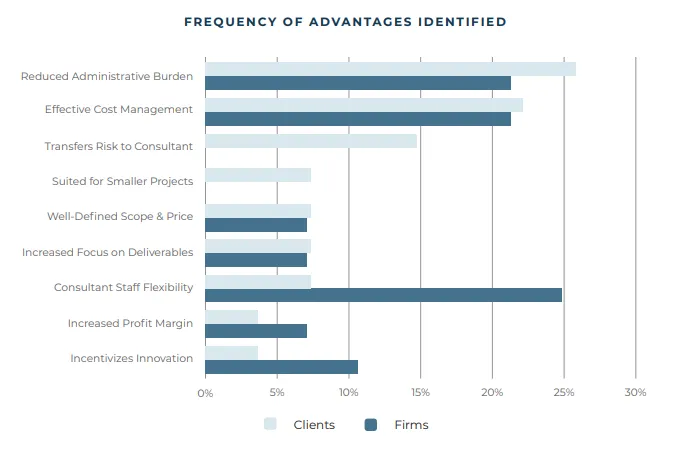
According to ACEC, interviewees identified several advantages of using lump sum contracts.
Courtesy of ACEC
Federal organizations have successfully implemented lump sum procurement for engineering and design services for decades, but many state DOTs use it sparingly. Instead, they are based on cost-plus-fixed-fee contracts with a price cap that cannot be exceeded, usually based on negotiated levels of effort and duration with established pricing regimes for specific services.
The downside for customers is that these types of contracts don’t necessarily incentivize innovation, efficiency and cost-effective service delivery, and are expensive and tedious to administer, the researchers say. In contrast, lump sum contracts shift the focus to project outcomes rather than project administration.
AI challenges, big data
While new digital technologies have the potential to increase the productivity of architects and engineers, this can be a double-edged sword for companies that charge by the hour.
As the data revolution unfolds, engineering firms will need to make massive investments in emerging technologies, such as generative artificial intelligence, while retraining and upskilling their professionals, according to ACEC. However, how exactly these technologies will be addressed in the delivery and pricing of engineering and design services remains a question.
“If a consulting engineering firm can deliver the same work product 30% to 50% more efficiently in the future, but still charge for its services by the hour, it is fundamentally in a race to the bottom,” according to the study “This is a business model that is unequivocally unsustainable for any business, let alone one where project and delivery risk is largely transferred to the consulting engineering firm.”
Essentially, engineering and design firms worry that this technological change will cost them twofold: they will bear the cost of purchasing new technology and training their workers, which will improve efficiency and, under the contract structure current typical, will reduce your billable hours. ACEC wants a different future, where engineering companies invest in technology and earn enough profit to enable a viable long-term business model, while customers receive the full value of their engineering capability enhanced by cutting edge technology.
This means that engineering and design firms must use a value-based model. According to ACEC, lump-sum contracts, which charge for services rendered instead of time and materials, better enable sustainable innovation.
In order for the AEC industry to benefit from these new technologies, it must reduce friction throughout the project delivery lifecycle, Autodesk vice president of AEC Strategy Nicolas Mangon said in the study.
“The industry needs to encourage the adoption of more incentive-based contracts, such as lump sum, so that companies can invest in their ability to leverage digital technology to deliver better project outcomes for their clients,” he said mango
Suitability of the project
Although researchers found many benefits to lump sum contracts, they are only suitable for projects with well-defined scopes of work. For example, very few interviewees indicated that project development and planning or construction engineering and inspection services were suitable for a lump sum, as these phases are difficult to define sufficiently.
Interviewees gave examples of jobs suitable for a lump sum:
- Renovation, restoration and rehabilitation projects.
- Interchange and intersection improvements.
- Bridge inspection.
- Replacement of sewers.
They also indicated that some projects are less suitable:
- Complex projects with more unknown variables.
- Projects that involve a significant commitment to third parties.
- Projects that require complex traffic maintenance.
Although there are notable limitations, lump sum contracts allow engineering and design firms to maximize their human and technology resources as they struggle with increasing workloads and staff shortages, concludes the report
“This increased autonomy opens up the possibility of better and more creative solutions to engineering/design problems, and this autonomy seems increasingly important as the industry enters an era where technological change increases and skilled personnel is scarcer,” according to the study.
