

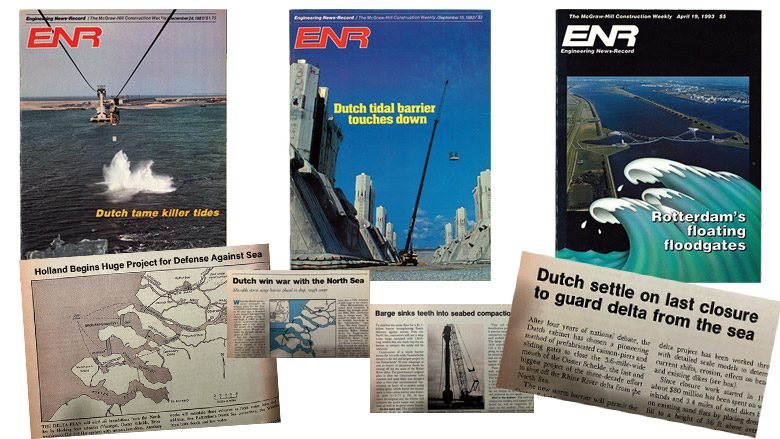

The world’s most sophisticated and complex flood barrier system currently protects the south-west of the Netherlands. It was developed in response to a catastrophe. A north-west storm combined with a spring tide in 1953 drove a storm surge of increasing intensity across the receding North Sea. The wave breached 500 levees, flooded 600 square miles of low-lying land in the Dutch Delta, and claimed 1,835 lives. The Rijkswaterstaat, the Dutch water authority, with one of the largest hydrological engineering laboratories in the world, produced a comprehensive master plan to prevent a further disaster.
The flood defense scheme includes three large dikes and a giant, enclosed tidal barrier that closes off four main estuaries in the Rhine-Meuse-Scheldt delta, as well as additional structures totaling 15.5 miles in length. The construction program took three decades to complete and had to be executed in an elaborate sequence. As well as protecting an estuary area of 1,900 square kilometers from storm surges, it aimed to solve a growing salinity problem.
By closing a series of wide, long, interconnected inlets that penetrate the area, the runoff from the Rhine and its distributaries was channeled so that the estuaries became three basins: tidal fresh water in the north, tidal salt water in the Oosterschelde, and non-tidal salt water in the remaining two arms. Four smaller basins, totaling 2,585 acres and containing 120,000 acre-ft, were constructed as drinking water reservoirs, supplying 132 billion gallons annually. The project also shortened the coastline by 430 miles, rendering 440 miles of levees obsolete and providing a greater degree of safety for residents of the affected islands, as well as preventing existing farmland from being contaminated by salt water.
The Volkerak works, which consisted of a 2.8-mile-long dam, a 2.5-mile lock complex, and a 0.75-mile bridge, closed an inland waterway connecting two deep-sea inlets. The core of the Volkerak Dam was made of floating concrete caissons, 149 ft long x 49 ft wide x 43.5 ft high, cast into a nearby dewatered building pit. The dam reduced tidal current velocities in four surrounding estuaries to allow subsequent construction of the primary dams. By modifying the unpredictable tidal currents, it also improved navigation. Begun in 1957, it was completed in 1969, with an additional set of locks added in 1977. One of the busiest waterways in Europe, its locks handled 150,000 ships a year in 1969.
The northernmost 5 km long structure, Haringvliet Dam, includes a series of 17 locks and a shipping lock. The locks let in salt water to prevent the Meuse and Rhine rivers from freezing, and can also drain the rivers in case of flooding. Work on Haringvliet Dam began in 1956, with large willow girdle mattresses placed in the 75ft deep channel. An artificial working island was built using caissons where the sluice gates were built. Each gate has two floodgates, including one facing the sea designed to break the force of the waves. A cable car was then built and used to transport 93,000 large concrete blocks and dump them into the canal to form the dam core. Finally, the rest of the dam was built with sand and stone, and was completed in 1970.
Next came the 3.7-kilometer-long Brouwershavensche Dam between Schouwen and Goeree islands, across a 100-foot-deep channel. It was also built with mattresses. The dam’s sand core was placed hydraulically and in tidal areas placed between quarry piers. To protect the toes of the embankment from erosion, concrete piles were placed in position and augmented with stones caged in gabions. On the seaward side, a 20-foot-wide layer of bituminous concrete stabilized the dam against wave action. The dam profile was designed with a low crest by adding a nearly horizontal 82-foot-wide outer berm to break storm-driven waves. A cable car was used to pour 260,000 2.5 ton concrete cubes to close the southern section. The northern section was enclosed with 14 concrete caissons, each 223 x 59 x 53 feet and weighing 8,000 tons. The construction lasted between 1962 and 1971.
The last and most difficult of the Delta Works components was the Oosterscheldekering, a 5.6-mile-long series of dams and storm barriers across three channels up to 130 feet deep. A preliminary stage involved sealing off the shallower parts of the estuary by creating three working islands and a 2.3-mile, 120-foot-high sand dike.
Construction barriers
Originally intended as a dam, environmentalists feared that closing the estuary would result in brackish closure, killing its oyster and mussel beds and wildlife habitats and creating adverse tidal action on nearby beaches. After four years of study and debate, it was decided that the centerpiece would be a 3.5-mile-long surge barrier. The barriers, divided between the three channels, have a total of 66 massive concrete piers, each weighing 18,000 tons and spaced 148 feet apart, supporting 63 steel gates. Dosbouw, a consortium of 11 Dutch companies, was the contractor.
Construction of the barriers began in 1976, with dredges cutting a 265-foot-wide trench that varied from one to 105 feet deep. A specially designed “deep densification pontoon” vessel, the Mytilus, was then moved into position: a 220 x 112-foot barge carrying four 44-ton compaction pins suspended from a 150-foot scaffold, with a 100-foot-long horizontal steel rebar lowered to the bottom for support. Steel pipe pins 138 feet long, each with a finned tip, were driven into the sand bottom with 200 hp vibrators, compacting the sand to a depth of 50 feet. The compaction work lasted four years.
Two mats were placed under each pier to protect the bottom and keep the piers level. The first mat, 15 inches thick, contains three layers: sand, fine gravel, and coarse gravel. The top mat, also 15 inches thick, contains three levels of coarse gravel. The mats were made using 12-foot-wide rolls of wire-reinforced fabric sewn together and fed into chain conveyors, aggregate placed over them with wire baskets at intervals to prevent shifting, and steel pins installed to seal the layers together. A special barge, the Cardium, was built to place the 5,500-ton mats. His 65-foot-diameter roller suffered a series of equipment teething problems, causing months of delays, but he managed to unroll the 165-foot-wide, 660-foot-long sections of carpet into place. Additional nylon mats extend nearly 2,000 feet on each side of the barrier, held in place by concrete blocks. The work of the foundation ended in 1984.
The monolithic piers were prefabricated in a working pit facing the estuary, and after each was completed the pit was flooded and towed into place by an armada of ships on a 72-hour journey. Placing the piers in position required two special vessels working in tandem. The Oostrea floated over a collapsed monolith, picked it up with grabs hanging from two gantry cranes, and brought it into place. Then the Macoma, anchored in place at low tide, dredged the sand from the mat. The two ships then locked and slowly lowered the dock into position within very precise parameters. Layers of progressively larger stones were then stacked around each structure, and piers connected with concrete beams at the top and bottom of the gate openings. The manufacture and installation of the piers took almost four years. The world’s largest mobile barrier was completed in 1986 and has been closed 28 times since then.
The entire Delta Works program, including raising dikes along rivers and estuaries, totaled $7 billion, of which the Oosterscheldekering accounted for $2.4 billion.
The Delta Works scheme always meant that the New Waterway, the ship channel that forms the northernmost arm of the delta, would remain without reservoirs, as it handles ship traffic in Rotterdam, the world’s largest port by tonnage between 1962 and 2004. So to protect Rotterdam from storm surges, Rijkswaterstaat conceived a flood. Its two floating radial beam structures are housed in dry docks on the banks of the canal when not in use, making it one of the largest floating structures in the world.
Each hollow steel gate is 690 feet wide, 50 feet high, and 72 feet deep. Shaped like a curved ship’s hull, each door weighs 15,000 metric tons when empty. They are supported by 750-foot-long steel trusses, each with three tubular longitudinal chords up to 6 feet in diameter, connected to ball-and-socket joints embedded in 100,000-ton concrete and sand anchorage. At dangerous tides, the gates float from their docks, closing the 1,200-foot-wide channel. It then floods and sinks 55 feet, resting on concrete sills in the channel bed. Construction began in 1991 and was completed in 1997. The gates cost $450 million. It has closed twice, once in 2007 and again in 2023.
