

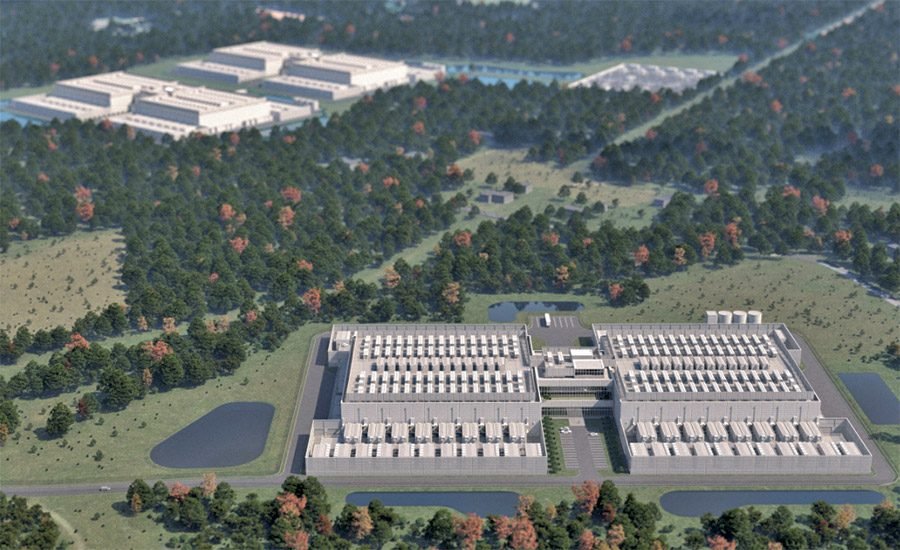
The $3.76 billion Manhattan Detention Center in New York City leads ENR East’s 2026 First Starts list, ranking first among projects that broke ground last year and anchoring a slate of large-scale transportation, digital infrastructure and institutional work across the region. The project, part of the city’s jail program, is closely followed by the ranking of CleanArc Data Centers’ $3 billion VA1 hyperscale data center campus in Caroline County, Virginia.
Completing the upper level is the $1.8 billion Midtown Bus Terminal Structure, Storage and Ramp Remodel in Manhattan, a major Port Authority of New York and New Jersey effort tied to the long-awaited replacement of the aging facility. Aside from the dominance of mission-critical construction in this year’s rankings, transportation megaprojects continue to feature prominently on the list, including the Manhattan Tunnel, part of the Gateway program, and the Newark Liberty International Airport replacement project.
Based on Dodge Construction Network data and details provided by industry companies and other sources, ENR East’s Top Starts rankings reflect projects that began in 2025 in Connecticut, Delaware, District of Columbia, Maine, Maryland, Massachusetts, New Hampshire, New Jersey, New York, Pennsylvania, Rhode Island, Vermont, Virginia and West Virginia.

The $1 billion Netflix Studios Fort Monmouth project in Monmouth County, NJ, ranks ninth on the ENR East Top Starts list.
Rendering courtesy of Netflix
Digital infrastructure drives growth
Advanced technology projects and mission-critical work remain the strongest growth drivers in the East, particularly in northern Virginia and emerging corridors further south, says Camilo Garcia, core regional leader for DPR Construction Northeast. “The demand for AI-driven computing is accelerating data center investment and capital commitment remains strong for projects with secured power positions,” he says.
Project viability increasingly depends on initial infrastructure coordination, not just financing. “Long-term electrical infrastructure planning and equipment procurement are now central to planning strategy,” says Garcia.
The Caroline County data center campus exemplifies that change, according to Matthew Englert, delivery manager for owner CleanArc Data Centers. “In the digital infrastructure sector, we are seeing a fundamental shift in demand towards facilities that can support the next wave of AI and cloud innovation,” he says. “These technologies require data center campuses built for scale, flexibility and long-term growth.”
Englert adds that considerations of sustainability and community are now integral to large-scale development. He says the project’s closed-loop cooling system “significantly” reduces water consumption. “Growth must be responsible,” says Englert. “We are prioritizing sustainable development, incorporating soil conservation initiatives and engineering solutions that have less environmental impact than traditional data center designs.”
Chris Beck, CEO of Turner Construction Co., which is building the $925 million Bauxite III Data Center No. 10 in Frederick, Md., says “the momentum in the data center market in Maryland and Northern Virginia is spreading across the broader region. We are in a smart growth phase for construction. AI is transforming healthcare demand and investment to continue building a health and investment strength to sustain the sustainability for health care and education drive a meaningful opportunity At the same time, our industry places greater emphasis on safety, recognizing that emotional well-being is as important as physical safety in our workplaces.
Megaprojects stand firm
“Media and entertainment and high-performing commercial interiors continue to lead opportunities in the East.”
—Vincent Ryan, Executive Vice President of JT Magen
Despite uncertain federal funding and broader market instability, transportation investment continued to anchor the region’s construction pipeline through 2025, with several multibillion-dollar public projects moving forward. At the same time, major institutional projects linked to health and safety are moving forward, including the $1.7 billion Wadsworth Center Laboratory No. 6 in Albany, New York. In a statement announcing the start of the project, New York Gov. Kathy Hochul said the lab “will enable the state to better predict and prepare for emerging threats to public health.”
Market reallocation, not withdrawal
While major projects continue to move forward, some industry leaders see a clear rebalancing between sectors.
Traditional office work and some higher education projects have cooled, says DPR’s Garcia. “Overall, the cooling in these sectors reflects capital discipline rather than structural collapse,” he says. “The market is not contracting broadly, it is being reallocated to sectors with durable demand and clearer long-term profitability profiles.”
Eric Reid, AECOM Tishman’s director of operations for the New York region, sees continued opportunity in targeted commercial development, particularly in a newly rezoned area of midtown Manhattan that has “unlocked tremendous potential for commercial development.” The ongoing work around Grand Central Terminal will create “an exciting hub of innovation, supporting the local economy for generations to come,” he adds.
Entertainment, media and experiential spaces are also emerging as enduring drivers. In Monmouth County, NJ, contractor JT Magen & Co. is building the $1 billion Netflix Studios in Fort Monmouth. “Media and entertainment and high-performance commercial interiors continue to lead regional opportunities,” says Vincent Ryan, Executive Vice President of Magen. “As an experienced builder in the data center sector, we expect this market to continue to grow in the coming years, driven by growing demand for digital infrastructure and AI-related capability. More broadly, owners are prioritizing partners. [that] can provide certainty, speed and technical expertise as projects become more complex and capital intensive.”
