

A Comprehensive Guide to Mini Excavator Operation and Safety
There is a specific kind of satisfaction that comes with sitting in the cab of a mini excavator. Whether you’re a seasoned veteran or a newcomer to the dirt, these machines represent the perfect marriage of power and precision. In the construction landscape of 2026, the mini has become the undisputed king of the urban job site.
But here’s the reality: because they are smaller and feel more approachable than a 50-ton beast, people treat them with less respect. That is exactly when accidents happen. If you want to be a top-tier operator, you need to master three things: technical skill, machine intuition, and unwavering safety.
1. Beyond the Joysticks: The Realities of Training and Certification
In the past, you could learn to dig by spending a Saturday in a backyard with a rental. While that may work well for a garden bed, the professional world has undergone significant changes. Today, being an operator is a skilled trade that requires documented proof of competency.
Why You Can’t Just Wing It
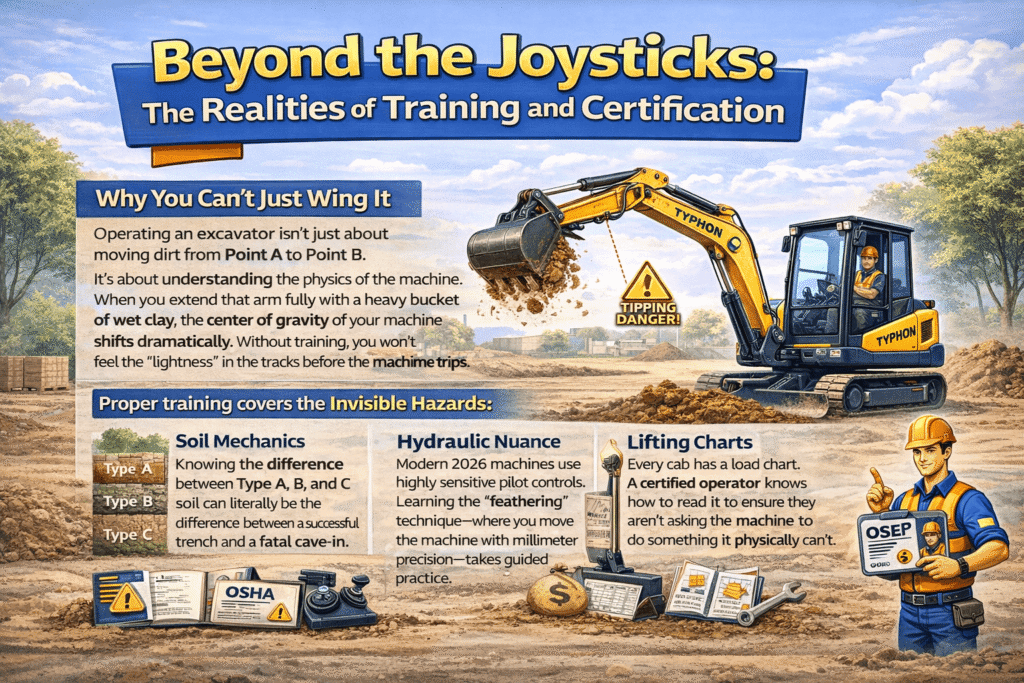
Operating an excavator isn’t just about moving dirt from Point A to Point B. It’s about understanding the physics of the machine. When you extend that arm fully with a heavy bucket of wet clay, the center of gravity of your machine shifts dramatically. Without training, you won’t feel the “lightness” in the tracks before the machine tips.
Proper training covers the invisible hazards:
- Soil Mechanics: Knowing the difference between Type A, B, and C soil can literally be the difference between a successful trench and a fatal cave-in.
- Hydraulic Nuance: Modern 2026 machines use highly sensitive pilot controls. Learning the “feathering” technique—where you move the machine with millimeter precision—takes guided practice.
- Lifting Charts: Every cab has a load chart. A certified operator knows how to read it to ensure they aren’t asking the machine to do something it physically can’t.
The Modern Certification Process
To be a pro, you usually need a combination of a QSEP (Qualified Skilled Equipment Practitioner) card or a regional equivalent. This involves:
- Classroom Theory: Learning the OSHA mandates and symbols.
- Simulation & Seat Time: Many modern schools now use VR simulators to mimic high-risk scenarios (like overhead power line contact) without the actual danger.
- The Practical Exam: You’ll be asked to dig a trench to a specific grade, backfill it, and load a trailer without “clunking” the ramps.
2. The Safety Anatomy: Features of a Modern Mini Excavator
The machines coming off the line in 2026 are safer than ever, but you have to know how to use the tools provided. When you’re looking at a machine, don’t just look at the horsepower; look at the protection.
The Survival Cage (ROPS, TOPS, FOPS)
- ROPS (Roll-Over Protective Structure): This is the frame. It is designed to take the weight of the machine if it flips. Crucial Point: ROPS is useless if you aren’t wearing your seatbelt. If the machine tips and you aren’t buckled, you will be thrown out—and the machine will land on you.
- FOPS (Falling Object Protective Structure) is essential for demolition, as it provides a protective barrier to prevent injuries from falling debris. If a brick falls from two stories up, you want steel between your head and that brick.
The Digital Guardrails
We are now seeing Active Interference Detection, which is a system that identifies potential hazards by monitoring the environment around the machine. Sensors around the machine can detect a human vest within 15 feet and automatically “dead-stick” the hydraulics. If your machine has this, keep the sensors clean. It is an invaluable tool in a busy and crowded work zone.
3. The Pro Mindset: Tips for Safe and Efficient Operation
Experience isn’t just about years on the job; it’s about the habits you build. Here is how the high-earning operators run their machines.
The Golden Rule: Blade Down, Hips Square
The dozer blade on a mini excavator isn’t just for pushing dirt; it’s your primary stabilizer. Always dig with the blade down. It anchors the machine to the ground and prevents the “seesaw” effect.
Mastering the Slope
Slopes are where mini excavators go to die.
- Travel straight up and down: Never travel across a side slope. The tracks on a mini excavator are relatively narrow, making them prone to lateral rolls, which are sideways tipping movements.
- Keep the heavy end uphill: If you’re climbing, keep the boom in front of you. If you’re descending, keep it behind you or very low to the ground to act as an anchor.
The Eye Contact Protocol
On a noisy site, hand signals are better than shouting. Never swing your cab toward a ground worker unless you have made eye contact and they have given you the “clear” signal. If they look away, you stop moving. Period.
4. The Big Three Accidents (and How to Kill the Risk)
Most accidents in the mini excavator world fall into three categories. Understanding them is the first step toward preventing them.
I. The Utility Strike (The Budget Killer)
Striking a gas line or a fiber optic cable is the fastest way to get fired and fined.
- The Fix: Never trust the marks 100%. Soft dig (using a shovel or vacuum) within 24 inches of a marked line. In 2026, use an underground utility locator tool before the teeth hit the dirt.
II. The “Quick-Coupler” Drop
This occurrence is a nightmare scenario: you’re swinging a bucket over a trench, and the bucket falls off because the quick-coupler wasn’t locked.
- The Fix: Every time you change an attachment, do a pressure test. Press the attachment firmly against the ground to ensure it’s locked in before you lift it over anyone or anything.
III. The Edge Collapse
Mini excavators are often used for trenching. If you park too close to the edge of an open hole, the weight of the machine can cause the soil to give way.
- The Fix: Keep your tracks at least as far back from the edge as the trench is deep. If the trench is 5 feet deep, stay 5 feet back.
[ecwid widgets=”productbrowser search” default_category_id=”167967260″ default_product_id=”0″ minicart_layout=”MiniAttachToProductBrowser”]
5. Staying Legal: Navigating OSHA Regulations
OSHA doesn’t care about your deadlines; they care about your safety. Staying compliant isn’t just about avoiding fines—it’s about professional integrity.
The Competent Person
Under OSHA 1926 Subpart P, every excavation site must have a Competent Person. This is someone who can identify existing and predictable hazards. If you are operating the machine, you should aim to be this person. You need the authority to stop work if the soil looks shifty or the weather turns.
Daily Documentation
In 2026, I checked, and it isn’t enough. You need a paper or digital trail.
- Pre-start inspections: Check the tracks, fluids, and safety locks.
- Trench Inspections: Check the walls of the dig every morning and after every rainstorm.
6. The 2026 Evolution: Technology as Your Spotter
We are entering an era where the machine is smarter than ever. Telematics now allow owners to see if an operator is “hot-rodding” (operating aggressively). Grade control systems (like 2D or 3D GPS) are now being integrated into mini excavators, allowing you to dig to a perfect 1% grade without a guy standing in the trench with a grade rod. This keeps workers out of the “danger zone” and makes you twice as fast.
Conclusion: The Legacy of a Good Operator
At the end of the day, a mini excavator is a tool of creation. You’re building the foundations of homes, the veins of our utility systems, and the beauty of our landscapes. However, the most significant accomplishment on any job site isn’t the depth of the hole or the speed of the backfill—it’s ensuring that everyone returns home safely.
Respect the equipment, maintain a humble attitude to continue learning, and never compromise on safety.
