

The Mountain States construction market is undergoing dynamic change, says Rich Hazel, president of Big-D Construction’s Salt Lake City regional office.
Public sector projects, data centers and transit-related developments are witnessing an upward trajectory, attributable to increased public investment in infrastructure and demand for data storage and transport facilities , he says On the other hand, developer-driven private projects such as commercial office, retail, warehouse and multi-family residential projects, all of which are often sensitive to interest rate fluctuations, are slowing.

Graph by ENR
ENR compiles two lists annually for the Mountain States: one for contractors working in Colorado, Wyoming and the Dakotas and one for construction companies in the area that includes Utah, Idaho and Montana. Average revenue reported by businesses in the seven-state region grew 7% to $341 million in 2023, from $318.5 million in 2022.
Big-D landed in the top spot again this year for businesses in the intermountain area. The firm is currently in the construction phase of a renovation project for the Frank E. Moss Federal Courthouse in downtown Salt Lake City and is converting offices in the South Temple Tower near City Creek Center into luxury apartments , the first project of its kind in Utah. Several manufacturing and mission-critical projects are in pre-construction, and Hazel says they will be breaking ground soon.
“As we look to the future, we foresee a continuation of current trends. However, Big-D remains optimistic that expected interest rate cuts in the second half of 2024 could provide much-needed stimulus to the developing market Hazel adds.

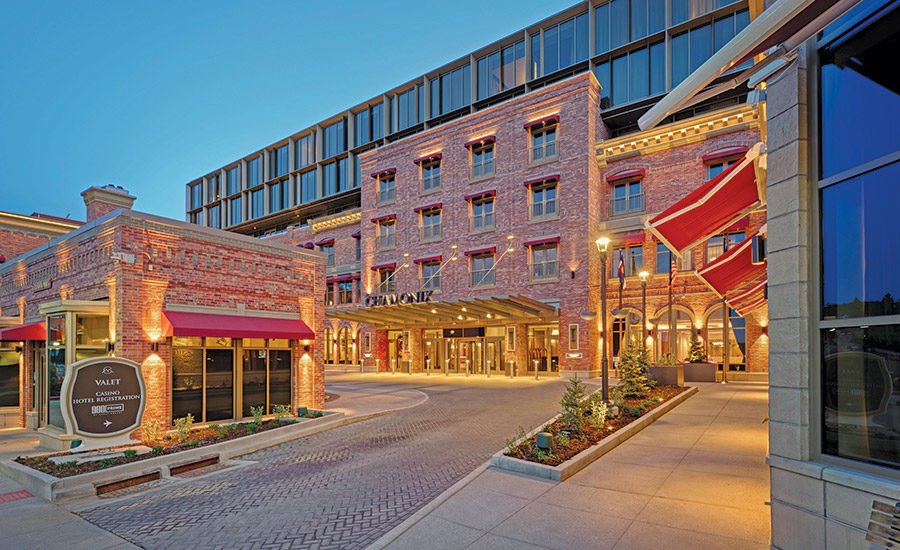
Big-D recently completed four mid-rise buildings and a two-story commercial building in the Post District, a mixed-use project in downtown Salt Lake City spanning over 750,00 square feet.
Image courtesy of Jared Kenitzer
Constant growth
Although the market is sending mixed signals, the overall outlook is positive, says Derek Hoffine, regional vice president of Hensel Phelps. The contractor tops ENR’s list this year for businesses in Colorado, Wyoming and the Dakotas.
Hoffine says that with high office vacancy rates, especially among Class B and C office buildings, this sector won’t see much growth. “Class A office space is in demand, but requires a well-located area with specific features that are in demand beyond modern conveniences. Hospitality, on the other hand, looks promising with growth and expansion with many projects in the early planning stages,” adds Hoffine.
Hensel Phelps is currently building the Rocky Mountain Laboratory Comparative Medicine Center, Building J, in Hamilton, Mont., for the National Institutes of Health. The project was awarded under an indefinite-delivery/indefinite-quantity contract and will provide laboratory, clinical, animal, and support facilities for NIH’s emerging scientific goals.

Graph by ENR
Challenges persist
Hazel and Hoffine say contractors in the seven-state region are still struggling with labor shortages, rising material costs and supply chain disruptions.
“This labor shortage isn’t just about numbers, it’s about the skills and experience that are in short supply,” adds Hazel. “We are investing in training and development to improve our workforce, but it remains a significant hurdle.”
“We are investing in training and development to improve our workforce, but it remains a significant hurdle.”
—Rich Hazel, President, Big-D Construction
Like many companies, Big-D and Hensel Phelps invest in training and apprenticeship programs to attract and develop new talent. “We have partnerships with local high schools and trade schools to transition new talent into the workforce,” says Hoffine.
On the supply chain side, and with mission-critical work on the rise, Hensel Phelps focuses on using alternative materials that are more readily available and less affected by price volatility. “Improved project planning, to anticipate commodity fluctuations, is a normal practice of ours to help our customers,” says Hoffine.
Hazel says Big-D has improved its prequalification processes to include thorough vetting of subcontractors. “This helps us to ensure that they have the experience and resources necessary for successful project execution. In addition, we use selective insurance products as part of our risk management strategy. This does not it not only mitigates financial risks but also contributes to the smooth and efficient progress of our projects,” he says.
Hazel says private projects located within enterprise zones are a bright spot, making steady progress despite wider market challenges. “This resilience is a testament to the strategic importance of these areas and the robustness of the projects they host,” he says. “We also expect to see an increase in public projects as more government funding becomes available at both the federal and local levels. [and] This will be particularly beneficial for projects related to transit, renovations of historic or outdated government buildings and civil infrastructure.”
