

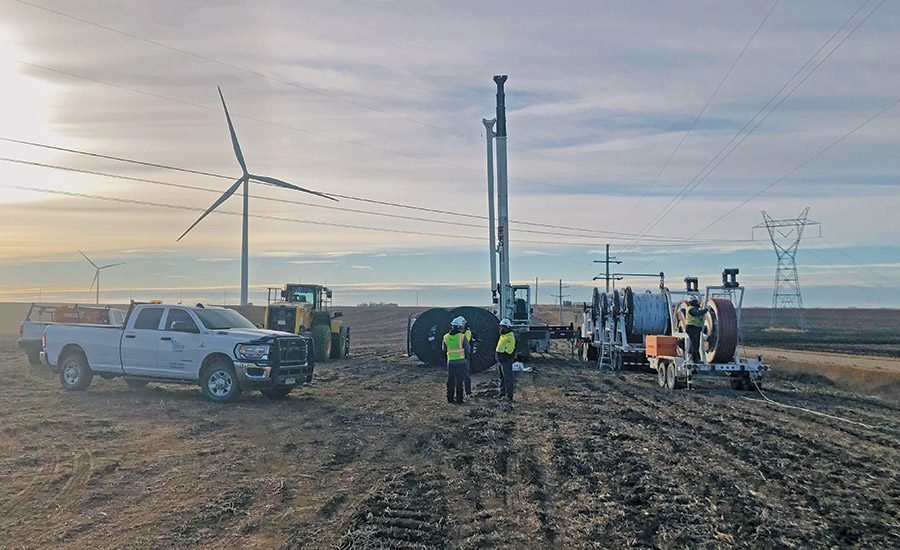

Family-owned Ward Electric Co. specializes in transmission and distribution work for substations, solar and wind projects and storm repair.
The Colorado-based contractor, which opened with just four people in 2005, has grown to more than 550 employees in six locations, including Mountain States offices in Denver, Grand Junction and Longmont, Colo., and additional offices in Kansas and Nebraska.
Second-generation owners brothers Mark Ward, CEO, and Matt Ward, company president, say much of the company’s growth over the past year has come from fire mitigation work and increased efforts to strengthen the resiliency of the power grid during periods of peak demand.
The contractor posted regional revenue of $110 million in 2024, up from $77.62 million in 2023, and ranks 13th on ENR’s list of top specialty contractors in the seven-state region.
The contractor’s foundation arm, JoyForWARD, honors Joyce Ward, the brothers’ late mother, who co-founded Ward Electric with her father, Mike. Since its inception in 2022, the foundation has distributed more than $850,000 to organizations focused on education, health, veterans, youth and special needs in the community.
Regional Editor Jennifer Seward sat down with Mark and Matt to learn more about the Mountain States Company of the Year. The questions and answers below have been edited and condensed.
Ward’s electrical projects at a glance
The Mountain Peak Power Plant in Keenesburg, Colo., is expected to add 162 MW of peak single-cycle natural gas power generation to United Power’s system. This plant was built to supply power to the grid and help cover energy demands during peak consumption hours. Ward Electric handled the elaborate switch yard construction, expanding both the footprint and capabilities of the substation.
A wildfire mitigation project for Xcel Energy is improving power line infrastructure along Colorado’s Front Range by replacing poles with taller, wildfire-specific models, upgrading to larger, stronger conductor wires, and installing non-sparking breakers and lightning arresters, all designed to meet strict wildfire standards and reduce significantly the risk of fires starting from power lines.
What is driving Ward Electric’s growth?
Brand: The [population] growth along the Front Range has helped. This, along with our safety, quality and people, has allowed us to add different services and acquire additional clients. [Recent work has included] fire mitigation with Xcel Energy and pole replacements with United Power and Core Electric, from system upgrades to capital upgrades and new development growth.
Matt: High voltage is our niche. Seventy percent of what we do is distribution work, 25% is transmission work and the other 5% is commercial/industrial. Our projects have been up to $38 million [for Western Spirit] and as small as $3,500. They are everywhere. Sometimes we will complete 3000-4000 work orders in a year. [With high voltage work, one pole consists of one work order.]
Also, the data center and AI boom is real and it takes a lot of power to get them going. Our work is customer-oriented, so United, Core and Xcel have new customers, they contract with us to build these centers.
Brand: We did a major substation upgrade for United Power in Keenesburg, a natural gas-fired power plant that generates about 160 megawatts more power.
What does forest fire mitigation involve?
Matt: Removal of old copper wire and installation of new poles, new insulators, new wire. We use a different style of fusion and special fixtures that do not spark to the ground when a cut fails. Manufacturers have come up with new things in recent years to eliminate sparks, [and] is an ongoing effort to replace the old copper solder that has been around since the 1950s and 1960s.
Brand: We replace it with a covered conductor so that if tree branches fall on it or something, it won’t spark. And we’ve been adding new devices that will send a signal to the control center when there’s a problem with the line, like high winds, and automatically shut it down. Our other projects are from overburden to underground conversion work – burying it underground for road widening or new developments.
“Mark and I view our people as our greatest asset, so we put a lot of time, effort and training into our people.”
—Matt Ward, president of Ward Electric
What is it like to work at Ward Electric? Matt: Mark and I consider our people our greatest asset, so we spend a lot of time, effort and training on our people. We have several safety programs, whether it’s top shooter rescue or first aid/CPR. And just today we had a thank you barbecue for all the guys at Xcel, and tomorrow we’re having one at United Power. We are running employee appreciation programs throughout the month.
Brand: We also offer education reimbursement [for skills training and leadership development] and continuous training throughout the year. We value our employees and hope this leads to less turnover. Internally, we continue to incorporate different ERPs [enterprise resource planning] systems, so your data reaches everyone without multiple hands touching it. Externally, we look at the best ergonomic tools for our field teams. For example, a battery-powered tool reduces the stress on your shoulders. And we even look at how electric vehicles and work trucks play into this industry. For example, there is a hybrid mixing bucket truck with an aerial device that increases safety because there is less noise, thus increasing air-to-ground communication.
What challenges are you dealing with?
Brand: The age gap is a real concern; there is a very large age gap in our industry between the generation approaching retirement.
Matt: The labor shortage for our skilled industry is real because not just anyone can do it.
