

Dive brief:
- As NASA looks to create permanent settlements on the Moon, a successful test of autonomous robots may bring that reality one step closer.
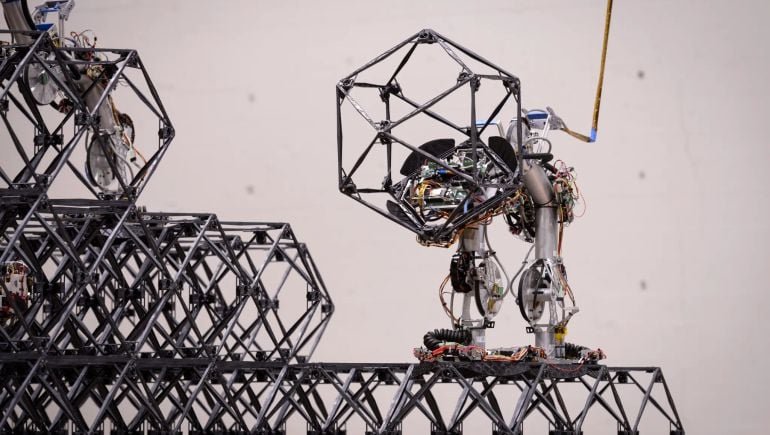
- NASA’s Automated Reconfigurable Mission Adaptive Digital Assembly Systems team, working on autonomous construction technology, successfully tested part of this work at the Ames Research Center in Santa Clara County, California, the agency announced Jan. 17. Three robots built a meter-scale shelter structure, about the size of a shed, using hundreds of building blocks.
- The robots used building blocks called voxels, short for volumetric pixels, which can form almost any structure, the agency says. Concept images show the building blocks turned into frames for solar panels on the Moon, stabilizing pillars for cave outposts and as support for ejection, or debris, shields on landing strips.
Diving knowledge:
The ARMADAS team provided structural plans to the robots, but did not micromanage their work, according to the release. Instead, software algorithms did the work of planning the robots’ tasks. The test demonstrated a crucial part of the programs’ capabilities: the system practiced the build sequence in simulation before starting actual execution.
While NASA did not detail the robots’ applications here on Earth, the agency emphasized the machines’ potential “to build large-scale infrastructure, such as solar power plants, communications towers, and habitats.” on the Moon or Mars. He also highlighted the ability of robots to build structures “before humans arrive.” The team published their results in the journal Science Robotics.
The voxels are transported by robots called Scaling Omnidirectional Lattice Locomoting Explorers (SOLL-E for short) that can climb and maneuver around the voxels, even when they are stacked on top of each other.
“In general, it is very difficult to develop robust autonomous robots that can operate in unstructured environments, such as a typical construction site,” said Christine Gregg, ARMADAS chief engineer at NASA Ames, in the statement. “We turn around this problem by making very simple and reliable robots that operate in an extremely structured lattice environment.”
Cost considerations
During the test, two robots walked around the outside of the structure, moving one voxel at a time. One was responsible for retrieving the materials before passing them to the second robot for placement. A third robot followed, climbing through the mass of voxels and joining them together.
“Making large structures from small building blocks allows us to use good materials at the lowest cost,” Kenny Cheung, ARMADAS principal investigator at NASA Ames, said in the statement. “The size of the structures that can be made is only limited by the number of building blocks that can be supplied.”
NASA maintains autonomous construction as a key axis ahead of the agency’s planned manned return to lunar orbit in 2025, as part of its Artemis programbefore landing humans there again in 2026. Last February, it provided $6 million in funding to academic institutions to research technology that would help create a permanent settlement on the moon, including autonomous buildings.
