


As ENR reported at the time, as the Depression deepened in the early 1930s, none of the initiatives taken by President Herbert Hoover or Congress helped much, and some, such as the Smoot-Hawley Tariff Act, which caused prices to rise. , were counterproductive. Hoover opposed congressional proposals to provide federal aid to the unemployed, believing that such aid should be managed by state and local governments and charities.
A major wave of bank failures occurred in the late 1930s. Unemployment reached 15% in mid-1931. The annual volume of construction fell 76% between 1928 and 1932. With unemployment at 22% in In early 1932, Hoover gave in to congressional pressure and established the Reconstruction Finance Corp. to make loans to banks, railroads, and local governments, but failed. stimulate commercial lending.
In contrast to Hoover’s laissez-faire approach, New York Governor Franklin D. Roosevelt was the first governor to publicly endorse the idea of unemployment insurance. As governor he established the Temporary Emergency Relief Administration, which for six years helped five million people.
When he entered the White House in 1933 after the 1932 election, Roosevelt and his “brain trust” quickly created a variety of bold ventures to put people back to work and revive a faltering economy. Its first program, the Civilian Conservation Corps, sent young people to plant trees, fight wildfires and carry out soil erosion control projects. It got off to a fast start, with 300,000 workers in 1,400 fields by July 1, 1933, the fastest peacetime mobilization in US history. Room and board provided, CCC workers sent much of their dollar-a-day wages home to their needy families.
Roosevelt was an advocate of publicly owned power generation and, as governor, had launched a state power authority that built large-scale hydroelectric plants. He convinced Congress to create the Tennessee Valley Authority, which built dams to supply Appalachia with cheap electricity, provide flood control, and protect the region’s topsoil.
Despite these two initiatives, Roosevelt was skeptical about the merit of public works. But his advisers, especially Frances Perkins and Raymond Moley, helped to convince him. In June 1933, Roosevelt signed the National Industrial Recovery Act. Title 1 of the NIRA promoted cooperation among businesses to achieve fair competition, while Title 2 created the Public Works Administration and freed up billions of dollars for tens of thousands of infrastructure projects , employing millions of people. The Grand Coulee Dam in Washington, the Fort Peck Dam in Montana, the All-American Canal in California, and the Triborough Bridge in New York City are some of the largest projects funded by the PWA.
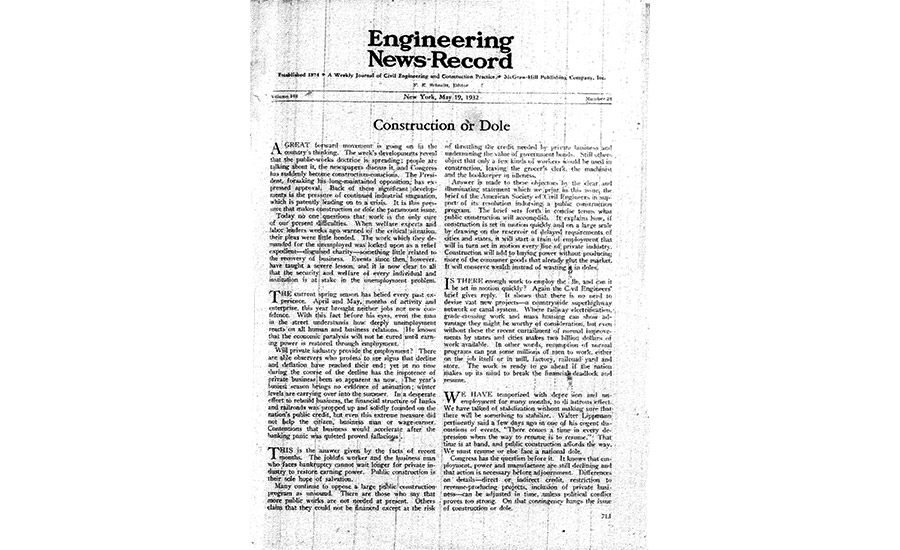
The ENR pushed for a federal public works program to fight the Depression as early as September 1931, stating in an editorial: “Public works can employ the idle and can make them available, not as a gift but as a right of work, food stores. clothing and shelter, of which the country abounds. Private companies have proven powerless to keep workers in their jobs. There is a national emergency ahead, but if the will to provide it is strong enough, work can be found for all.” A 1932 editorial was harsher. “Sedatives in the form of budget balancing and rehabilitation of bank credit no longer hope to increase the purchasing power necessary to stimulate industry. Work is the only remedy, and work is only available in public construction”.
While Congress debated NIRA, ENR devoted 20 pages of its May 18, 1933 issue to articles by prominent public figures advocating the value of public works. Interior Sec. Harold Ickes, California State Engineer Edward Hyatt, Engineer Malcolm Pirnie, and Public Administration Clearinghouse Director Louis Brownlow, whose article was titled “The Citizen as a Shareholder in public facilities”, they intervened.
The following week’s editorial was a full-fledged endorsement. “Civil engineers should find special gratification in the fact that the bill fully embodies the principle which they and the Engineering News-Record have been urging upon the government for the past year, namely, the utilization of employment through the construction of public works as the spearhead of the attack on depression.and deflation.By thus recognizing the responsibility of the nation in the restoration of the earning power of the workers, the bill discards many traditions in bankruptcy. and establishes a new course oriented towards public welfare.
Title 1 of the NIRA required industries to develop fair competition codes that prevented destructive price cutting, established wage and hour standards, and protected union rights. It took until January 1934 to get 21 large organizations of contractors, engineers, architects and unions to draft the building code. ENR applauded these efforts. “For years this industry has had a great need for coordination, but so far it has only managed to stand apart, a group of separate and practically antagonistic elements. The result was continued inefficiency, discord and disputes… According to the code, industry can solve its most pressing labor problems. It can eliminate bad practices that were a permanent obstacle to a sound and efficient existence. It can set a course of industrial planning and direction of its operations which should lead to progressively greater stability.” Protections for the rights of voluntary workers in the NIRA would become a national mandatory minimum wage and maximum hours standards, and a ban on child labour.
Roosevelt also created a short-term work program, the Civil Works Administration, during the harsh winter of 1933-1934, which employed four million one-time relief recipients in mostly manual labor jobs manual, such as the construction of roads, sidewalks and sewers. and painting public buildings. It resulted in 255,000 miles of improved roads, 2,200 miles of sewer lines, and 4,000 new or improved school buildings.
Another ENR initiative that supports the government’s public works programs was carried out by Elsie Eaves, ENR Business News Manager and a qualified civil engineer. Between 1933 and 1935 he organized and directed an inventory of necessary construction projects that could proceed if federal funding was provided. This helped Congress pass legislation on the provision of loans to revive construction activity.
Rural America lagged far behind cities in terms of electric service. Only 10% of American farms had electricity. The Rural Electrification Act of 1935 gave loans to rural electric cooperatives to establish networks of transmission and distribution lines and to buy wholesale power. By 1942 almost 50% of farms had electricity.
Although the PWA financed the demolition of slum housing and the construction of some public housing, the creation in 1937 of the US Housing Authority greatly consolidated and expanded this commitment.
By 1936 unemployment had fallen to 9.9%, the stock market was rising and bank failures were minimal. Although the economy did not fully recover for several more years, economists generally agree that public works programs had the highest economic multipliers of the various New Deal programs.
