

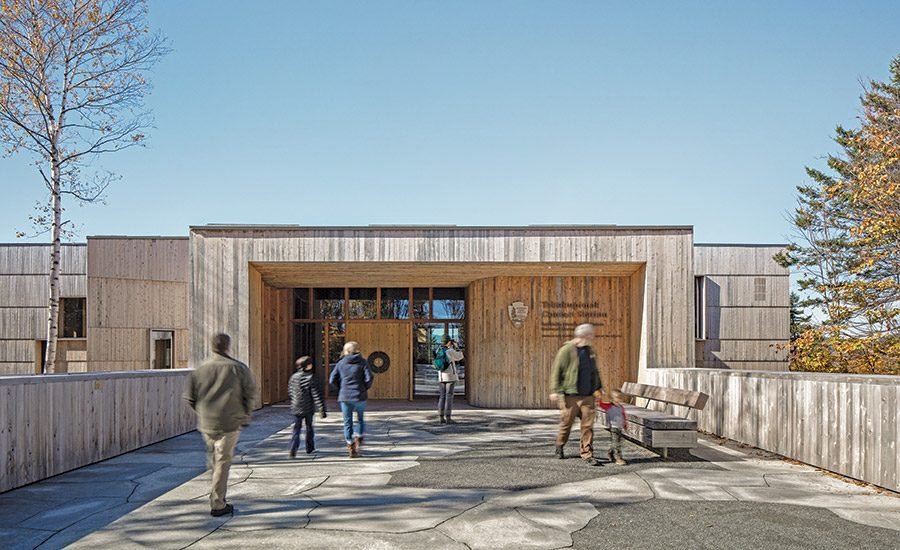
Tekakapimäk Contact Station in Katahdin Woods and Waters National Monument
Penobscot County, Maine
EXCELLENCE IN SUSTAINABILITY and BEST PROJECT, GOVERNMENT/PUBLIC BUILDING
KEY PLAYERS
Owner: Elliotsville Foundation
Main design company: Saunders Architecture
Construction Manager: Wright-Ryan construction
Structural/Civil Engineer: Haley Ward
MEP Engineer: Allied Engineering
Architect of record: Alisberg Parker Architects
Landscape architect: Reed Hildebrand
Project management and owner representative: Stern Consulting International
Exhibitions, orientation and signage design: WeShouldDoItAll (WSDIA)
Production of the exhibition: Split Rock Studios; DCL signage manufacturing
Works and construction of roads: Emery Lee & Sons Inc.
Site landscape work: OBP Trailworks
Located on a 23-acre site atop Lookout Mountain, the new Tekakapimek Contact Station invites visitors to explore the 87,563-acre Katahdin Woods and Waters National Monument in north-central Maine, showcasing its peaks and rivers, night skies and wildlife. As unique as its surroundings, the $31 million Tekakapimek Contact Station is a work of collaborative design and construction, intentionally infused with the knowledge of the Wabanaki, a confederation of five Eastern Algonquian nations.
“This project challenged us all to think differently about what it means to manage and collaborate,” says Lucas St. Clair, president of the Elliotsville Foundation, which donated the land for the national monument. “All Wabanaki cultural knowledge and intellectual property shared in this project are owned by the Wabanaki Nations, and we are honored to have supported processes that maintain and protect this principle.”
The monument was established by presidential proclamation on August 24, 2016, following the Elliotsville Foundation’s gift to the people of the United States. The monument is managed by the National Park Service. As part of the transfer to the Department of the Interior, certain deeds included time-limited reserved rights allowing the Elliotsville Foundation, as a private entity, to establish the visitor contact station. In 2018, the foundation notified its intention to exercise this right on what is now known as Lookout Mountain. He subsequently opened an official consultation with the National Park Service.
Called Tekαkαpimək, which is a Penobscot word for “as far as one can see,” the contact station overlooks Katahdin and the East Branch of the Penobscot River while remaining hidden from paddlers below. A gazebo and meeting circle to the east welcome the first light of day, honoring the traditions of the “Dawn People” and offering views of the Wabanaki homelands.
Built in a remote location, sustainability was more than an aspiration, it was a necessity. The project has almost zero operational emissions, establishing a new sustainability benchmark within the National Park Service. The building’s systems were designed for maximum efficiency and minimum environmental impact. A 36.75kW solar PV array powers all building operations with lithium-ion battery storage and a propane generator for emergency backup.

Built entirely off the grid, the facility uses solar and thermal energy, local materials and innovative passive systems to minimize its carbon footprint while advancing sustainable building practices.
Photo by James Florio, courtesy of Wright-Ryan Construction
Passive heating strategies include a Trombe wall system, underfloor heating and thermal mass. Cooling is achieved entirely through natural cross ventilation, night washdown, shade and ceiling fans, eliminating the need for mechanical air conditioning. The building is designed to function as a “thermal battery,” according to the team, leveraging its mass and envelope performance to modulate interior temperatures. No water is removed from the site.
The facility’s sustainable design is also rooted in Wabanaki’s ecological knowledge and conservation ethic. Tekakapimäk features extensive use of wood inside and out, with raw and locally harvested cedar cladding and wood and solid wood used throughout. These biogenic materials make the building a natural carbon sink. If laid end to end, the interior beadboard finishes would span 23 miles. The cross-laminated wood is FSC certified and sustainably sourced.
A signature innovation of the project was the development of 165 custom-made, structural-grade Douglas-fir glulam columns. A unique process was created to ensure the wood retained a natural look and feel, with the columns laminated over a nine-month period in an old potato barn in Patten, Maine. During this time period, the column sections were subjected to AITC cyclic delamination and shear tests to ensure bond strength and durability.
Located on a remote ridge in unorganized northern Penobscot County, the site had no road access and featured steep, uneven terrain. The team built nearly four miles of new access roads, designed to minimize ecological impact while allowing safe year-round access.
“We were trying to honor the tribes, the local economy and the local environment. We kept that in mind the whole time.”
—Chris Simmons, Project Executive, Wright-Ryan Construction
Constructing the building on a steep slope required specialized anchoring and foundation systems, including rock anchors embedded deep into a cliff ledge. Jeff Heseltine, Wright-Ryan’s vice president of field operations, says the process was like “building a boat on the side of a mountain.”
The remote location limited access to skilled labor and trades. Wright-Ryan recruited and trained local carpenters and coordinated travel and accommodation for specialist teams. Just-in-time deliveries, local staging areas and precise logistics kept the project on track despite material procurement challenges, severe weather and pandemic-era supply chain delays.
Contact Station Tekαkαpimək required a highly customized and proactive security approach due to its remote and mountainous location, limited access to the site and difficult terrain. Wright-Ryan Construction developed a job-specific safety plan that took into account steep slopes, minimal scene areas and limited access to emergency response.
To address the lack of immediate emergency services, Wright-Ryan implemented a unique call-and-response system with local EMS, ensuring that emergency protocols were clear, rehearsed and built into the safety plan. Fall protection and access safety were paramount, especially given the building’s location on a steep slope. A narrow 5- to 8-foot work zone was established around the building footprint with carefully placed footings and foundation walls designed to support the scaffolding and protect workers during vertical construction.
A solar-powered remote camera system with off-site monitoring improved security and safety monitoring, while remote monitoring of electrical and mechanical systems helped proactively mitigate potential hazards. During the 76,000 hours of work on the project, the team saw no recordable incidents and no lost time accidents.
The completed project aims to serve as a benchmark for cultural collaboration, craftsmanship and construction in one of America’s most remote and sacred landscapes. As visitors move through the building, they are oriented to the Penobscot watershed through laser-etched concrete tiles, which depict transportation routes from the river’s headwaters to Penobscot Bay. As a result, the floor serves as a map underfoot.
A woven copper ceiling above the front desk, crafted by Wabanaki basket weavers, signals cultural resilience through traditional techniques in unexpected ways. The building and site integrate Wabanaki language, symbolism and commissioned artwork to create an immersive experience.
“It was almost like building a work of art when you consider the vision,” says Chris Simmons, project executive at Wright-Ryan. “We were trying to honor the tribes, the local economy and the local environment. We kept that in mind the whole time.”
Jennifer Neptune, exhibit writer and member of the Wabanaki Advisory Council of the Penobscot Nation, hopes that members of the Wabanaki tribe can see themselves reflected in the exhibits and be proud of who they are and the culture their ancestors saved for them. “I hope all visitors leave with a deeper understanding, respect and relationship with these forests and waters and the places they call home.”
The project was made possible almost entirely by private philanthropic support, led by the Elliotsville Foundation, the Roxanne Quimby Foundation, Burt’s Bees, the National Park Foundation, LL Bean, the NorthLight Foundation and an anonymous donor, as well as other generous contributors to the Friends of Katahdin Woods & Waters “A Monumental Welcome” campaign.
The team estimates that the Tekαkαpimək project generated an estimated local economic impact of $28 million (80% of total project costs) benefiting regional contractors, artisans, tribal members and Maine businesses. A 2021 study reported $2.8 million in annual visitor spending, with numbers expected to grow over time following the opening of Tekαkαpimək and additional investments to improve the visitor experience. The project also models equitable development, centering Indigenous knowledge, protecting Wabanaki cultural property, and demonstrating how collaboration can elevate voices to shape a more inclusive future.
