


Construction is in Nick Almeter’s blood. As a teenager, he spent his summers and holidays working with his father, who owned a construction management company. He worked in and out of the office, running errands, working through the hot Buffalo summers with crews and field managers, and doing whatever else was needed.
“My father taught me about hard work, commitment and thinking outside the box to get a job done,” says the Halmar International project manager. His first job out of college was with a contractor who “taught me how to operate heavy machinery including excavators, front-end loaders, bulldozers and the value of surveying.”
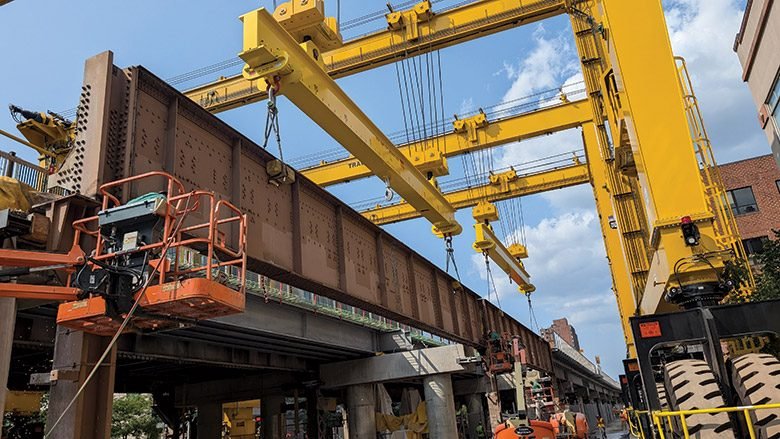
Thinking outside the box and learning the ins and outs of construction machinery contributed to the solution Almeter and his design and construction team came up with to replace the Park Avenue Viaduct in Manhattan. They got equipment manufacturer Mi-Jack Products, Inc. custom-build the largest possible pair of girders to accommodate 190,000-pound precast bridge segments. Over 19 weekends, crews performed 128 bridge installations that equate to 8,240 feet of track for the 132-year-old structure, all without disrupting Metro-North train service.
Matt Moran, chief engineer at Mi-Jack, recalls the request in 2022 for a custom 200-ton rubber gantry crane. “The MJ200HD model was selected as the ideal solution, designed to straddle both sides of the rail and minimize the ground footprint, reducing road closures from four lanes to two, an otherwise impossible task in the dense northern Manhattan environment,” he says.
The oversized components were shipped from Hazel Crest, Illinois, to 125th Street for pre-assembly, then staged at 119th Street for precise placement along Park Avenue, Moran adds. Column and side beam positions were aligned to within ¼ inch for structural connections, checked by 50 surveyors before installing the 82,000-pound top beams across the four raised tracks. “Precise load control was essential to aligning 130-ton bridge assemblies to within 1/8 inch, ensuring accurate track alignment under tight time constraints,” he says.
Crews built structural supports under the existing viaduct. At the time, two of the viaduct’s four tracks were out of service. Using a 200-ton capacity mobile gantry, crews cut and removed sections of the existing structure, with the remainder of the structure supported on a temporary bracing system.
The $590 million first phase was completed last fall. Owner New York’s Metropolitan Transportation Authority said the project as a whole is $93 million under budget and 51 months ahead of schedule.
The gantries “solved a lot of the logistical constraints of the project,” says Almeter. “It allows us to place trucks under the viaduct, load them efficiently for demolition, and assemble units up to three blocks away and move them 900 feet.”
This is not Almeter’s first foray into an out-of-the-box solution for a major rail project. In 2019, the team of Dragados USA, John P. Picone, Halmar International and CCA Civil used a box grab method developed by an Italian engineer to move several railroad crossings for the Long Island Rail Road’s $2.6 billion 3rd track program, with weekend-only closures (ENR 9-2/19, p. 18). Petrucco’s box pick-up system used jacks and hydraulic spreaders to move a cast-in-place concrete box that brought the entire underpass and rail bridge into place in a matter of hours.
Almeter remembers going through the proposal phase with the design team led by Stantec. “One of the guys in Europe said, maybe we can do something that’s been done over there. I’m like, well, bring [the inventor] inside.” Crews cast a concrete box on the job that consists of a 112-foot by 40-foot reinforced concrete slab, with 24-foot side walls and two spans on the top support rail and a driveway. The 2,000-metric-ton concrete box was cast into place and then slid 58 feet to its final location. It was the first use of the method in the US
Almeter says these accelerated bridge building techniques are a passion for him. “The rail industry in New York City has latched onto the ABC and I like it. I’ve replaced about 14 bridges that way, but the Park Avenue Viaduct takes it to whole new levels.”
Anthony Tufano, senior vice president of rail at MTA Construction & Development, has worked with Almeter on both projects. “I have not found a more competent, prepared and dedicated project leader on any design and construction team,” he says. “Nick brings an innovative and comprehensive approach to project delivery, leaving no stone unturned during planning and execution. He constantly evaluates the most efficient methods to deliver successful projects while ensuring rail operations are sustained and community impacts are carefully managed.”
