


Milan, Italy-based Nicola Valiante, engineer and director of design services at Webuild SpA, has always been interested in finding better ways of doing things. Throughout a 25-year career, most of it with the company that is now Webuild (formerly Salini Impregilo), in both design and construction, he says he has taken a keen interest in the integration between the two disciplines.
Although he started out as a hydraulic engineer, at one point he wanted to be able to focus not just on design, but on the constructability of the designs he created.
“I think that, knowing… construction methodology, [that] the design itself can be improved and become much more effective”, he says, noting that this philosophy underpins all his work in developing project solutions.
This approach was on full display in the Riachuelo Wastewater Treatment System, a mega-project to clean up the polluted Matanza-Riachuelo River in Argentina, which was completed in the summer of 2025. Valiante led the design, testing and development of a first-of-its-kind piping system that redistributes pre-treated water into the river using a vertical pipe-lift method within the tunnel.
The project, 87% financed by the World Bank at a cost of 1.228 billion dollars, has the capacity to treat up to 2.3 million cubic meters of wastewater per day with an average flow of 27 m3 per second and was designed to expand access to sanitation for 1.5 million residents of 14 municipalities.

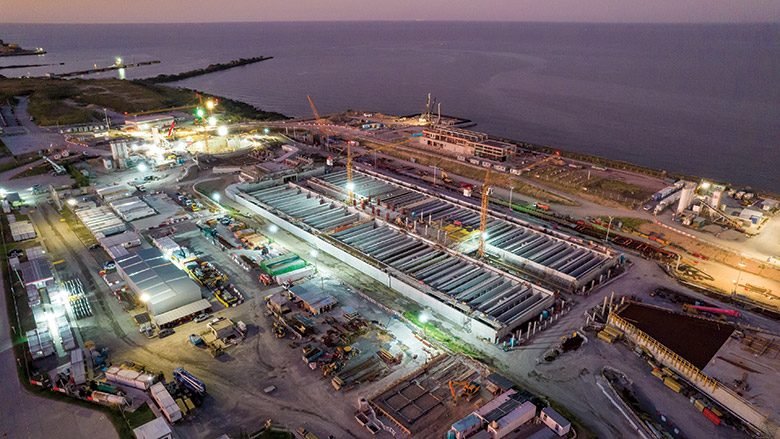
Valiante developed a solution on a wastewater pretreatment system in Buenos Aires (above) that involved 34 vertical bars installed inside a tunnel, a system that required testing (above).
Photo courtesy of Webuild
Improvement of the original
Owner Agua y Saneamientos Argentinos SA (AySA) initially envisioned a mouth tunnel leading to a transition well that then connected to a pipeline with a vertical system to discharge pre-treated wastewater into the river, with the shaft and pipeline placed above a pile system.
Valiante and his team analyzed the AySA concept and concluded that the initial design could be improved. The team felt that the initial concept was more complex than necessary and could create risk by causing more pollutants and exposing crews, who would be working in the water, to potential safety hazards.
“The game changer [was] we started looking at whether there will be a method, a method of building the lift from inside the tunnel, and that would have brought many advantages and improvements,” says Valiante. “It became very clear that if we could run the lift from inside the tunnel, most of the safety problems would disappear.” In addition, the schedule could be significantly compressed and the system itself would work more efficiently.
The new approach would also increase discharge capacity, from the rate of 24 m3 per second to 27 m3 per second, an increase of 12.5%.
The owner agreed to the change, and Valiante and his team spent two years developing the rigging system to connect 34 pipes inside the tunnel.
Graeme Montieth, tunneling specialist and secretary of the UK Pipe Jacking Association, commented that Webuild “managed to make a bespoke rig that can work inside a… tunnel”. Continuing, he said, “They built and tested the whole system before they put it in. The test bed is a bit of a triumph.”
Valiante notes that it is using the same improvement approach on current projects, including developing a new way to install precast concrete inside the tunnels of Snowy 2.0, Australia’s largest hydroelectric dam project.
