

Fab 52 (Eagle Project)
Chandler, Ariz.
Project of the Year and Excellence in Security
Sent by: Hoffman Construction
Region: ENR Southwest
Owner: Intel
Principal design firm and civil/structural/MEP engineer: Jacobs Engineering Group
Contractor: Hoffman Construction
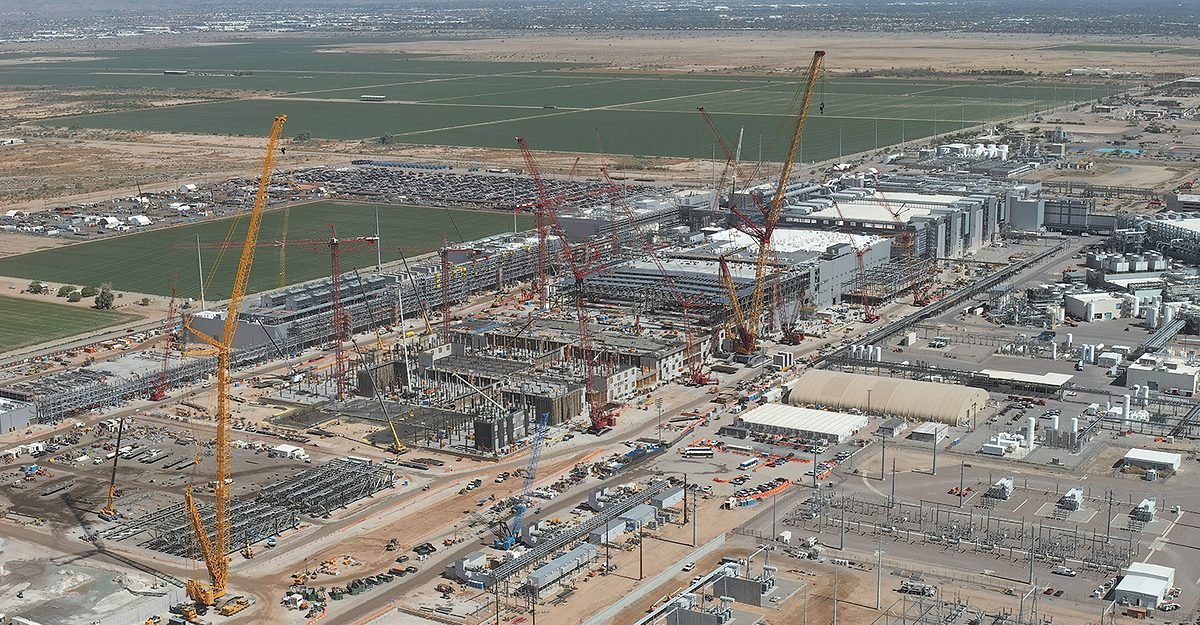
Working on scales both vast and incomprehensibly nanoscopic, a team of thousands of designers, contractors and craftsmen delivered Intel’s 2.9 million square meter chip manufacturing facility in less than four years. The $5 billion-plus Fab 52 project essentially establishes a new city within an existing city of factories built over decades at Intel’s sprawling 600-acre Ocotillo campus in Chandler, Arizona, which is continually growing as chip technology evolves.
“Having the opportunity to build a state-of-the-art wafer fabrication facility, I find, is extremely challenging, but also exciting, because the scale and breadth of the project is hard to fathom,” says Matthew J. Ward, Intel’s vice president of construction. (equivalent to only one nanometer scale).two dozen hydrogen atoms).
The multi-level plant was built in 3.5 years.
Photo courtesy of Hoffman Construction
To produce “quadrions” of tiny atomic-scale transistors for chips at the plant each week, the project team built about 685,000 square feet of cleanroom space, about the size of four football fields, which is climate-controlled, with air exchanged hundreds or even thousands of times per hour and filtered to a level 1,000 cleaner operating room.
Intel turned to longtime partners Jacobs Engineering Group to design the project and Hoffman Construction to build it. Already tasked with working on another large Intel plant in Israel, the companies had to pivot when Intel dramatically accelerated the schedule for the Arizona plant.
Fortunately, Jacobs already had a significant team at Fab 52 that could convert much of the ongoing designs for the Israel plant and apply design automation routines to handle tasks like adapting to US code compliance, which quickly “increased the design velocity,” says Adam Youngbar, senior vice president and general manager of Jacobs’ electronics business.

Photo courtesy of Hoffman Construction
At the same time, Hoffman began rough excavation based on preliminary plans and refined the dimensions of the pit as the design progressed. “We were giving minute-by-minute information to the construction team in the field so we could get ahead of what we needed to do,” says Nathan Moroney, Hoffman’s executive vice president. In total, the project moved 880,000 cubic meters of earth.
Concrete foundation work followed a couple of months after reprioritization. Meanwhile, Jacobs advanced the more than 200 Revit and CAD models using a “production system design in collaboration with Intel to shorten our design cycles and reduce the amount of changes on this project,” says Youngbar. Key space planning decisions were made early in the design process, and Piping and Instrumentation Diagram (P&ID) designs were also locked in early. This allowed construction documents to flow continuously to “feed the machine” of work on site, he adds. In total, 408 miles of pipe were 3D modeled for the project.

Photo courtesy of Hoffman Construction
In the four-level plant (see graphic), the main manufacturing space occupies two levels: the ultra-clean room that houses the manufacturing “tools” sits above a sub-fabricated level equipped with thousands of pumps, transformers and other process systems that support the above tools. The 42-inch-thick cast-in-place concrete floor system between these two levels was needed to provide extreme vibration control and accommodate thousands of 14-inch diameter openings for airflow, MEP, and process piping. “The penetrations had to perfectly match the design and engineering models dimensionally and geometrically, because the final tooling distribution pipe was built off-site during construction to the same dimensions,” according to the project team. To execute these precise slab penetrations, the team developed a concrete formwork system consisting of a grid of circularly shaped penetrations (cans) into the slab, which, once completed, were compared to Swiss cheese.
Looking for quick answers on construction and engineering topics?
Try Ask ENR, our new intelligent AI search tool.
Ask ENR →

BEGIN
Hoffman regularly uses off-site manufacturing (OSM) on his projects, but stepped up the rollout dramatically for Fab 52. For the “forming” slab, the forming system was assembled, aligned and prepared off-site, along with prefabricated rebar assemblies to exacting standards. The teams used custom pickers to place the shape modules and truss cages in a specific configuration.
In total, more than 440,000 m3 of concrete were placed.

Photo courtesy of Hoffman Construction
Many other components of the project went through several levels of OSM before final installation to optimize shipping and assembly. For a 1.5-mile-long (up to six stories high) trestle system that connects the new plant to other campus facilities, about 800 smaller modules arrived on site from three different states, then were locally assembled into increasingly larger modules until final placement, says Intel’s VP of construction.
“What it allows us to do is we don’t ship air; it allows us to ship all these systems economically in a smart way,” adds Moroney.
Hoffman also used OSM vertically, pre-assembling roofs, ducts, cable trays, pipes and other systems at ground level in increasingly larger and longer configurations. “This allows you to work at lower elevations, be more efficient, be safer, and then lift it into place, disconnect it, and connect it,” says Moroney. The method requires intense coordination with the design process to execute properly, he adds.

More than 30,000 craftsmen entered and exited the project, maintaining an exemplary safety record for more than 35 million hours.
Photo of Diego Díaz, courtesy of Hoffman
At its peak, the site’s skyline was crowned with 55 cranes, including the world’s largest crawler crane, a Liebherr LR 13000 provided by Buckner HeavyLift Cranes. Nicknamed “Skyreacher” by a local elementary school, the crane placed dozens of roof trusses, each 168 feet long and weighing up to 240 tons: 35,000 tons of steel make up the structure.
At its peak, the site bustled with the activity of 7,000 artisans and another 3,000 technicians installing specialized manufacturing tools. “We brought in more than 31,000 craft workers to maintain the workforce” during the 3.5-year construction cycle, the team says. About one-fifth of the workers did not speak English, so the team implemented weekly bilingual mass safety meetings, a contractor orientation in Spanish and project signage in Spanish.
The safety guidelines also emphasized that “we want people to feel psychologically safe so they can talk about anything that’s not safe at work or something that needs to be addressed,” Moroney says. Hoffman’s Get Us There Safely (GUTS) program also included GUTS rooms — dedicated spaces where “anyone in the workplace can go and have a safe place” to vent, have a private conversation or handle personal business, he adds. “It’s really a space for mental health, because we recognize that’s what people need in these workplaces.”
Ward also brought safety expertise from his manufacturing experience to the construction site, conducting weekly safety walks alongside Hoffman to provide a “plant manager safety lens,” he says.
Over 35 million hours of work, the team had an incident rate of just 0.55 and a lost time rate of just 0.07.
“Safety is not just a priority, it’s a core value that drives every decision, every action and every project Hoffman undertakes,” says John. R. Cooper Jr., who served as site safety manager for Maxim Crane Works LP “In complex, high-risk environments, their unwavering commitment to safety sets a benchmark that the entire construction industry strives to meet.”

To manufacture transistors the size of a few atoms, Intel needed a cleanroom the size of four football fields, ultrapure water and wastewater facilities, air separation units, refrigeration plants and a power substation.
Photo courtesy of Hoffman Construction
good administrator
Click on the image to view the entire infographic.
Graphic courtesy of Intel

Construction also included a first-of-its-kind ultrapure water facility, a wastewater treatment plant, air separation units to produce nitrogen, oxygen, and hydrogen for on-site use, and a new substation to upgrade the power supply to the campus from a 69 kV to 230 kV supply. All ancillary systems align with Intel’s 2030 global net positive water and renewable energy goals.
Fab 52 got its nickname “Project Eagle” when a pair of bald eagles nested next to the site on Gila River Indian Community land. The project team worked with local officials to establish strict no-disturbance rules and work radii to minimize noise and protect nests, resulting in four eagles successfully hatching during the project.
For Ward, who moved from fab operations to construction specifically to help run Fab 52, the Herculean effort is far more important than personal satisfaction for himself or the vast team. The project “was an opportunity to be part of building a facility that is at the forefront of what humanity can offer.”
