


The $3.4 billion effort to build a 22-mile critical bypass road around Lima, Peru, has been awarded to a Spanish consortium. The Periférico Road Ring will surround the Peruvian capital, crossing 11 districts and the port city of Callao. When completed, it will create a vital link for several main roads that reach the city but do not intersect.
“Investors around the world should know that Peru is a reliable and stable country with safe rules [for investments]” Peru’s Prime Minister Gustavo Adrianzen said at an awards ceremony on April 4. Proinversión, Peru’s private investment promotion agency, announced the award.
The consortium is led by Cintra, Ferrovial’s motorway subsidiary, and includes Sacyr and Acciona. The group will be responsible for the design, financing, construction, operation and maintenance of the megaproject.
The project is being built under a co-financed public-private partnership model, with the consortium and Peru partially providing the initial investment. The 30-year maintenance and operation concession will allow the consortium to recoup its investment through toll revenues.
The road will have three toll lanes. A pair of free lanes will run alongside the freeway in each direction. It will include a pair of tunnels each more than a mile long, as well as 11 viaducts, 16 underpasses and 18 overpasses.
According to the consortium, the road will incorporate the most advanced technology for traffic management, implementing the use of cameras and other systems for its supervision, with a rapid response model for all types of incidents. It will also install state-of-the-art signaling, lighting and security systems.
To minimize impacts to the communities the road passes through, pedestrian bridges will be built every third of a mile and green areas will be respected, officials said. The government estimates that around 2,600 properties will need to be acquired to make way for the project.
Construction is scheduled to begin this summer and will open in phases beginning in 2028. The entire project is slated for completion in 2034.
A joint venture led by Ferrovial proposed the project to Peruvian officials more than a decade ago. It was then accepted by Proinversión and, in 2016, the Ministry of Finance of Peru declared its viability. The current consortium was formed a year later. The consortium submitted its bid in December this year and competitors had a period of 90 days to submit an intention to bid.
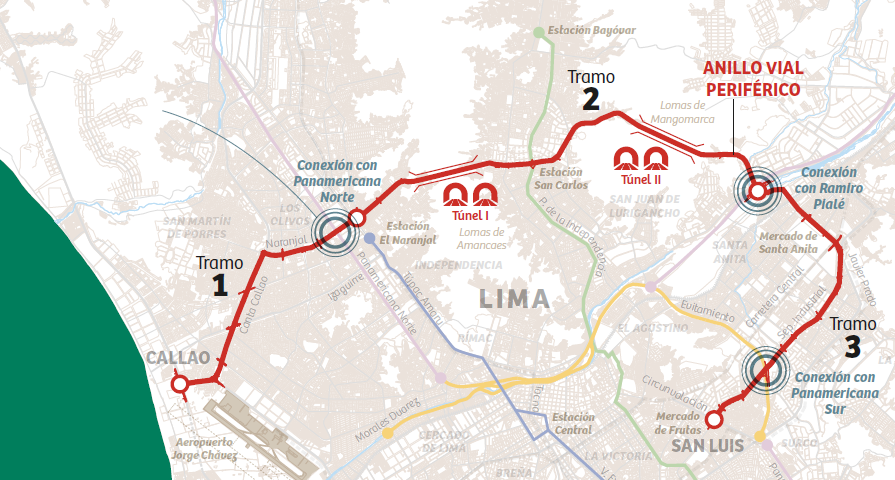
The Anillo Vial Periférico will connect multiple major highways leading to the metropolitan area of Lima.
Courtesy of Ferrovial
A bad connection
The road aims to address a number of interconnected transport problems that have long plagued Peru’s capital.
The population of the metropolitan area of Lima of 11.8 million represents an increase of 50% in the last two decades. One of the results has been traffic jams. Peruvian officials estimate that the ring road will cut driving times in the city in half. It will achieve this by creating a direct route through many of Lima’s outer municipalities, eliminating the need to travel to central Lima and back to any destination.
“It will allow an improvement in intercity connections, in private and public transport, and an improvement in access to educational and health institutions,” said Adrianzen.
The Pan-American highway, which crosses the western coast of the country, does not pass through Lima itself. Instead, drivers must traverse major metropolitan area highways, increasing city congestion and slowing freight transit times. This is further complicated by the main road leading west into Peru’s interior, the Carretera Central, which does not connect to the north/south roads.
Finally, it will create a connection between the city of Callao and Lima proper. Callao is the site of the country’s main port and airport. The lack of a direct road between Callao and downtown Lima has long been a source of aggravation for travelers and a drag on shipping productivity.
“[The ring road] it will have direct access to the international airport Jorge Chávez and the port of Callao, it will reduce logistics costs and improve competitiveness”, said the Minister of Transport of Peru, Raúl Pérez Reyes.
The ring road will create a corridor for the transport of goods, which also includes the main arterial roads of Lima. Transportation headaches in and out of Callao have long been a problem for Peru. Congestion in Lima hampers the ability to transport the country’s exports, particularly the substantial mining materials produced in the highlands.
The Port of Callao handles approximately 85% of the country’s total cargo. Peruvian exports exceeded 10 billion dollars in the first two months of this year. Surface transport limitations hinder the port’s capacity for growth.
The port’s growth is expected to expand dramatically when the $1.3 billion Chancay multi-purpose port terminal, under construction about 40 miles north of Lima, is completed. The port has the support of the Chinese company COSCO Shipping Ports and the Peruvian Volcan Compañía Minera Construction.
The first terminal of the new deep-water port is scheduled to be completed by the end of this year. A second terminal is also planned.
