

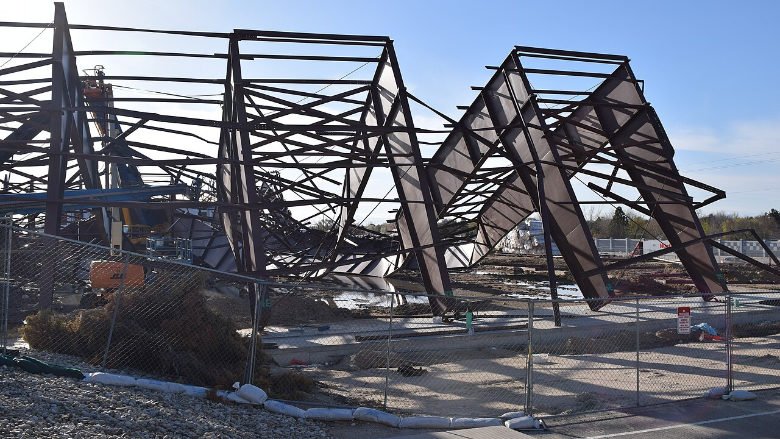
The aircraft hangar under construction that collapsed earlier this year in Boise, Idaho, was being rushed through with modified plans that had not been approved by the city, according to a lawsuit filed by the families of two workers killed in the incident The work has also been carried out in unsafe wind conditions, they allege in the lawsuit.
Mariano Coc Och, 32, and Mario Sontay Tsi, 24, both worked for Big D Builders Inc. of Meridian, Idaho, the general contractor building the 39,000-square-foot, 45.5-foot-tall hangar for Jackson Jet. Center at Boise Airfield, prior to the January 31 collapse.
The two were working about 40 feet up a lift, installing bolts to secure a beam held by a Grove TM9120 crane owned by Boise-based Inland Crane Inc., when the structure collapsed, according to the complaint . When the falling beam hit the lift arm, they were “slammed” to the ground. Coc Och died instantly, and Sontay Tsi died a few minutes later.
A third person, Craig Durant, who was a co-owner of Big D, also died in the collapse. Nine other workers were injured.
Lawyers representing the families of Coc Och and Sontay Tsi filed a lawsuit earlier this month in federal court in Idaho against Big D, Inland Crane and other companies involved in the project.
Boise officials approved the original plans for the hangar in December, records show. However, lawyers for the two families say the owner threatened to impose penalties if the work was not completed on time.
Big D later had a second set of drawings drawn up, which were not submitted to the City Council, according to the complaint. The modified plans had 25-30% less bracing than the approved plans, and the cable bracing connections were designed at an angle that could cause them to cut the cables under certain conditions.
According to the complaint, the “serious design and engineering defects” included a lack of adequate bracing, any side flanges, adequate cable support, X-bracing across all available bays and adequate column joint support and the beams
The work proceeded to the unapproved plans using parts that had been “rushed,” “poorly and poorly welded” and were not properly sized to fit the prefabricated parts of the structure, according to the complaint. And even when Big D submitted plan amendments to the city in January, they did not include the bracing or structural support amendments.
Big D “disputes the allegations listed in the complaint, but we are unable to comment further on the matter as it is now the subject of pending litigation,” a company representative said via email.
 The plaintiffs say the unapproved modifications were made with “poorly welded” components (right), compared to the manufacturer’s (left). Photos courtesy of Serna & Associates PLLC
Big D moved Coc Och and Sontay Tsi from another project to the hangar in an effort to finish the shell by Jan. 31, according to the complaint. On Jan. 30, workers were reporting bending beams and snapping cables and reinforcing, they later told police.
January 31 was a windy day. According to the complaint, cranes working on nearby projects, including the Arthur skyscraper in downtown Boise and the expansion of the Micron semiconductor facility, had stopped work that morning because of the weather. However, work on the hangar continued until the fatal collapse at around 4:54 p.m.
A representative for Inland Crane said in a statement that the company “expresses its deepest condolences to the families and loved ones of the victims in this tragic incident.” They added that they believe the evidence shows that Inland and its employees are not at fault.
An Occupational Safety and Health Administration case initiated after the collapse remains open, records show.
Coc Och and Sontay Tsi were both originally from Carcha, Guatemala. Enrique Serna, one of the lawyers representing their families, says the men had been sending money home to their families, including Sontay Tsi’s children. Despite being far from home, both had been in daily contact with their families via video call before their deaths.
“They’re feeling the void now,” Serna says of their families.
