

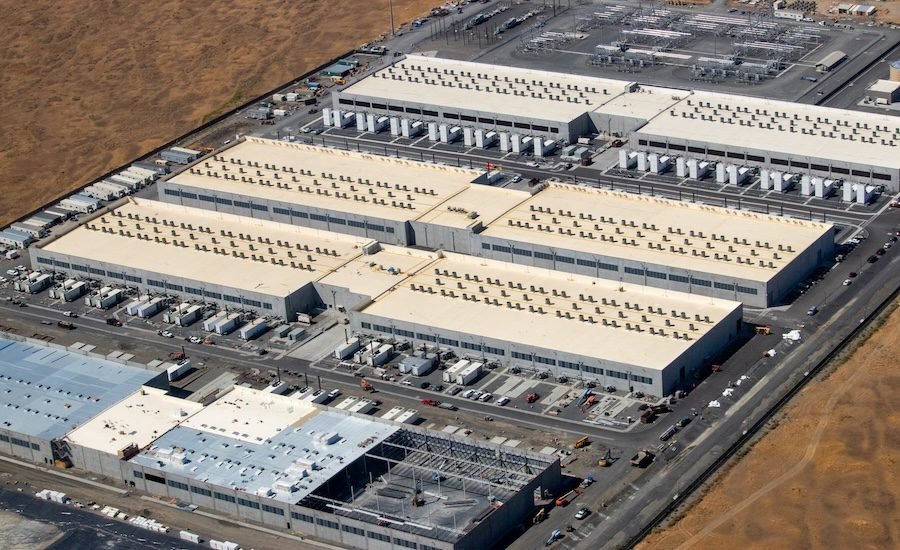

Finding power for data centers is just the beginning. Data centers themselves require significantly more electrical engineering work than any other facility, and there simply aren’t enough engineers, digital designers, or contractors in the US to meet the current demand.
The need for new electricians alone is expected to increase by 6% annually, according to a report last year by the Bureau of Labor Statisticsand many of these electricians will be working on the 446 new data centers planned for North America by the end of the decade.
This labor shortage is another obstacle to American ambitions to consolidate the nation’s leadership in the artificial intelligence race.
The importance of this shortage cannot be overstated because of the central position that electrical systems occupy in data centers: “You can’t do anything without electricity,” one data center developer told me. “Electricity is the largest expense in the data center … it can account for 45% of the total project expense.”
As companies rush to build more complex and energy-consuming data centers to meet the nation’s needs for more computing power, artificial intelligence offers a unique solution to problems of its own making. These buildings that house the servers, which allow the artificial intelligence to “think”, need that intelligence to meet the demand for these services.
Looking for quick answers on construction and engineering topics?
Try Ask ENR, our new intelligent AI search tool.
Ask ENR →
Power needs within the data center
“Electricity has never been a bigger problem” John Diamondthe director of Strategic Facility Advisors, he tells me. Diamond has worked on energy issues for years, developing everything from commercial nuclear power plants to designing, building, operating and analyzing data centers for companies such as Adobe, eBay, Google and Equinix.
The trend towards increased demand for computers is best illustrated in a recent Goldman Sachs reportwhich highlighted the hockey stick trajectory of power and computing needs globally. In 2015, data centers provided 184 million compute instances and consumed 197 terawatt-hours of electricity. By 2023, these numbers had skyrocketed to over 1 billion compute instances and 411 TwH.
As computing operations for artificial intelligence require more and more power, they also require more sophisticated electrical systems to power them. Electricity demands for server racks and cabinets are increasing from 100 kilowatts now (roughly enough electricity to power three average American homes for a day) up to 300 kilowatts, and potentially 600 kilowatts in a few years, Diamond says.
These rapidly growing power demands in data centers are coupled with growing needs for cooling infrastructure and a radical rethinking of the design of these incredibly complicated systems. Also, if design complexities are one challenge, finding the talent to generate and execute those designs is another.
The labor crisis
How serious the workforce problem is for data center developers depends on who you ask and how data centers sell their capacity. Some companies sell their services before construction, while others build first and then start marketing their capabilities. Although the former are more sensitive to the pressures of time than the latter, both feel acutely the current limitations of the labor market.
Experts like Sean Mulliganwho designed data center facilities for Facebook and other big tech companies, see the problem as part of a cascade of shortages facing the industry. Considering the projections of up to $1 trillion in data center development spending In the next five years, there aren’t enough electrical contractors, equipment suppliers or cable suppliers to build properly and properly to meet demand, Mulligan says.
The problem has become so pronounced that some data center developers are even recruiting experts from outside the field to handle some of the electrical work.
“It’s very hard to find electricians,” one industry consultant told me. The situation in the digital design of electrical systems is so dire, and the required skills so high, that contractors have to resort to pulling expert electricians from their construction teams into the offices to perform the digital design.
In one case, a mechanical engineer had to jump in to take care of some electrical work to get a facility up and running. “He had to jump in to fill a gap in electrical engineering,” the consultant said. “It has to help them make changes to the tension… [When] they have to do a rework at the moment, this hat has to be put on, and then physically this hat has to be put on,” to get the job done.
An AI to solve AI problems
For many data center developers, finding ways to automate the design process and allow more prefabrication of materials to speed up construction times is the holy grail.
“Automation can help in many different ways,” says Diamond. Developers’ main concern is getting power into the cabinets, and the biggest new trend he sees is optimizing the design to eliminate unnecessary components.
While many of the larger tech companies may have a large project engineering staff on hand to design these facilities, the next level may not. For those companies that also serve large technology companies, having tools to optimize designs and achieve the same level of capabilities for prefabrication can be a huge benefit, Diamond says.
“Even if you have your dream team sitting at Microsoft or Google or Apple, with proprietary systems they’ve built or software they’ve bought, there are half a dozen companies in the world that can do that,” Diamond tells me. “Then you go down to the upper level [co-located datacenters]and they are designing and supplying for hyperscalers. They won’t have 20-30 [professional engineers] to the staff Their willingness to adopt software will be highly desirable.”
Using artificial intelligence for generative design can help reduce the costs and man-hours associated with the first step for project developers, enabling design teams to overcome their biggest obstacle to delivering to clients… staff.
And as Diamond says, these designs facilitate prefabrication, smoothing the way for accelerated timelines between projects.
As much of the industry moves to prefabrication, speeding up designs lowers construction costs. According to Diamond, there is less rework, less wasted material and accelerated speeds for construction.
Achieving a $1 trillion lawsuit
As demand for computing power continues to accelerate, data center electrical engineering challenges present both a crisis and an opportunity for the industry.
The irony that artificial intelligence, which requires unprecedented engineering power and resources, may ultimately provide the solution to its own infrastructure problems is not lost on developers. By automating complex electrical designs, optimizing power distribution systems, and enabling more efficient prefabrication, AI tools are poised to multiply the productivity of scarce engineering talent.
The data center industry is scrambling to deploy nearly $1 trillion earmarked for construction over the next five years, and the only way to meet demand may be through AI assistance.
Francesco “Frio” Iorio is the co-founder and CEO of Augmenta, a technology start-up that uses artificial intelligence to help and optimize the design process of electrical systems.
