


Reconstruction projects are gaining momentum in the south as officials continue to assess the extent of damage caused by Hurricane Helene in the region. More than 230 people have died from the storm. Damage from the hurricane is expected to total between $30.5 billion and $47.5 billion, according to data analytics firm CoreLogic.
More than 110,000 customers were still without power in North Carolina as of Oct. 8. In Georgia, more than 57,000 were still without power, and in South Carolina more than 21,000, according to the online tracker poweroutage.us. In an update on Oct. 5, Duke Energy reported that more than 1.3 million customers in North Carolina and another 1 million in South Carolina had power restored, saying that 90 percent of customers who they can receive power, service has been restored.
In western North Carolina, Duke Energy reports that the storm “severely damaged significant portions of our electrical infrastructure,” mapping different areas it labels as “complex repair areas” and “disaster reconstruction areas.” covering areas of nine counties. The Asheville, North Carolina, area and communities east and south of the city are listed in the “disaster reconstruction zone,” which Duke says, “will need new poles, lines, electrical equipment, buildings and infrastructure”, where “temporary restoration solutions”. are in development”.
In the “complex repair zone,” which covers areas primarily in Henderson, Rutherford and Buncombe counties, Duke explains, “areas experienced significant damage, including broken poles, downed lines, damaged transmission lines or access issues on the road.”
Duke’s goal in the region is to rebuild infrastructure and install new transformers and main power lines, while drones and helicopters assess the most damaged areas. The more than 18,000 workers on hand are dealing with bent and fallen trees, washed-out electrical equipment and damaged roads.
Contract awarded for I-40
Interstates 40 and 26 remained closed between Tennessee and North Carolina on October 8 as the North Carolina Department of Transportation (NCDOT) begins work to repair washed-out sections of I-40 and the Department of Transportation of Tennessee (TDOT). ) is working to reopen lanes on its side of I-40.
NCDOT selected three contractors who submitted bids for four emergency repair sites, according to spokesman David Uchiyama. Wright Brothers Construction won the contract and is working along with its subcontractor GeoStabilization International on I-40, shoring up the roadway with earth nails. Uchiyama says the work is expected to be completed by Jan. 4, 2025, though no date has been set for the interstate’s reopening.
“This operation is necessary to save what is left of the westbound lanes,” he says.
At least 100 bridges in the region will have to be rebuilt. As of Oct. 8, about 630 roads remained closed and more than 450 had been reopened thanks to more than 2,000 NCDOT personnel working with more than 1,100 pieces of heavy equipment, he says. The agency has identified more than 4,700 damage sites, including 400 bridges and 500 culverts.
Work has been aided by the rapid reopening of I-26 south of Asheville in South Carolina and the opening of I-40 at Old Fort Mountain, which have allowed emergency response, including traffic related to construction, access the devastated areas, says Uchiyama. .
He adds that NCDOT’s business partners are helping in many ways, including quarries that have extended hours to allow the agency additional access to materials.
In Tennessee, 30 of the 49 sections of state routes closed by the storm have reopened, including State Route 350 in Greene County and SR 133 in Johnson County, the former of which was piled up to 30 feet high with rubble with several areas washed away. exposing bare dirt and damaged supply poles.
“In just 120 hours, 75 TDOT employees hauled dozens of truckloads of debris from Jones Bridge Road and repaired asphalt craters displaced by the storm,” says Tennessee Lieutenant Governor and TDOT Commissioner Butch Eley.
On Oct. 7, TDOT reported nearly 50,000 hours of work since the storm to clear, repair and rebuild roads.
TDOT Regional Communications Officer Mark Nagi says I-40 is expected to be open around Oct. 20 in Tennessee to the North Carolina state line with one lane in each direction at two westbound lanes.
Water repairs prioritized
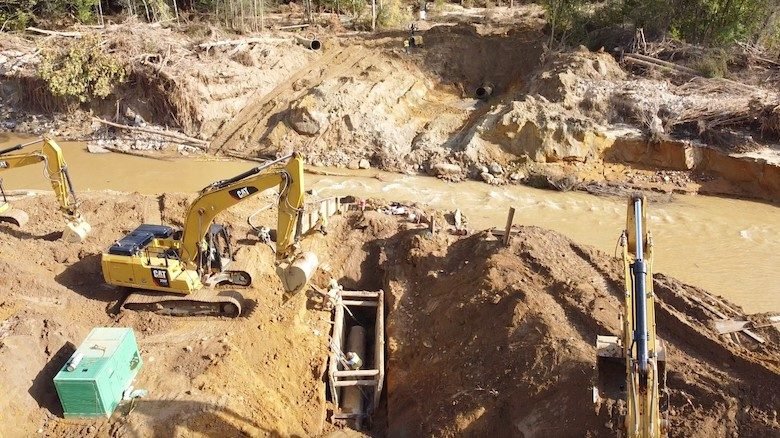
In an Oct. 7 update, Asheville says extensive repairs are needed to treatment facilities, underground and underground water pipes and washed-out roads. Workers were in the process of rebuilding a 36-in. branch line to the city’s North Fork Reservoir in nearby Black Mountain, which when completed will serve about 80 percent of the system’s customers.
Those crews also face other complications, such as debris clogging intact portions of pipelines and working conditions that are still dangerous after the flood, which the city says, “provide a stark illustration of the impossibility to provide a precise timetable for the restoration of service”.
The city aims to have a 36-in. The water diversion line was reconnected to its North Fork reservoir on nearby Black Mountain before October 11although the reservoir remained murky and must be allowed to clear before water can be drawn. The work was being performed by local contractors TP Howard’s Plumbing and Tennoca Construction Co., who were working to complete critical repairs to the distribution system, which has three water treatment plants in total. One of them, in Mills River near the Asheville Regional Airport, was operating at full capacity on October 8. The city continues to forecast several more weeks of work until full system operations are restored.
In Tennessee, state officials report 19 drinking water facilities are experiencing operational issues, 17 of which have issued boil water advisories. Three wastewater treatment plants have been affected by flooding, in Hamblen, Johnson and Unicoi counties.
