


The Maryland Transportation Authority (MDTA) has begun evaluating proposals to rebuild Baltimore’s Francis Scott Bridge, with the goal of awarding a contract for the initial phase of the progressive design project by late summer and have a new structure in place by mid-October 2028.
Citing procurement regulations, the agency said it could not disclose how many proposals were received before the June 24 deadline, or name which companies made the submissions. That information will be made public once the contract is awarded and the selection announced, according to an agency spokesman.
Steps to rebuild the Key Bridge began just days after an apparent loss of power caused the 984-foot container ship M/V Dali to drift toward a pylon that supported the original mid-girder structure century old in the early morning of March 26. The impact collapsed the main span of the bridge, killing six construction workers.
President Joe Biden subsequently pledged full federal funding for a replacement structure, a program the MDTA currently estimates will cost between $1.7 billion and $1.9 billion. A funding strategy has not yet been finalized, although revenue from the expected litigation may be used to replenish public sources, officials have said.
Although state officials have often referred to a brace design in public comments about a replacement structure, the MDTA’s request for proposals only specified that the new bridge has a 75-year service life, with the final design to be developed by the agency and the design-build team. The agency has set a target of 26% DBE participation, with the possibility of a project employment contract as a requirement for the second phase of the program.
On April 30, Italian group Webuild and its US subsidiary Lane Construction offered a pro bono proposal for a replacement cable-stayed structure that included significantly increased vertical and horizontal clearance to better accommodate large container ships that were passing through the port of Baltimore. A spokesperson for Lane Construction could not confirm whether Webuild also responded to MDTA’s RFP.
Similarly, a Kiewit spokesperson declined to comment on an early June social media post announcing the company’s plans to respond to MDTA’s RFP and a “virtual subcontractor/vendor outreach event ” which would discuss the anticipated opportunities for contract and teamwork.
The channel has been cleaned
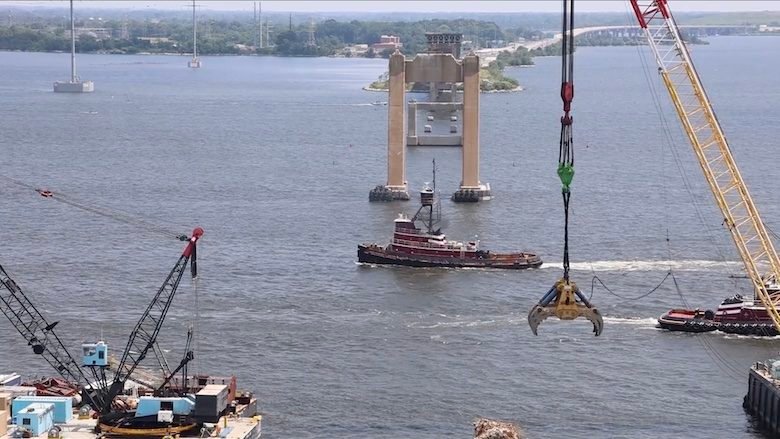
Meanwhile, marine traffic there from the Port of Baltimore is gradually returning to normal after the June 10 reopening of the 700-foot-wide shipping channel, which had been blocked for more than two months with steel , concrete and asphalt from the collapsed bridge.
According to the six-agency unified command that oversaw the operation, the federally funded effort to remove approximately 50,000 tons of debris involved a fleet of 18 barges, 22 tugboats, 13 floating cranes, 10 excavators and four survey vessels. as well as hundreds. of workers and technicians. The unified command also said any follow-up work needed on the canal, including steel removal at the mud line 50 feet deep or below, will be performed as part of routine maintenance for the Corps’ Baltimore District of Engineers to safeguard future dredging. operations
During the effort, Baltimore District Commander Col. Estee Pinchasin said, the team remained mindful of the far-reaching impacts of the incident, especially the six workers who lost their lives.
“Not a day went by that we didn’t think of all of us, and that kept us going,” Pinchasin said.
Since the beginning of April, Skanska USA Civil Southeast, Inc. has been removing debris from outside the main navigation channel under an emergency acquisition contract awarded by MDTA. The Maryland Board of Public Works will consider finalizing the $50.3 million contract price in early July, just weeks before the operation is scheduled to close, according to a recent Skanska announcement. Funding will come from MDTA toll revenue, though the work may also be eligible for Federal Highway Administration emergency relief funds.
Dalí is leaving
As proposals to rebuild the key bridge arrived on June 24, the Dali began a 170-mile journey from the port of Baltimore to Norfolk, Va., where it will continue to recover and repair damage from the collapse of the bridge
The U.S. Coast Guard, which oversaw the voyage, said the Dalí sailed under its own power with a full crew of 22 and six rescue experts, and was accompanied by four tugs, a lifeboat and a patrol boat to maintain a safety zone of 500 meters. . Traffic on Annapolis’ Chesapeake Bay Bridge was temporarily halted as a safety measure while the fully loaded Dali passed through the structure’s 186-foot vertical clearance.
The Dali’s departure from Baltimore followed the completion of the National Transportation Safety Board’s onboard examination of the engineering systems and electrical system tests, and interviews with the ship’s crew. According to a June 24 investigation update, the NTSB Materials Laboratory is analyzing electrical components and control wiring associated with a circuit breaker that unexpectedly opened when the Dali was three boat lengths from the bridge of the key on March 26, causing the initial loss of electricity. power to all lighting on board and most equipment.
A break in the control circuit for the switch’s low-voltage release was also observed during the NTSB’s examination and testing of Dali’s electrical power distribution system and control circuits, according to the update
NTSB says it will “continue to evaluate the design and operation of the ship’s electrical power distribution system and investigate all aspects of the accident to determine probable cause and identify possible safety recommendations.”
