

✕
With an extended period of construction activity and no imminent signs of recession, prices for used construction equipment at resale and auction have found their level, with less of the fluctuations seen in recent years. And that stability may indicate that the latest supply chain disruptions related to the COVID-19 pandemic may finally be coming out of the system.
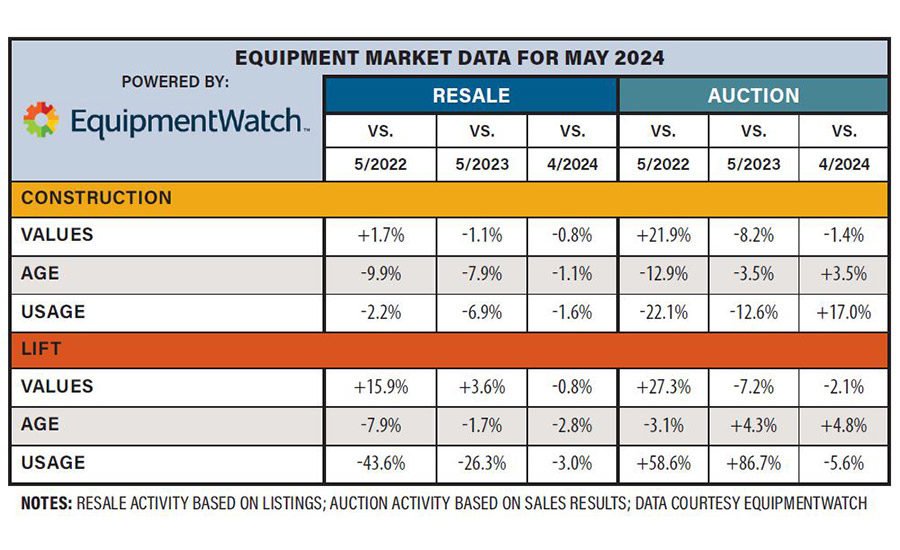
“The values that we’re seeing year-over-year have been going down the last couple of months, about a percentage point each month,” says Sam Pierce, sales engineer at industry market analyst EquipmentWatch. In its sales data, the analyst has seen resale values of used construction equipment fall 0.8% in May compared to April and 1.1% from May 2023. Auction prices are also down 8.2% year-on-year, another sign. of more reasonable cycles, says Pierce. “In the construction market, it seems that values are falling after the large increases we have seen in previous years. It’s pretty stable, changing only about one percent month-to-month.”
OEMs have reported good results, but there are headwinds. Caterpillar reported $27.4 billion in construction industry sales in 2023, up 9% from 2022, in the company’s annual report released June 14. Caterpillar CEO Jim Umpleby noted in his remarks to shareholders at the annual meeting that the company is turning a profit on new equipment. despite the ongoing energy transition towards battery-powered and low-emission equipment. “We are developing an expanded portfolio of all-electric, fuel-flexible and increasingly efficient products to help customers meet their climate-related goals,” he said.
But all is not well for OEMs. Japan-based Komatsu, the second-largest construction equipment maker after Caterpillar, reported largely flat sales in its annual report earlier this spring. While the manufacturer expects to see sales growth in North America in fiscal 2024, unfavorable Japanese yen exchange rates and fixed production costs will limit its supply and hurt profits.
John Deere reported a 7% year-over-year drop in sales for its construction and forestry division in the second quarter of 2024, which translated into a 20% drop in year-over-year operating profit. But that sector outperformed Deere’s farm equipment sales and cited construction as a bright spot. “Thanks to [our team] we continue to demonstrate structurally higher performance levels across business cycles and benefit from stability in the construction end markets amid declining agricultural and turf demand,” said John C. May, CEO and President of Deere, in the announcement of the company’s second quarter results.
The construction that serves as a support for the broader equipment sector is surprising news after a few shaky years, notes Pierce. “Compared to the agricultural and elevator categories, construction is more stable. Both have experienced year-on-year increases [used equipment] prices. Agriculture has increased by 5% and the increase is 3.6% more than last year.”
And after the last few years, stability is welcome. “Two years ago the [used equipment] The numbers were all over the place, it was wild,” Pierce recalls. “Now we’re seeing what I would expect to see — these more normal trends, not these big swings of people trying to get or liquidate teams — that’s a good sign.”
