

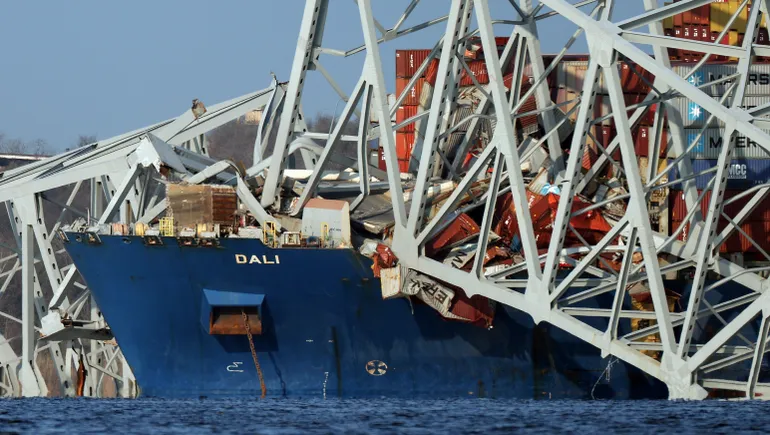
President Biden promised that the federal government would step in cover costs to rebuild the Baltimore bridge that collapsed when a container ship hit it on March 26, but ultimately it will likely be a pool of reinsurance funds that will bear the brunt of the costs when everything is resolved between now and then years, say insurance specialists.
Dali, the ship owned by Grace Ocean Private in Singapore that struck the Francis Scott Key Bridge, is insured by the Britannia P&I club, one of a dozen protection and indemnity clubs that cover most goods shipped to the whole world across the oceans. Reinsurance News says.
These clubs, owned by shipowners, share the risk by pooling resources to buy the reinsurance that will cover the costs. In Dali’s case, the ship is covered by a bundle of reinsurance for up to $3.1 billion. It is led by Axa, a French insurer that manages funds from around 80 insurance companies. The Wall Street Journal says so.
Given the large number of insurers involved in the Axa fund, the burden on each insurance company is expected to be manageable, even if the final price runs into the billions, as expected.
“It’s unlikely to be significant for individual reinsurers because it will be spread across so many,” Brandan Holmes, an official at ratings firm Moody’s, said in the Journal report.
Preliminary estimates indicate the final cost of the accident up to $4 billion, which would make it the largest marine insurance loss ever. The only other accident that comes close to that is the $1.5 billion payout after the Costa Concordia, a cruise ship, ran aground on an island off Italy in 2012. CNN reported.
Although the reinsurance pool Dali has access to is more than $3 billion, the ship owner is expected to invoke a 150-year-old law, called Limitation of liability lawthis could limit the amount on the hook by only the value of the cargo the ship was carrying and the value of the ship itself.
If this legal move works, most of the damages would be left for others to pay. It’s a “powerful tool that favors ship owners,” John Fulweiler, a maritime attorney, he told France 24.
The law was enacted in 1851 to protect shipping companies from having to pay ruinous sums for accidents at sea. It’s similar to the law the Titanic’s owners relied on to limit losses after that historic disaster, though it would require the owners to prove they had no prior knowledge of problems with the ship, insurance experts say. he told the Financial Times.
“It’s an old law” that produces “a lot of injustices,” Fulweiler said.
The bridge alone could be worth more than $1.2 billion, Loretta Worters, spokeswoman for the Insurance Information Institute. he told CNN.
The bridge was built in 1977 at a cost of $60 million, about $300 million today, according to the Journal. The state of Maryland, which insures the bridge under a policy led by Chubb, has coverage of up to $350 million. If the cost reaches $1.2 billion, a large coverage gap would remain.
“If they want to start rebuilding the bridge, Chubb can help pay for it,” John Neal, the head of insurance market company Lloyd’s, said in the Financial Times report. “And then you can get into the proper arguments about who gets it back from, when and how much.”
Replacing the bridge would only be a fraction of the cost. Half a dozen workers are believed to have died in the accident and dozens more were injured. According to one estimate, wrongful death liability could reach $700 million. Hundreds of millions of dollars more would probably have to be paid for the business disruption caused by the port closure, one report to the Guardian he says
Few companies with business interruption will be able to rely on their business interruption insurance for relief, Robert Merkin, a law professor at the University of Reading, told the Journal. These policies typically only apply to outages that occur in any way on your property.
“It depends on the wording,” Merkin said.
Some policies have extensions that could cover external events, such as a bridge collapse, he said, but most are written to cover damage only to the company’s facilities.
Given the importance of the bridge to Baltimore and the disruption the accident is causing to the Port of Baltimore, one of the busiest ports in the United States and the country. main port for vehiclesinsurers should immediately step up to cover the costs and decide who is responsible for what next, Neal said.
“Insurers [should] stand up and say, ‘Hey, let’s start dealing with all this,'” Neal told the Financial Times.
