

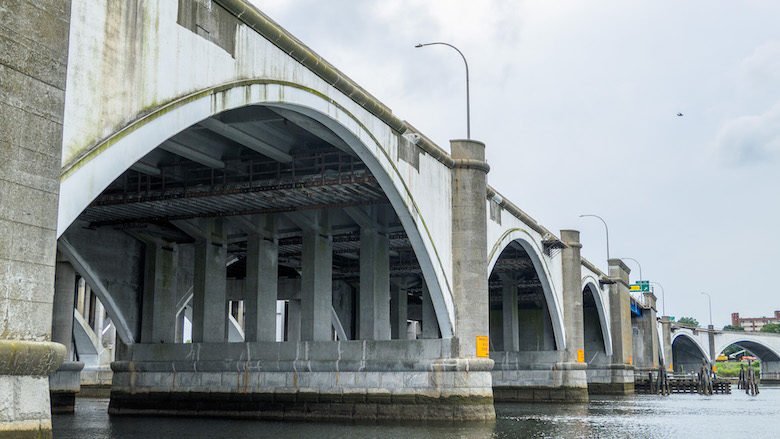
meIn an attempt to recoup money the state owes others for diverting traffic in the middle of a high-volume Interstate-195 bridge in Providence after structural flaws were discovered, the Rhode Island Department of Transportation file a lawsuit on August 16. , against 13 engineers and contractors who had inspected or performed work on the 56-year-old structure in the past decade.
All defendants knew or should have known, the DOT suit claims, of the Washington Bridge’s previous engineering and inspection history and considered it “as part of their collective obligations to the State”.
A named defendant, Warwick, RI-based Aetna Bridge Co., is currently working on a DOT contract to demolish the closed westbound span of the bridge, deemed unsafe.
In March, Rhode Island Gov. Dan McKee (D) vowed to take action against those responsible for failing to disclose the bridge’s dire condition. The lawsuit “seeks to hold those responsible accountable and recover as much as possible for the state,” state Attorney General Peter Neronha said in a statement.
The anticipation of lawsuits after McKee’s call for accountability may have cooled the atmosphere surrounding the state’s request for proposals to replace the westbound span of the bridge. The proposals were submitted last month. There are no companies that have made contributions.
The breach of contract and negligence complaint filed in state court in Providence lists each contract under which engineers and contractors performed inspections, prepared plans or began repairs to the Washington Bridge. The state in its complaint says it is seeking to recover money owed to third parties because of the stop and go.
The lawsuit raises familiar questions about inspections, scope of services and standards of engineering care that have come up in the past with unforeseen danger or failures in vital infrastructure.
Designed by Charles A. Maguire & Associates in 1967 and built in 1968, the bridge’s problems first became known from a 1992 inspection that noted gaps in the prestressed girder tendon grout and problems with the ‘cracking of the beam which at the time was not considered serious. . Neither Maguire & Associates nor the inspection consultant in the first report are charged.
The 1,671-foot-long span carries I-95 over the Seekonk River connecting Providence and East Providence. Its 18 bays vary in type of structure. Systems include post-tensioned cantilevers, prestressed beams and simply supported steel beams and prestressed beams.
The bridge is “inherently non-redundant,” states a report and recommendations released by the DOT in March, when the state closed the westbound span.
An inspection in the early 1990s first indicated problems with gaps in the prestressed tendon grout and cracks in the beams.
Cantilever beams in spans of the bridge “do not have” internal post-tensioning redundancy or “adequate access to permit inspection, maintenance or replacement” of individual elements, the state’s recent report states.
State transportation officials had kept the bridge open during a five-year, $78 million design-build reconstruction effort starting in 2021 by the joint venture of Barletta Heavy Division and Aetna Bridge Co., with Vanasse Hangen Brustlin-based in Watertown, Massachusetts as a leader. designer But on Dec. 8, state officials said, a VHB engineer noticed an apparent failure of a 2-foot-long steel anchor or tie in a section of bridge that was not part of the reconstruction works.
Braces are integral to the stability of cantilever beams.
 Failure of mooring to a beam.
Source: Rhode Island Department of Transportation report
An intensive inspection revealed other defects, including loose grout around the post-tensioning cables, prompting the agency to completely close the bridge’s westbound span.
According to VHB’s report to the transport department, several steel bars in a span between piers 6 and 7 showed evidence of deterioration and failure due to corrosion and shear. At one site, inspectors noted “bounce” of both the components and the “cantilever end and anchorage under live load.”
So, the reconstruction project was abandoned.
In its lawsuit, which names the joint venture as a defendant, the state claims the Barletta-Aetna joint venture said in its proposal that it intended to replace the critical fracture tie on the east side of Pier 4 , which required an annual inspection, with a new column support.
The joint venture acknowledged the fracture-critical nature of the moorings “but failed to address their existence at Piers 6 and 7,” the lawsuit states.
AECOM, which the state hired in 2012 to design and prepare construction plans for a design-bid-build project to completely rehabilitate the existing structure, is also guilty in the lawsuit. He claims AECOM’s inspections and creation of construction plans for an earlier design, bid and build project should have revealed the full extent of the bridge damage. The project for which these plans were created was eventually abandoned.

Evidence of distress at the end of a beam in one of the bridge spans. Source: Rhode Island Department of Transportation report
Five companies named as defendants carried out inspections from 2017 to December 2023, when the serious problems came to light. An inspection in 2016 specifically sought to identify deteriorated parts of the bridge; another in 2017 was a routine checkup; another in 2017 by AECOM involved the beam ends of multi-span nestable beams; another in 2018 was the monitoring of deteriorated parts of the substructure and superstructure.
There were additional inspections in 2021, 2022 and 2023.
The companies named as defendants could not immediately be reached for comment. However, an Aetna spokesman told WPRI, a regional television station, that the contractor is proud of its “more than 76-year history of building and repairing bridges in our state.”
“We stand behind the quality of all our past work and the work we will perform in the future,” the spokesman said. “We will vigorously defend against any claims made in this lawsuit.”
